
The clarinet is a single-reed musical instrument in the woodwind family, with a nearly cylindrical bore and a flared bell.

A musical ensemble, also known as a music group or musical group, is a group of people who perform instrumental and/or vocal music, with the ensemble typically known by a distinct name. Some music ensembles consist solely of instrumentalists, such as the jazz quartet or the orchestra. Other music ensembles consist solely of singers, such as choirs and doo wop groups. In both popular music and classical music, there are ensembles in which both instrumentalists and singers perform, such as the rock band or the Baroque chamber group for basso continuo and one or more singers. In classical music, trios or quartets either blend the sounds of musical instrument families or group together instruments from the same instrument family, such as string ensembles or wind ensembles. Some ensembles blend the sounds of a variety of instrument families, such as the orchestra, which uses a string section, brass instruments, woodwinds and percussion instruments, or the concert band, which uses brass, woodwinds and percussion.

The oboe is a type of double reed woodwind instrument. Oboes are usually made of wood, but may also be made of synthetic materials, such as plastic, resin, or hybrid composites.

Woodwind instruments are a family of musical instruments within the greater category of wind instruments. Common examples include flute, clarinet, oboe, bassoon, and saxophone. There are two main types of woodwind instruments: flutes and reed instruments. The main distinction between these instruments and other wind instruments is the way in which they produce sound. All woodwinds produce sound by splitting the air blown into them on a sharp edge, such as a reed or a fipple. Despite the name, a woodwind may be made of any material, not just wood. Common examples include brass, silver, cane, as well as other metals such as gold and platinum. The saxophone, for example, though made of brass, is considered a woodwind because it requires a reed to produce sound. Occasionally, woodwinds are made of earthen materials, especially ocarinas.
The heckelphone is a musical instrument invented by Wilhelm Heckel and his sons. The idea to create the instrument was initiated by Richard Wagner, who suggested its concept at the occasion of a visit of Wilhelm Heckel in 1879. Introduced in 1904, it is similar to the oboe but, like the bass oboe, pitched an octave lower, the heckelphone having a significantly larger bore.

The bass clarinet is a musical instrument of the clarinet family. Like the more common soprano B♭ clarinet, it is usually pitched in B♭, but it plays notes an octave below the soprano B♭ clarinet. Bass clarinets in other keys, notably C and A, also exist, but are very rare. Bass clarinets regularly perform in orchestras, wind ensembles and concert bands, and occasionally in marching bands, and play an occasional solo role in contemporary music and jazz in particular.

The basset horn is a member of the clarinet family of musical instruments.
Contrabass refers to several musical instruments of very low pitch—generally one octave below bass register instruments. While the term most commonly refers to the double bass, many other instruments in the contrabass register exist.
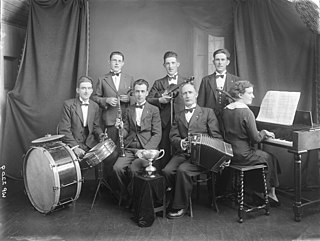
A septet is a formation containing exactly seven members. It is commonly associated with musical groups but can be applied to any situation where seven similar or related objects are considered a single unit, such as a seven-line stanza of poetry. In jazz, a septet is any group of seven players, usually containing a drum set, string bass or electric bass, and groups of one or two of the following instruments, guitar, piano, trumpet, saxophone, clarinet, or trombone. See, for example, Miles Davis, and Chick Corea's 1984 album, Septet.

The contra-alto clarinet, E♭ contrabass clarinet, is a large clarinet pitched a perfect fifth below the B♭ bass clarinet. It is a transposing instrument in E♭ sounding an octave and a major sixth below its written pitch, between the bass clarinet and the B♭ contrabass clarinet.
The bass oboe or baritone oboe is a double reed instrument in the woodwind family. It is essentially twice the size of a regular (soprano) oboe so it sounds an octave lower; it has a deep, full tone somewhat akin to that of its higher-pitched cousin, the English horn. The bass oboe is notated in the treble clef, sounding one octave lower than written. Its lowest sounding note is B2 (in scientific pitch notation), one octave and a semitone below middle C, although an extension with an additional key may be inserted between the lower joint and bell of the instrument in order to produce a low B♭2. The instrument's bocal or crook first curves away from and then toward the player (unlike the bocal/crook of the English horn and oboe d'amore), looking rather like a flattened metal question mark; another crook design resembles the shape of a bass clarinet neckpiece. The bass oboe uses its own double reed, similar to but larger than that of the English horn. compared to the bassoon

A double reed is a type of reed used to produce sound in various wind instruments. In contrast with a single reed instrument, where the instrument is played by channeling air against one piece of cane which vibrates against the mouthpiece and creates a sound, a double reed features two pieces of cane vibrating against each other. This means, for instruments with the double reed fully exposed, that the air flow can be controlled by the embouchure from the top, bottom and sides of the reed. The term double reeds can also refer collectively to the class of instruments which use double reeds.
The alto clarinet is a woodwind instrument of the clarinet family. It is a transposing instrument pitched in the key of E♭, though instruments in F have been made. In size it lies between the soprano clarinet and the bass clarinet. It bears a greater resemblance to the bass clarinet in that it typically has a straight body, but a curved neck and bell made of metal. All-metal alto clarinets also exist. In appearance it strongly resembles the basset horn, but usually differs in three respects: it is pitched a whole step lower, it lacks an extended lower range, and it has a wider bore than many basset horns.

In music, an octet is a musical ensemble consisting of eight instruments or voices, or a musical composition written for such an ensemble.
Johann Heinrich Wilhelm Grenser was a German musical instrument maker.
William Waterhouse was an English bassoonist and musicologist. He played with notable orchestras, was a member of the Melos Ensemble, professor at the Royal Northern College of Music, author of the Yehudi Menuhin Music Guide "Bassoon", of The New Langwill Index, and contributor to the New Grove Dictionary of Music and Musicians.
In music, a decet—sometimes dectet, decimette, or even tentet—is a composition which requires ten musicians for a performance, or a musical group that consists of ten people. The corresponding German word is Dezett, the French is dixtuor. Unlike some other musical ensembles such as the string quartet, there is no established or standard set of instruments in a decet.
John Juzek(néJanek Jůzek, akaJan, akaJohann;1892, Písek – c. 1965, Luby) was a Czech merchant, widely known in North America as an exporter of violins, violas, cellos, and double basses made and labeled under his anglicized name, "John Juzek," crafted mostly by guilds and various independent makers in the Bohemia region of the Czechoslovakia and Germany border.
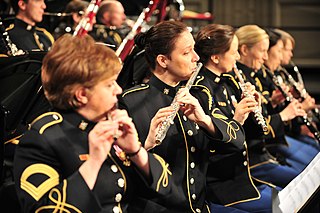
The woodwind section, which consists of woodwind instruments, is one of the main sections of an orchestra or concert band. Woodwind sections contain instruments given Hornbostel-Sachs classifications of 421 and 422, but exclude 423
Peter Bressan was a noted woodwind instrument maker of whose work several examples exist in museums and private collections.