
Honduras, officially the Republic of Honduras, is a country in Central America. In the past, it was sometimes referred to as "Spanish Honduras" to differentiate it from British Honduras, which later became modern-day Belize. The republic of Honduras is bordered to the west by Guatemala, to the southwest by El Salvador, to the southeast by Nicaragua, to the south by the Pacific Ocean at the Gulf of Fonseca, and to the north by the Gulf of Honduras, a large inlet of the Caribbean Sea.
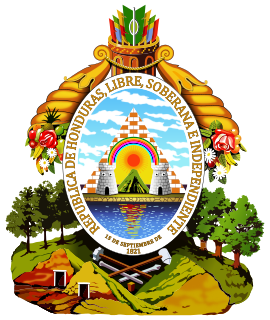
Honduras is divided into 18 departments. Each department is headed by a governor, who is appointed by the President of Honduras. The governor represents the executive branch in the region in addition to acting as intermediary between municipalities and various national authorities; resolves issues arising between municipalities; oversees the penitentiaries and prisons in his department; and regularly works with the various Secretaries of State that form the President's Cabinet. To be eligible for appointment as governor, the individual must a) live for five consecutive years in the department; b) be Honduran; c) be older than 18 years of age and; d) know how to read and write.
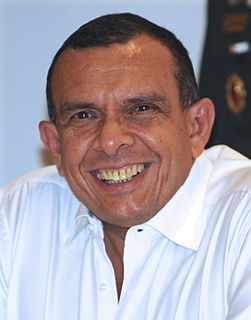
Porfirio Lobo Sosa, known as Pepe Lobo, is a Honduran politician and agricultural landowner who served as President of Honduras from 2010 to 2014. A member of the conservative National Party and a former deputy in the National Congress of Honduras from 1990, he was president of the National Congress of Honduras from 2002 to 2006. He came second to Manuel Zelaya with 46% of the vote in the 2005 general election. After the military ousted Zelaya in a coup d'état, Lobo was elected president in the 2009 presidential election and took office on 27 January 2010.
Honduras National Congress has 128 members (diputados); they serve four-year terms.

Carlos Roberto Flores Facussé was President of Honduras from 27 January 1998 to 27 January 2002 and President of the National Congress from 25 January 1994 to 25 January 1998.
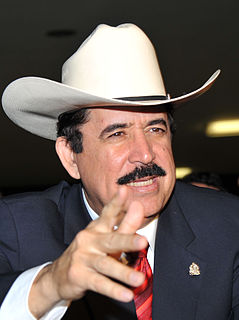
José Manuel Zelaya Rosales is a Honduran politician who was President of Honduras from 27 January 2006 until 28 June 2009. He is the eldest son of a wealthy businessman, and inherited his father's nickname "Mel". Before entering politics he was involved in his family's logging and timber businesses.

Liga Nacional de Fútbol Profesional de Honduras, commonly known as Liga Nacional is the first and highest division of football in Honduras. The league season is divided into Opening (autumn) and Closing (spring). One team is relegated to the Liga de Ascenso and one team is promoted from Liga de Ascenso. The first 4 clubs participate in play-offs to decide the champion. The winners of the Opening and Closing competitions participate in the CONCACAF Champions League.
Roberto Micheletti Baín is a Honduran politician who served as the interim de facto president of Honduras from June 28, 2009 to January 27, 2010 as a result of the 2009 Honduran coup d'état. The Honduran military ousted the President, and the National Congress read a letter of resignation, which was refuted two minutes later by Zelaya in conversation with CNN en Español; days later, the coup-plotters claimed that the Supreme Court had ordered to forcefully detain President Manuel Zelaya because "he was violating the Honduran constitution"; Zelaya was exiled rather than arrested. Micheletti, constitutionally next in line for the presidency, was sworn in as president by the National Congress a few hours after Zelaya was sent into exile by the Honduran military. He was not acknowledged as de jure president by any government or international organization. The 2009 General Election took place as planned in November and elected Porfirio Lobo Sosa to succeed Micheletti.
The 2009 Honduran constitutional crisis was a political dispute over plans to either rewrite the Constitution of Honduras or write a new one.
The Vice Presidents of Honduras, also known as Presidential Designates, officially the Designates to the Presidency is the second highest political position in Honduras. According to the current constitution, the President and Vice-Presidents are elected in the same ticket. From 1957 to 2006 and from 2010 to present there are positions of first, second, and third Vice-President known as designados presidenciales, literally Presidential Designates.

The President of Honduras officially known as the President of the Republic of Honduras, is the head of state and head of government of Honduras, and the Commander-in-chief of the Armed Forces. According to the 1982 Constitution of Honduras, the Government of Honduras consists of three branches: Executive, Legislative and Judicial. The President is the head of the Executive branch, their primary duty being to "Execute and enforce the Constitution, treaties and conventions, laws and other legal dispositions." The President is directly elected for a four year term.
The Political Constitution of the Republic of Honduras was approved on 11 January 1982, published on 20 January 1982, amended by the National Congress of Honduras 26 times from 1984 to 2005, and 10 interpretations by Congress were made from 1982 to 2005. It is Honduras' twelfth constitution since independence in 1838. Previous charters were adopted in 1839, 1848, 1865, 1873, 1880, 1894, 1906, 1924, 1936, 1957 and 1965.
The Supreme Court of Honduras is the Supreme Court and Constitutional Court of Honduras. The Supreme Court is the highest judicial authority in Honduras.
The 2009 Honduran constitutional crisis was a political confrontation concerning the events that led to, included, and followed the 2009 Honduran coup d'état and the political breakdown associated with it. The coup was repudiated around the globe, but Roberto Micheletti, head of the government installed after the coup, has claimed that the Honduran Supreme Court ordered the detention of Manuel Zelaya, deposed President of Honduras, and that the following succession was constitutionally valid.
The 2009 Honduran coup d'état, part of the 2009 Honduran constitutional crisis, occurred when the Honduran Army on June 28, 2009 followed orders from the Honduran Supreme Court to oust President Manuel Zelaya and send him into exile. Zelaya had attempted to schedule a non-binding poll on holding a referendum on convening a constituent assembly to rewrite the constitution. Zelaya refused to comply with court orders to cease, and the Honduran Supreme Court issued a secret warrant for his arrest dated 26 June. Two days later, Honduran soldiers stormed the president's house in the middle of the night and detained him, forestalling the poll. Instead of bringing him to trial, the army put him on a military aeroplane and flew him to Costa Rica. Later that day, after the reading of a resignation letter of disputed authenticity, the Honduran Congress voted to remove Zelaya from office, and appointed Speaker of Congress Roberto Micheletti, his constitutional successor, to replace him.
The cuarta urna or fourth ballot box referendum was a plan by Honduran president Manuel Zelaya to run a non-binding referendum to consult the public regarding the administration of a second, binding referendum to convoke a constitutional assembly. The referendum was planned to run concurrently with the November 2009 presidential, congressional, and mayoral elections. Some Hondurans opposed the plan, including many politicians from the two largest parties. When Zelaya pushed ahead with plans for this referendum on whether to include a fourth ballot box, the Supreme Court issued a warrant for his arrest and the army expelled him from the country in a June 28 coup d'etat, precipitating the 2009 Honduran constitutional crisis.
Juan Orlando Hernández Alvarado, often known as JOH, is the fifty-fifth and current president of Honduras, who assumed office on January 27, 2014, after winning the 2013 Honduran general election. He began his second presidential term on January 27, 2018.

Tegucigalpa, colloquially referred to as Téguz, is the capital and largest city of Honduras along with its twin sister, Comayagüela.
General elections were held in Honduras on November 24, 2013. Voters went to the polls to elect a new President, the 128 members of the National Congress, 298 Mayors and vice-mayors and their respective councilors and 20 representatives to the Central American Parliament.


