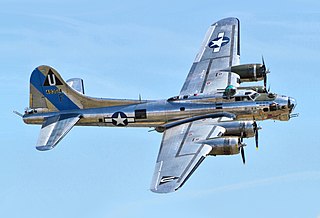
The Boeing B-17 Flying Fortress is a four-engined heavy bomber developed in the 1930s for the United States Army Air Corps (USAAC). Relatively fast and high-flying for a bomber of its era, the B-17 was used primarily in the European Theater of Operations and dropped more bombs than any other aircraft during World War II. It is the third-most produced bomber of all time, behind the four-engined Consolidated B-24 Liberator and the multirole, twin-engined Junkers Ju 88. It was also employed as a transport, antisubmarine aircraft, drone controller, and search-and-rescue aircraft.
7th Division may refer to:

The Brazilian Expeditionary Force, nicknamed Cobras Fumantes, was a military division of the Brazilian Army and Air Force that fought with Allied forces in the Mediterranean Theatre of World War II. It numbered around 51,600 men, including a full infantry division, liaison flight, and fighter squadron.

World War II (1939–1945) involved sustained strategic bombing of railways, harbours, cities, workers' and civilian housing, and industrial districts in enemy territory. Strategic bombing as a military strategy is distinct both from close air support of ground forces and from tactical air power. During World War II, many military strategists of air power believed that air forces could win major victories by attacking industrial and political infrastructure, rather than purely military targets. Strategic bombing often involved bombing areas inhabited by civilians, and some campaigns were deliberately designed to target civilian populations in order to terrorize them and disrupt their usual activities. International law at the outset of World War II did not specifically forbid the aerial bombardment of cities – despite the prior occurrence of such bombing during World War I (1914–1918), the Spanish Civil War (1936–1939), and the Second Sino-Japanese War (1937–1945).
The Army of Occupation Medal is a military award of the United States military which was established by the United States War Department on 5 April 1946. The medal was created in the aftermath of the Second World War to recognize those who had performed occupation service in either Germany, Italy, Austria, Japan or Korea. The original Army of Occupation Medal was intended only for members of the United States Army, but was expanded in 1948 to encompass the United States Air Force shortly after that service's creation. The Navy and Marine equivalent of the Army of Occupation Medal is the Navy Occupation Service Medal, which features the same ribbon with its own medallion and clasps.

Salon-de-Provence Air Base is a base of the French Air and Space Force located 4 km (2.5 mi) south Salon-de-Provence, Bouches-du-Rhône in southern France.
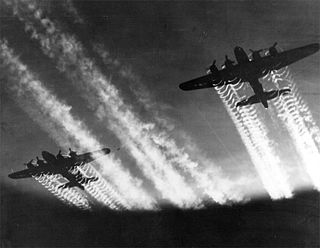
The military history of the United States during World War II covers the victorious Allied war against the Axis Powers, starting with the 7 December 1941 attack on Pearl Harbor and ending with the 2 September 1945 surrender of Japan. During the first two years of World War II, the United States had maintained formal neutrality which was made official in the Quarantine Speech which was delivered by US President Franklin D. Roosevelt in 1937, while it was supplying Britain, the Soviet Union, and China with war materiel through the Lend-Lease Act which was signed into law on 11 March 1941, as well as deploying the US military to replace the British forces stationed in Iceland. Following the "Greer incident" Roosevelt publicly confirmed the "shoot on sight" order on 11 September 1941, effectively declaring naval war on Germany and Italy in the Battle of the Atlantic. In the Pacific Theater, there was unofficial early US combat activity such as the Flying Tigers.
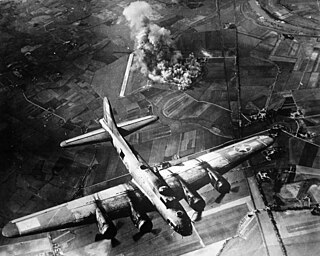
The Combined Bomber Offensive (CBO) was an Allied offensive of strategic bombing during World War II in Europe. The primary portion of the CBO was directed against Luftwaffe targets which was the highest priority from June 1943 to 1 April 1944. The subsequent highest priority campaigns were against V-weapon installations and petroleum, oil, and lubrication (POL) plants. Additional CBO targets included railyards and other transportation targets, particularly prior to the invasion of Normandy and, along with army equipment, in the final stages of the war in Europe.

Royal Air Force Lymington or more simply RAF Lymington is a former Royal Air Force Advanced Landing Ground in Hampshire, England. The airfield is located approximately 1 mile (1.6 km) east of Lymington; about 80 miles (130 km) southwest of London.
The following outline is provided as an overview of and topical guide to World War II:

The 389th Strategic Missile Wing is an inactive unit of the United States Air Force. Its last assignment was with the 13th Strategic Missile Division at Francis E. Warren Air Force Base, Wyoming, where it was inactivated on 25 March 1965.

Juvincourt-et-Damary is a commune in the Aisne department in Hauts-de-France in northern France.

The 47th Liaison Squadron is an inactive United States Air Force unit. Its last assignment was with Tactical Air Command at Langley Air Force Base, Virginia, where it was inactivated on 25 August 1948. The squadron was activated in July 1943. It trained in the United States until the spring of 1944, then deployed to the European Theater of Operations. It served as a courier and communication unit for various headquarters. After V-E Day, it remained in Germany as part of the occupation force until 1947, when it returned to the United States as a paper unit. It remained in that status until inactivating.
Baheira Airfield is an abandoned military airfield complex in Libya, which is located about 19 Miles (30 km) Southeast of Ajdabiya, Libya.

Berca Airfield is a former civil airport and military airfield, located in the Al Birkah suburb of Benghazi, Libya.
Sidi Azeiz Airfield, or Sidi Azeis is an abandoned World War II military airfield in the eastern desert of Libya. It was located near the Egypt–Libya border near Jabbanat Sidi, about 100 km east of Tobruk. German Coordinates are given as 31°40′00″N24°54′00″E

Air warfare was a major component in all theaters of World War II and, together with anti-aircraft warfare, consumed a large fraction of the industrial output of the major powers. Germany and Japan depended on air forces that were closely integrated with land and naval forces; the Axis powers downplayed the advantage of fleets of strategic bombers and were late in appreciating the need to defend against Allied strategic bombing. By contrast, Britain and the United States took an approach that greatly emphasized strategic bombing and tactical control of the battlefield by air as well as adequate air defenses. Both Britain and the U.S. built substantially larger strategic forces of large, long-range bombers. Simultaneously, they built tactical air forces that could win air superiority over the battlefields, thereby giving vital assistance to ground troops. The U.S. and Royal Navy also built a powerful naval-air component based on aircraft carriers, as did the Japanese; these played the central role in the war at sea.
France was one of the largest military powers to come under occupation as part of the Western Front in World War II. The Western Front was a military theatre of World War II encompassing Denmark, Norway, Luxembourg, Belgium, the Netherlands, the United Kingdom, France, Italy, and Germany. The Western Front was marked by two phases of large-scale combat operations.

An air force – in the broadest sense – is the national military branch that primarily conducts aerial warfare. More specifically, it is the branch of a nation's armed services that is responsible for aerial warfare as distinct from an army or navy. Typically, air forces are responsible for gaining control of the air, carrying out strategic and tactical bombing missions, and providing support to land and naval forces often in the form of aerial reconnaissance and close air support.
