
The Angles were one of the main Germanic peoples who settled in Great Britain in the post-Roman period. They founded several kingdoms of the Heptarchy in Anglo-Saxon England. Their name, which probably derives from the Angeln peninsula, is the root of the name England, as well as ultimately the word English for its people and language. According to Tacitus, writing around 100 AD, a people known as Angles (Anglii) lived beyond the Lombards and Semnones, who lived near the River Elbe.

The Germanic peoples were tribal groups who lived in Northern Europe in Classical Antiquity and the Early Middle Ages. In modern scholarship, they typically include not only the Roman-era Germani who lived in both Germania and parts of the Roman empire, but also all Germanic speaking peoples from this era, irrespective of where they lived, most notably the Goths. Another term, ancient Germans, is considered problematic by many scholars since it suggests identity with present-day Germans. Although the first Roman descriptions of Germani involved tribes west of the Rhine, their homeland of Germania was portrayed as stretching east of the Rhine, to southern Scandinavia and the Vistula in the east, and to the upper Danube in the south. Other Germanic speakers, such as the Bastarnae and Goths, lived further east in what is now Moldova and Ukraine. The term Germani is generally only used to refer to historical peoples from the 1st to 4th centuries CE.

Arminius was a chieftain of the Germanic Cherusci tribe who is best known for commanding an alliance of Germanic tribes at the Battle of the Teutoburg Forest in AD 9, in which three Roman legions under the command of general and governor Publius Quinctilius Varus were destroyed. His victory at Teutoburg Forest precipitated the Roman Empire's permanent strategic withdrawal and the decolonisation of Germania Magna, and modern historians regard it as one of Imperial Rome's greatest defeats. As it prevented the Romanization of Germanic peoples east of the Rhine, it has also been considered one of the most decisive battles in history and a turning point in human history.

The Chauci were an ancient Germanic tribe living in the low-lying region between the Rivers Ems and Elbe, on both sides of the Weser and ranging as far inland as the upper Weser. Along the coast they lived on artificial mounds called terpen, built high enough to remain dry during the highest tide. A dense population of Chauci lived further inland, and they are presumed to have lived in a manner similar to the lives of the other Germanic peoples of the region.

The Irminones, also referred to as Herminones or Hermiones, were a large group of early Germanic tribes settling in the Elbe watershed and by the first century AD expanding into Bavaria, Swabia, and Bohemia. Notably this included the large sub-group of the Suevi, that itself contained many different tribal groups, but the Irminones also included for example the Chatti.

The Rugii, Rogi or Rugians, were one of the smaller Germanic peoples of Late Antiquity who are best known for their short-lived 5th-century kingdom upon the Roman frontier, near present-day Krems an der Donau in Austria. This kingdom, like those of the neighbouring Heruli and Sciri, first appears in records after the death of Attila in 453. The Rugii, Heruli, Sciri and others are believed to have moved into this region from distant homelands under pressure from the Huns, and become part of Attila's Hunnic empire which also moved and came to be based in this region. The Rugii were subsequently part of the alliance which defeated Attila's sons and the Ostrogoths at the Battle of Nedao in 454, giving their kingdom independence. In 469 they were part of a similar alliance who lost to the Ostrogoths at the Battle of Bolia, weakening their kingdom significantly.
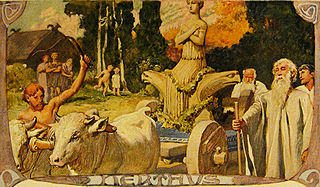
Germanic mythology consists of the body of myths native to the Germanic peoples, including Norse mythology, Anglo-Saxon mythology, and Continental Germanic mythology. It was a key element of Germanic paganism.
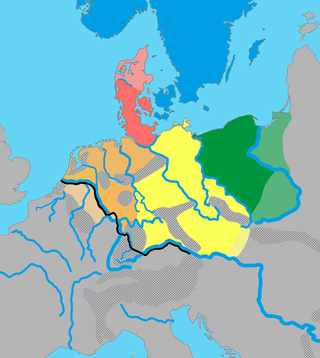
The Ingaevones were a Germanic cultural group living in the Northern Germania along the North Sea coast in the areas of Jutland, Holstein, and Lower Saxony in classical antiquity. Tribes in this area included the Angles, Chauci, Saxons, and Jutes.
The Istvaeones were a Germanic group of tribes living near the banks of the Rhine during the Roman Empire which reportedly shared a common culture and origin. The Istaevones were contrasted to neighbouring groups, the Ingaevones on the North Sea coast, and the Herminones, living inland of these groups.

An Irminsul was a sacred, pillar-like object attested as playing an important role in the Germanic paganism of the Saxons. Medieval sources describe how an Irminsul was destroyed by Charlemagne during the Saxon Wars. A church was erected on its place in 783 and blessed by Pope Leo III. Sacred trees and sacred groves were widely venerated by the Germanic peoples, and the oldest chronicle describing an Irminsul refers to it as a tree trunk erected in the open air.

Mannus, according to the Roman writer Tacitus, was a figure in the creation myths of the Germanic tribes. Tacitus is the only source of these myths.

A rune is a letter in a set of related alphabets known as runic alphabets native to the Germanic peoples. Runes were used to write Germanic languages before they adopted the Latin alphabet, and for specialised purposes thereafter. In addition to representing a sound value, runes can be used to represent the concepts after which they are named (ideographs). Scholars refer to instances of the latter as Begriffsrunen. The Scandinavian variants are also known as fuþark, or futhark; this name is derived from the first six letters of the script, ⟨ᚠ⟩, ⟨ᚢ⟩, ⟨ᚦ⟩, ⟨ᚨ⟩/⟨ᚬ⟩, ⟨ᚱ⟩, and ⟨ᚲ⟩/⟨ᚴ⟩, corresponding to the Latin letters ⟨f⟩, ⟨u⟩, ⟨þ⟩/⟨th⟩, ⟨a⟩, ⟨r⟩, and ⟨k⟩. The Anglo-Saxon variant is known as futhorc, or fuþorc, due to changes in Old English of the sounds represented by the fourth letter, ⟨ᚨ⟩/⟨ᚩ⟩.

Germanic paganism or Germanic religion refers to the traditional, culturally significant religion of the Germanic peoples. With a chronological range of at least one thousand years in an area covering Scandinavia, the British Isles, modern Germany, the Netherlands, and at times other parts of Europe, the beliefs and practices of Germanic paganism varied. Scholars typically assume some degree of continuity between Roman-era beliefs and those found in Norse paganism, as well as between Germanic religion and reconstructed Indo-European religion and post-conversion folklore, though the precise degree and details of this continuity are subjects of debate. Germanic religion was influenced by neighboring cultures, including that of the Celts, the Romans, and, later, by the Christian religion. Very few sources exist that were written by pagan adherents themselves; instead, most were written by outsiders and can thus present problems for reconstructing authentic Germanic beliefs and practices.
Germanic kingship is a thesis regarding the role of kings among the pre-Christianized Germanic tribes of the Migration period and Early Middle Ages. The thesis holds that the institution of feudal monarchy developed, through contact with the Roman Empire and the Christian Church, from an earlier custom of sacral and military kingship based on both birth status and consent from subjects.
The mythologies in present-day France encompass the mythology of the Gauls, Franks, Normans, Bretons, and other peoples living in France, those ancient stories about divine or heroic beings that these particular cultures believed to be true and that often use supernatural events or characters to explain the nature of the universe and humanity. French myth has been primarily influenced by the myths and legends of the Gauls and the Bretons as they migrated to the French region from modern day England and Ireland. Other smaller influences on the development of French mythology came from the Franks.
In Germanic paganism, Tamfana is a goddess. The destruction of a temple dedicated to the goddess is recorded by Roman senator Tacitus to have occurred during a massacre of the Germanic Marsi by forces led by Roman general Germanicus. Scholars have analyzed the name of the goddess and have advanced theories regarding her role in Germanic paganism.
North Germanic peoples, Nordic peoples and in a medieval context Norsemen, were a Germanic linguistic group originating from the Scandinavian Peninsula. They are identified by their cultural similarities, common ancestry and common use of the Proto-Norse language from around 200 AD, a language that around 800 AD became the Old Norse language, which in turn later became the North Germanic languages of today.

Trees hold a particular role in Germanic paganism and Germanic mythology, both as individuals and in groups. The central role of trees in Germanic religion is noted in the earliest written reports about the Germanic peoples, with the Roman historian Tacitus stating that Germanic cult practices took place exclusively in groves rather than temples. Scholars consider that reverence for and rites performed at individual trees are derived from the mythological role of the world tree, Yggdrasil; onomastic and some historical evidence also connects individual deities to both groves and individual trees. After Christianisation, trees continue to play a significant role in the folk beliefs of the Germanic peoples.
Anglo-Saxonism is a cultural belief system developed by British and American intellectuals, politicians, and academics in the 19th century. Racialized Anglo-Saxonism contained both competing and intersecting doctrines, such as Victorian era Old Northernism and the Teutonic germ theory which it relied upon in appropriating Germanic cultural and racial origins for the Anglo-Saxon "race".

Early Germanic culture was the culture of the early Germanic peoples. The Germanic culture started to exist in the Jastorf culture located along the central part of the Elbe River in central Germany. From there it spread north to the ocean, east to the Vistula River, west to the Rhine River, and south to the Danube River. It came under significant external influence during the Migration Period, particularly from ancient Rome.

