Related Research Articles

Ravenna is the capital city of the Province of Ravenna, in the Emilia-Romagna region of Northern Italy. It was the capital city of the Western Roman Empire during the 5th century until its collapse in 476, after which it served as the capital of the Ostrogothic Kingdom and then the Byzantine Exarchate of Ravenna.

In architecture, a loggia is a covered exterior gallery or corridor, usually on an upper level, but sometimes on the ground level of a building. The corridor is open to the elements because its outer wall is only partial, with the upper part usually supported by a series of columns or arches. An overhanging loggia may be supported by a baldresca.

Saint Vitalis of Milan was an early Christian martyr and saint.
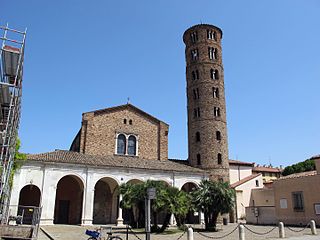
The Basilica of Sant'Apollinare Nuovo is a basilica church in Ravenna, Italy. It was erected by the Ostrogothic king Theodoric the Great as his palace chapel during the first quarter of the 6th century. This Arian church was originally dedicated in 504 AD to "Christ the Redeemer".

Apollinaris of Ravenna is a Syrian saint, whom the Roman Martyrology describes as "a bishop who, according to tradition, while spreading among the nations the unsearchable riches of Christ, led his flock as a good shepherd and honoured the Church of Classis near Ravenna by a glorious martyrdom."

The Basilica of Sant' Apollinare in Classe is a church in Classe, Ravenna, Italy, consecrated on 9 May 549 by the bishop Maximian and dedicated to Saint Apollinaris, the first bishop of Ravenna and Classe.
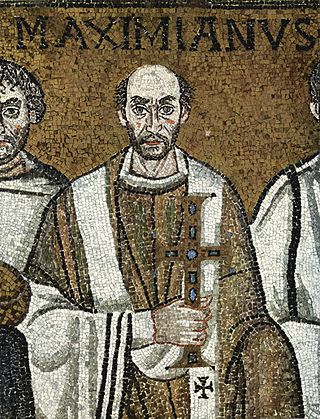
Maximianus of Ravenna, or Maximian was bishop of Ravenna in Italy. Ravenna was then the capital of the Byzantine Empire's territories in Italy, and Maximianus's role may have included secular political functions.
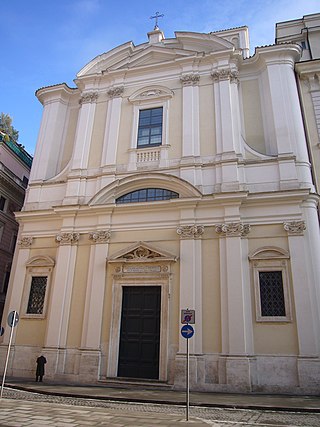
The Basilica di Sant'Apollinare alle Terme Neroniane-Alessandrine is a titular church in Rome, Italy, dedicated to St Apollinare, the first bishop of Ravenna.

The 2007–08 Serie B regular season is the seventy-sixth since its establishment. It started on August 25, 2007, and ended with the promotion playoff final on June 15, 2008.
Sant'Apollinare may refer to :

Ursicinus is a saint of the Catholic Church and was Bishop of Ravenna from 533 to 536. He is not to be confused with the 1st-century saint Ursicinus of Ravenna.

Classe was a commercial port located 4 km (2.5 mi) east south east from Ravenna, Italy. It was near the head of the Adriatic coast. For almost five hundred years it was an important strategic military port. When it was not being used as a military port, it was an important commercial port for the imperial capital of Ravenna in the Roman Empire. Classe comes from the Latin word classis, meaning fleet.
St. Apollinaire may refer to:
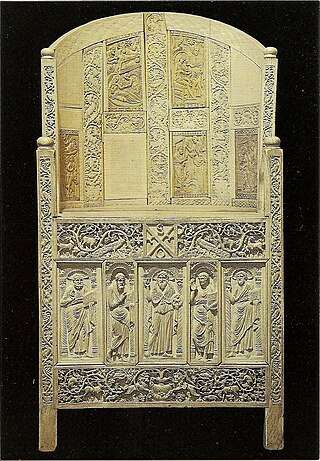
The Throne of Maximian is a cathedra that was made for Archbishop Maximianus of Ravenna and is now on display at the Archiepiscopal Museum, Ravenna. It is generally agreed that the throne was carved in the Greek East of the Byzantine Empire and shipped to Ravenna, but there has long been scholarly debate over whether it was made in Constantinople or Alexandria.
Lorenzo Raggi was an Italian Catholic Cardinal.

Byzantine mosaics are mosaics produced from the 4th to 15th centuries in and under the influence of the Byzantine Empire. Mosaics were some of the most popular and historically significant art forms produced in the empire, and they are still studied extensively by art historians. Although Byzantine mosaics evolved out of earlier Hellenistic and Roman practices and styles, craftspeople within the Byzantine Empire made important technical advances and developed mosaic art into a unique and powerful form of personal and religious expression that exerted significant influence on Islamic art produced in Umayyad and Abbasid Caliphates and the Ottoman Empire.
The following is a timeline of the history of the city of Ravenna in the Emilia-Romagna region of Italy.

A bifora is a type of window divided vertically in two openings by a small column or a mullion or a pilaster; the openings are topped by arches, round or pointed. Sometimes the bifora is framed by a further arch; the space between the two arches may be decorated with a coat of arms or a small circular opening (oculus).
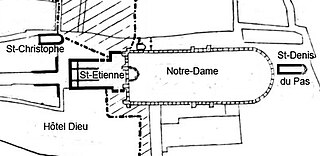
The Basilica and Cathedral of Saint-Étienne in Paris, on the Île de la Cité, was an early Christian church that preceded Notre-Dame de Paris. It was built in the 4th or 5th century, directly in front of the location of the modern cathedral, and just 250 meters from the royal palace. It became one of the wealthiest and most prestigious churches in France. Nothing remains above the ground of the original cathedral. It was demolished beginning in about 1163, when construction began on Notre-Dame de Paris. Vestiges of the foundations remain beneath the pavement of the square in front of Notre-Dame and beneath the west front of the cathedral. The church was built and rebuilt over the years in the Merovingian, Carolingian and Romanesque architectural styles.
References
- ↑ Garollo, Gottardo (1907). Ulrico Hoepli (ed.). Dizionario biografico universale. Editore Libraio della Real Casa, Milan. p. 109.
- ↑ Vite brevi degli artefici defunti che fecero per Ravenna opere esposte by Gasparo Martinetti Cardoni, page 3.
- ↑ History of Sant'Apollinare Nuovo Archived 2014-02-02 at the Wayback Machine .
 | This article about an Italian painter born in the 18th century is a stub. You can help Wikipedia by expanding it. |