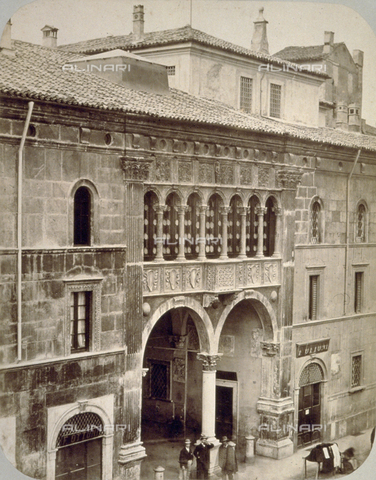
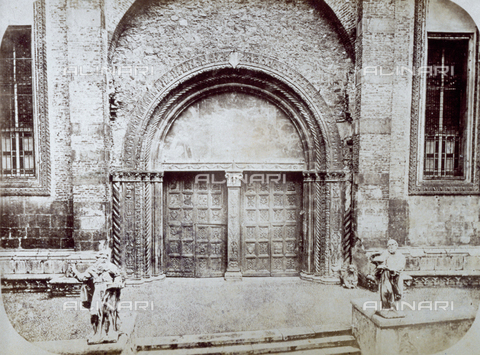
Alcamo is the fourth-largest town and commune of the Province of Trapani, Sicily, with a population of 44.925 inhabitants. It is on the borderline with the Metropolitan City of Palermo at a distance of about 50 kilometres from Palermo and Trapani.

Giorgio Vasari was an Italian Renaissance Master, who worked as a painter, architect, engineer, writer, and historian, who is best known for his work The Lives of the Most Excellent Painters, Sculptors, and Architects, considered the ideological foundation of all art-historical writing, and the basis for biographies of several Renaissance artists, including Leonardo da Vinci and Michelangelo. Vasari designed the Tomb of Michelangelo in the Basilica of Santa Croce, Florence that was completed in 1578. Based on Vasari's text in print about Giotto's new manner of painting as a rinascita (rebirth), author Jules Michelet in his Histoire de France (1835) suggested adoption of Vasari's concept, using the term Renaissance to distinguish the cultural change. The term was adopted thereafter in historiography and still is in use today.

GiacomoBarozzida Vignola, often simply called Vignola, was one of the great Italian architects of 16th century Mannerism. His two great masterpieces are the Villa Farnese at Caprarola and the Jesuits' Church of the Gesù in Rome. The three architects who spread the Italian Renaissance style throughout Western Europe are Vignola, Serlio and Palladio. He is often considered the most important architect in Rome in the Mannerist era.

Piazza della Signoria is a w-shaped square in front of the Palazzo Vecchio in Florence, Italy. It was named after the Palazzo della Signoria, also called Palazzo Vecchio. It is the main point of the origin and history of the Florentine Republic and still maintains its reputation as the political focus of the city. It is the meeting place of Florentines as well as the numerous tourists, located near Palazzo Vecchio and Piazza del Duomo and gateway to Uffizi Gallery.

Parione is the 6th rione of Rome, identified by the initials R. VI, and belongs to the Municipio I. Its name comes from the fact that in the area there was a huge ancient wall, maybe belonging to the stadium of Domitianus; the nickname people gave to this wall was Parietone, from which the name "Parione".

Campo Marzio is the 4th rione of Rome, identified by the initials R. IV. It belongs to the Municipio I and covers a smaller section of the area of the ancient Campus Martius. The logo of this rione is a silver crescent on a blue background.

Grazio Cossali, sometimes called Orazio Cossali was an Italian painter who worked in Brescia, Cremona, and Venice, active during the Mannerist or early Baroque periods.

Tommaso Bona was an Italian painter of the Renaissance period, mainly active in Brescia.

Piazza della Repubblica is a city square in Florence, Italy. It was originally the site of the city's forum; then of its old ghetto, which was swept away during the improvement works, or Risanamento, initiated during the brief period when Florence was the capital of a reunited Italy—work that also created the city's avenues and boulevards. At that time, the Loggia del Pesce from the Mercato Vecchio was also moved to Piazza Ciompi. The square's Giubbe Rosse cafe has long been a meeting place for famous artists and writers, notably those of Futurism.

Villas and palaces in Milan are used to indicate public and private buildings in Milan of particular artistic and architectural value. Milan has always been an important centre with regard to the construction of historical villas and palaces, ranging from the Romanesque to the neo-Gothic, from Baroque to Rococo.

Rodolfo Vantini was an Italian architect. He is remembered for his Neoclassical contributions to architecture in his native city of Brescia and in the surrounding regions of northern Italy. His masterpiece is the design of Milan's Porta Orientale customs offices.
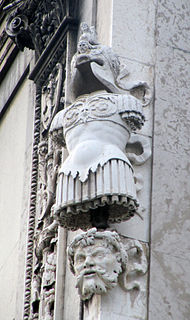
Gasparo Cairano, also known as Gasparo da Cairano, de Cayrano, da Milano, Coirano, and other variations, was an Italian sculptor of the Renaissance.
Antonio della Porta, better known as Tamagnino was an Italian sculptor of the Renaissance.
Gianni Pezzani, is an Italian photographer.

Bernardino delle Croci was an Italian goldsmith and sculptor of the Brescian Renaissance. He was the founder of the Delle Croci family of important goldsmiths and sculptors, known for their specialism in processional crosses, reliquaries and altars.

Studio fotografico Vasari it is one of the oldest Italian companies operating in the field of photography.
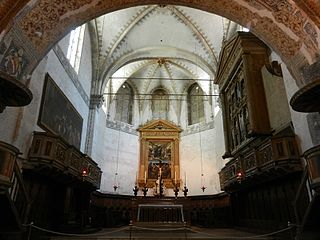
Bernardino da Martinengo was an Italian mason and architect. His appellation serves to identify his origins in Martinengo in the area of Bergamo. In 1481, he was cited as a member of a bricklayers group, where he learned construction techniques of the late Gothic. Towards the end of the same decade, he was registered amongst the construction workers of the Monte di Pietà vecchio, a palazzo situated in the Piazza della Loggia in Brescia, where he would be one of the accusers of Filippo Grassi, the construction manager, for fraud against the municipality.
LudovicoBeretta was an Italian architect of the Brescian renaissance. His work is considered emblematic of the development of the Renaissance architectural paradigm in the middle of the sixteenth century.