
Gian Singh Nihang, also known as Gian Singh 'Sutantar', was a Sikh scholar and martial artist, belonging to the Nihang order, famous for his work on Shastar Vidya. [1] [2]
Gian Singh Nihang, also known as Gian Singh 'Sutantar', was a Sikh scholar and martial artist, belonging to the Nihang order, famous for his work on Shastar Vidya. [1] [2]
He spent 40 years on textual analysis of Guru Granth Sahib from very rare Manuscripts and over a hundred codices (Birs) and published some basic findings. [3] His work with Kundan Singh and Randhir Singh research scholar is known as Sri Guru Granth Sahib ji dian Santha-Sainchian are Puratan Hathlikhit Pavan Biran de Praspar Path-Bhedan di Suchi ( The list of textual variations present in the early sacred manuscripts and printed versions of the Guru Granth Sahib) which was published in 1977.

Sikhism, also known as Sikhi, or Sikh Dharma, is a Dharmic religion and philosophy that originated in the Punjab region of the Indian subcontinent, around the end of the 15th century CE. It is one of the most recently founded major religious groups and stands at fifth-largest worldwide, with about 25–30 million adherents.

The Guru Granth Sahib is the central holy religious scripture of Sikhism, regarded by Sikhs as the final, sovereign and eternal Guru following the lineage of the ten human gurus of the religion. The Adi Granth, its first rendition, was compiled by the fifth guru, Guru Arjan (1564–1606). Its compilation was completed on 29 August 1604 and first installed inside Golden Temple in Amritsar on 1 September 1604. Baba Buddha was appointed the first Granthi of the Golden Temple. Shortly afterwards Guru Hargobind added Ramkali Ki Vaar. Later, Guru Gobind Singh, the tenth Sikh guru, added hymns of Guru Tegh Bahadur to the Adi Granth and affirmed the text as his successor. This second rendition became known as the Guru Granth Sahib and is also sometimes referred to as the Adi Granth.
Adherents of Sikhism follow a number of prohibitions. As with any followers of any faith or group, adherence varies by each individual.

The Dasam Granth is a collection of various manuscripts in Sikhism containing compositions attributed to Guru Gobind Singh. Guru Gobind Singh ordained the sacred text Guru Granth Sahib as his successor, eternally ending the line of human Gurus. It is the primary holy scripture of the Sikhs and regarded by Sikhs as the living embodiment of Ten Gurus. Bachittar Natak is a part of composition
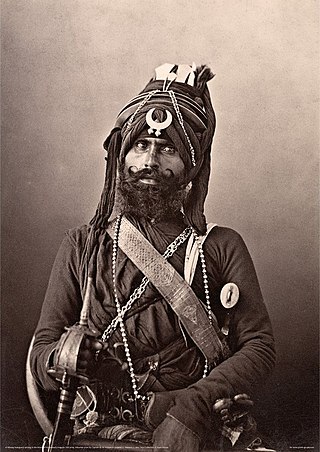
The Nihang or Akali also known as Dal Khalsa is an armed Sikh warrior order originating in the Indian subcontinent. Nihangs are believed to have originated either from Fateh Singh and the attire he wore or from the "Akali" started by Guru Hargobind. Early Sikh military history was dominated by the Nihang, known for their victories where they were heavily outnumbered. Traditionally known for their bravery and ruthlessness in the battlefield, the Nihang once formed the irregular guerrilla squads of the armed forces of the Sikh Empire, the Sikh Khalsa Army.

The Namdharis, also known as Kuka and Kukaism, are a Sikh sect that differs from mainstream Sikhs chiefly in that it believes that the lineage of Sikh Gurus did not end with Guru Gobind Singh (1666–1708), as they recognize Balak Singh (1797–1862) as the 11th Guru of the Sikh religion, thus continuing the succession of Sikh Gurus through the centuries from Guru Nanak Dev to the present day. The 12th Guru was Ram Singh (1816–1885), who moved the sects centre to Bhaini Sahib (Ludhiana) and is regarded as the first Indian to use non-cooperation and non-violence boycott in order to combat the British Empire in India.
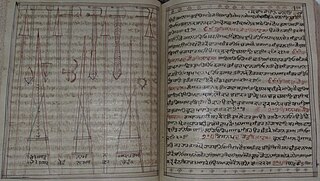
The Sarbloh Granth or Sarabloh Granth, also called Manglacharan Puran or Sri Manglacharan Ji, is a voluminous scripture, composed of more than 6,500 poetic stanzas. It is traditionally attributed as being the work of Guru Gobind Singh, the tenth Sikh guru. Scholars, on the other hand, attribute the work to after the Guru's death, being authored by an unknown poet. The work is mostly revered by the Nihang sect.

The principal Sikh scripture is the Adi Granth, more commonly called the Guru Granth Sahib. The second most important scripture of the Sikhs is the Dasam Granth. Both of these consist of text which was written or authorised by the Sikh Gurus.
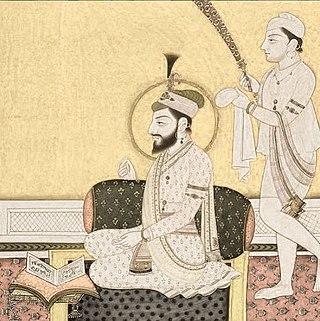
Sant Bhasha is a liturgical and scriptural language composed of vocabulary common to northern Indian languages, which was extensively used by saints and poets to compose religious verses. It can be understood by readers with a background in either Punjabi, Hindi-Urdu and its dialects.

A gyananya or gyananya is an honorific Sikh title used by someone learned in Sikhism and who often leads the congregation in prayers, such as Ardas, or in singing (kirtan). The word gyan means "knowledge" in Punjabi, being a derivative of the Sanskrit word jnana. So a "gyananya" is one who has spiritual and religious knowledge and can help the congregation—the Sadh Sangat—in understanding the Sacred Texts and the history of the religion.

Varan Bhai Gurdas, also known as Varan Gyan Ratnavali, is the name given to the 40 vars which is traditionally attributed to Bhai Gurdas.
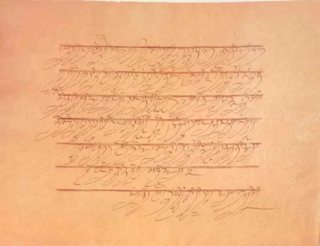
Chandi Di Var is a composition written by Guru Gobind Singh, included in the 5th chapter of Dasam Granth.
A Hukamnama, in modern-times, refers to a hymn from the Guru Granth Sahib which is given as an injunction, order, or edict to Sikhs. It also refers to edicts issued by the contemporary Takhts. In the historical sense, it was used to refer to an issued injunction, order, or edict given by one of the Gurus of Sikhism or their officiated followers and associates during their lives.
Sikhism has often been criticised by non-Sikhs regarding its texts, practices, and societal norms, but Sikhs and other scholars argue that these criticisms are flawed and are based on a biased and poor understanding of the texts, especially of the multiple languages used in the Sikh scriptures. They also argue that most western scholars who attempted to interpret eastern religious texts were missionaries and could not overcome the bias they carried with them, irrespective of whether they were translating the Quran, Vedas, Puranas or the Guru Granth Sahib. Guru Nanak rejected ritualistic worship and encouraged belief in one true God, Waheguru. The veneration and bowing to the Guru Granth Sahib, has often been interpreted by western scholars as akin to idolatry, as observed by the Hindu faith, which defeats the ideology of Guru Nanak. Other scholars dismiss Sikhism as, either consciously or spontaneously, a syncretism of the Hindu Bhakti and Muslim Sufi movements.

Akali Kaur Singh Nihang was a religious preacher and Sikh scholar.
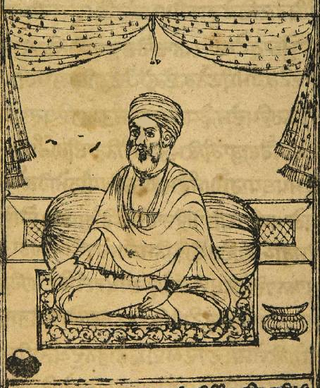
Pandit Tara Singh Narotam (1822–1891) or also Pundit Tara Singh Nawtam was a famous Punjabi scholar who belonged to the Sikh Nirmala Sect.
Sachkhoj Academy(ਸਚੁ ਖੋਜ ਅਕੈਡਮੀ) is a non profitable Sikh academical institution started by Dharam Singh(b. 1936), a Nihang Singh theologian, preacher and writer, known for his exegesis of Adi Granth and Dasam Granth. He worked as a secretary in Budha Dal, under Baba Chet Singh Nihang. The academy was started in 1996 at Khanna, where classes are delivered on the exegesis of various compositions of Adi Granth, Dasam Granth and various topics of Sikhism and other religions. Academy has uploaded enormous amount of audio and video lectures on the internet with expositions of various Compositions of Aad and Dasam granth. It provides platform for independent researchers of Gurbani to perform unbiased research, and learning to use the Adi Granth dictionary lexical resource for the exegesis.

Dharam Singh is a Nihang theologian, writer, preacher known for exegesis and expositions of Adi Granth and Dasam Granth. Enrolled as Nihang in Budha Dal, he worked as a secretary and participated in various religious conventions. He contributed the view of Sikh Religion on Human Rights in German Book, Menschenrechte im Weltkontext. In February 2015, he was the very first speaker of the dialogue series entitled Religion Matters established by the German Federal Ministry of Economic Cooperation and Development (BMZ). On letter call from SGPC, he had written various articles in response to Gurbaksh Singh Kala Afghana, who spoke against Amrit and Dasam Granth.

Pashaura Singh (1928–2008) also known as Santa Singh or to Nihang Sikhs as Jathedar Akali Baba Santa Singh Ji Nihang 96 Crori was the 13th Jathedar of Budha Dal, succeeding Akali Chet Singh.
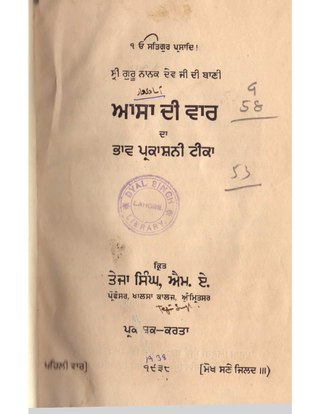
A steek or teeka [other spellings may exist such as stik or tika] is an exegesis or commentary on a Sikh religious text, usually Gurbani, but can also include other writings like the Ghazals of Bhai Nand Lal. An author of a steek or teeka is known as a teekakar. A steek always includes an explanation, or viakhya of the specific religious text, but depending on the complexity of the steek, can also include footnotes, commentary, and contexts to the specific verses and where they were first written/revealed.