Related Research Articles
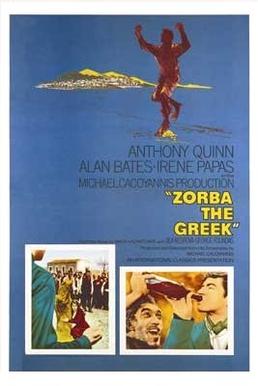
Zorba the Greek is a 1964 drama film written, produced, edited, and directed by Greek Cypriot filmmaker Michael Cacoyannis. It stars Anthony Quinn as Zorba, an earthy and boisterous Cretan peasant, and Alan Bates as Basil, the buttoned-up young intellectual he befriends. The cast also includes Lila Kedrova, Irene Papas, and Sotiris Moustakas. The musical score was composed by Mikis Theodorakis. The film is based on the 1946 novel The Life And Times Of Alexis Zorba by Nikos Kazantzakis.
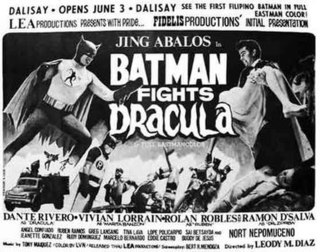
Batman Fights Drácula is a 1967 Filipino superhero film directed by Leody M. Diaz and scripted by Bert R. Mendoza. The film, which was not authorized by DC, is thought to be lost.
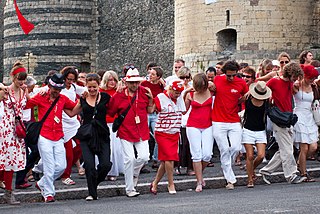
Sirtaki or syrtaki is a dance of Greek origin, choreographed for the 1964 film Zorba the Greek. It is a recent Greek folkdance, and a mixture of "syrtos" and the slow and fast rhythms of the hasapiko dance. The dance and the accompanying music by Mikis Theodorakis are also called Zorba's dance, the Zorba or "the dance of Zorba". The dance has become popular in Greece and one that is identified with the Greeks, becoming an "invented tradition".

"Zorba's Dance" is an instrumental by Greek composer Mikis Theodorakis. The song featured for the dance, which has become known as sirtaki, in the 1964 film Zorba the Greek, for which Theodorakis wrote the soundtrack, and became renowned around the world. It is now commonly played and danced to in Greek tavernas. The film's track has since been recorded as a standalone song by many different musicians from around the world.

Michael Cacoyannis, sometimes credited as Michael Yannis, was a Greek Cypriot theatre and film director, writer, producer, and actor.
Zorba may refer to:
Ron Field was an American choreographer, dancer, and director.
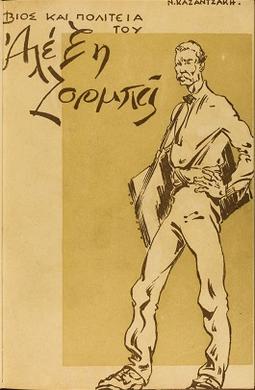
Zorba the Greek is a novel written by Nikos Kazantzakis, first published in 1946. It is the tale of a young Greek intellectual who ventures to escape his bookish life with the aid of the boisterous and mysterious Alexis Zorba. The novel was adapted into the successful 1964 film of the same name directed by Michael Cacoyannis, as well as a stage musical and a BBC radio play.

Chania, also spelled Hania, is one of the four regional units of Crete; it covers the westernmost quarter of the island. Its capital is the city of Chania. Chania borders only one other regional unit: that of Rethymno to the east. The western part of Crete is bounded to the north by the Cretan Sea(part of the Aegean Sea) and to the west and south by the Mediterranean Sea and Libyan Sea. The regional unit also includes the southernmost island of Europe, Gavdos.
Marianna Zorba is a Greek singer and a music teacher. She loves ethnic and folk music. In 1997 she represented Greece in the 42nd Eurovision Song Contest. She was engaged to Manolis Manouselis, a composer, the week before the grand finale in Dublin. A few weeks after the contest they married. Marianna and the song, "Horepse" scored 39 points and reached 12th place. Marianna and Manolis decided to move to Crete in 2002. He works as an architect and she as a music teacher. Together they formed the duo Notios Anemos and they perform in music festivals, concerts and theatrical plays in Crete. They published a record together in 2005.
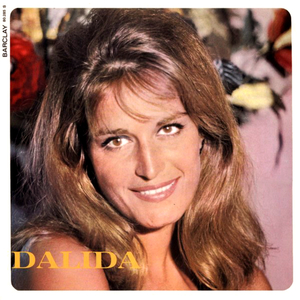
Il Silenzio is an album by Dalida. It marked her comeback to a more successful career. It contains her success "Il Silenzio ", "Scandale dans la famille" and the Greek flavoured "La danse de Zorba".

Walter Lassally was a German-born British cinematographer. He won the Academy Award for Best Cinematography in 1965 for the film Zorba the Greek.

Kissamos is a town and a municipality in the west of the island of Crete, Greece. It is part of the Chania regional unit and of the former Kissamos Province which covers the northwest corner of the island. The town of Kissamos is also known as Kastelli Kissamou and often known simply as Kastelli after the Venetian castle that was there. It is now a port and fishing harbour, with a regular ferry from the Peloponnese via Kythira. A town museum is located in the old Venetian governor's palace and there have been important archaeological finds in the town, including fine mosaics, dating from the Roman city of Kisamos. The head town of the municipality is Kastelli-Kissamos itself.

Zorba is a musical with a book by Joseph Stein, lyrics by Fred Ebb, and music by John Kander. Adapted from the 1946 novel Zorba the Greek by Nikos Kazantzakis and the subsequent 1964 film of the same name, it focuses on the friendship that evolves between Zorba and Nikos, a young American who has inherited an abandoned mine on Crete, and their romantic relationships with a local widow and a French woman, respectively.
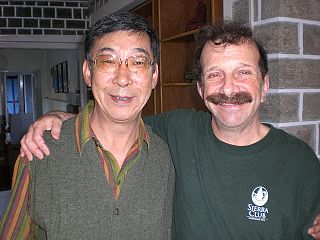
Robert Zorba Paster is a physician and radio show host.
Spilia Museum of Kissamos is a museum in Kissamos, Crete, Greece.
The 23rd Annual Tony Awards was broadcast by NBC television on April 20, 1969, from the Mark Hellinger Theatre in New York City. Hosts were Diahann Carroll and Alan King.
LCD were a computer generated dance act, active in the late 1990s. Signed to Virgin Records, their only hit single was a Europop version of the Greek song "Zorba's Dance". The music video to the song, made in computerised animation, featured a band of overweight men playing the song.
Giorgos Provias is a Greek dancer, actor, and choreographer; the creator of the staple Greek "folk" dance Sirtaki.

Cyclone Zorbas, or Medicane Zorbas, was the first officially documented Mediterranean tropical-like cyclone, or medicane, since Cyclone Numa in 2017. Zorbas originated as an extratropical cyclone in the eastern Mediterranean Sea. Warm sea surface temperatures allowed the system to quickly deepen and transition into a tropical cyclone. Zorbas intensified as it headed northward towards Greece, finally reaching its peak intensity with maximum sustained winds of 120 km/h (75 mph) and a minimum central pressure of 987 mbar (29.15 inHg) on September 29.

