Giuseppe Maria Terreni (1739 - 1811) was an Italian painter.

Giuseppe Maria Terreni (1739 - 1811) was an Italian painter.
He was born in Livorno and there frescoed the Chapel of the Sacrament in the Livorno Cathedral and the Hall of Buon Umore in the Florentine Accademia of fine arts. [1]
Terreni also painted in some chapels of the church of Santa Caterina in the neighborhood of Venezia Nuova of Livorno. Alongside Antonio Niccolini, he helped decorate the Teatro degli Avvalorati (no longer extant). he also helped decorate the cupola of the Sanctuary of Montenero. [2] The painting Festa al Santuario di Montenero (1774), has been attributed to Terreni. Festa al Santuario di Montenero is presently at the Albright-Knox Art Gallery of Buffalo. In 1794, he painted in the Chapel of the Rosary of the Certosa di Calci in Pisa. A few years later, with Giuseppe Castagnoli, he redecorated the Sala delle Nicchie in the Palazzo Pitti of Florence.
From 1783 to 1785, he completed vedute of the city and port of Livorno, demonstrating influence of Giuseppe Zocchi and Jakob Philipp Hackert. [3]

Livorno is a port city on the Ligurian Sea on the western coast of Tuscany, Italy. It is the capital of the Province of Livorno, having a population of 158,493 residents in December 2017. It is traditionally known in English as Leghorn.

Giovanni Fattori was an Italian artist, one of the leaders of the group known as the Macchiaioli. He was initially a painter of historical themes and military subjects. In his middle years, inspired by the Barbizon school, he became one of the leading Italian plein-airists, painting landscapes, rural scenes, and scenes of military life. After 1884, he devoted much energy to etching.
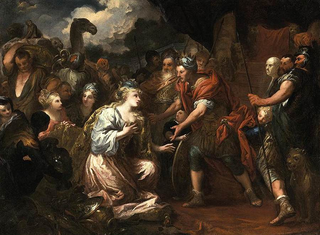
Pietro Dandini was an Italian painter of the Baroque period, active mainly in Florence.

Filippo Maria Galletti (1636–1714) was an Italian painter of the Baroque period, active mainly in Tuscany, Parma, and Liguria. He was a pupil of the painter Ciro Ferri and Pietro Dandini. He became a Theatine priest, and painted religious works in Lecce and Livorno, and the church of Santa Lucia (Parma). He entered the Theatine order.

Giuseppe Maria Orlandini was an Italian baroque composer particularly known for his more than 40 operas and intermezzos. Highly regarded by music historians of his day like Francesco Saverio Quadrio, Jean-Benjamin de La Borde and Charles Burney, Orlandini, along with Vivaldi, is considered one of the major creators of the new style of opera that dominated the second decade of the 18th century.
Guglielmo Janni (1892–1958) was an Italian painter belonging to the modern movement of the Scuola romana .
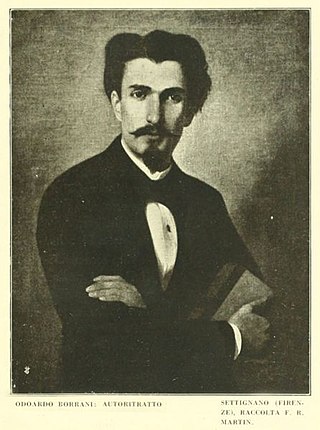
Odoardo Borrani was an Italian painter associated with the Macchiaioli group.

Adolfo Tommasi was an Italian painter.

Ulvi Liegi was an Italian painter and printmaker. Part of the Post-macchiaioli movement, he painted various cityscapes of Livorno and depictions of Livornese daily life.

Francesco Saverio Netti was an Italian painter.

Giuseppe Sciuti was an Italian painter.

Angiolo Tommasi was an Italian painter, active in the Macchiaioli movement. He was the brother of the painter Ludovico and cousin of the painter Adolfo Tommasi; all three were influential for the arts in their native Tuscany in the late 19th and early 20th-centuries. Angiolo painted both genre and landscape themes.

The Sanctuary of Madonna dei Miracoli is a church in Alcamo, province of Trapani, Sicily, southern Italy; it is dedicated to the Madonna of the Miracles.

Santa Caterina da Siena is a Baroque architecture, Roman Catholic church in the district Venezia Nuova central Livorno, region of Tuscany, Italy. It stands in front of the Piazza dei Domenicani. The church is notable for its tall octagonal dome and lantern rising above a rough, unfinished rectangular base.

Cesare Maffei was an Italian painter of the Neoclassical period, active in Tuscany.
The following is a timeline of the history of the city of Livorno in the Tuscany region of Italy.
Salvatore Fighera was an Italian composer of both sacred and secular music. Born in Gravina in Puglia, he completed his musical studies at the Conservatorio di Sant'Onofrio a Capuana in Naples and spent several years in Milan after leaving the conservatory in 1783. On his return to Naples he served as the maestro di cappella of several churches, most notably the Santuario di San Sebastiano Martire, a post he held until his death.
Marco Lastri was an eclectic and polymath writer, active in Florence, region of Tuscany, Italy.

| International | |
|---|---|
| National | |
| Artists | |
| People | |
 | This article about an Italian painter born in the 18th century is a stub. You can help Wikipedia by expanding it. |
