
Giuseppe Vaccai (Pesaro, August 21, 1836 -1912) was an Italian painter, mainly of landscapes.
Giuseppe Vaccai (Pesaro, August 21, 1836 -1912) was an Italian painter, mainly of landscapes.
His father was a well-known music composer, and Vaccai did not dedicate himself to painting until after twenty years of age. The family sent him to the Sapienza University of Rome to train as a lawyer. But in Rome, his fellow Pesarese, Cavaliere Carlo Gavardini, introduced him to the landscape artist, Jean-Achille Benouville who took him in his studio. His canvases reproduce the pine forests of Ravenna as well as the valleys and coasts of central Italy. Among his works are: Il fosso Ghiaia a Ravenna; Sulle sponde del Nera; Intorno alla Pineta; The Adriatic Beach in Pesaro; and Albacina. In 1870 at Parma, he exhibited a Vallala di Poschiavo dal monte Cavagna. In 1877 at Naples, he exhibited a Fosso Ghiaia nella Pineta di Ravenna and a Paesaggio. Among his works exhibited in Turin, Milan, Rome and Bologna, were: In riva all' Adriatico; Sulle colline; Marina di Pesaro a levante; Marina di Pesaro verso Cattolica; Le foci di Piobbico; Stazione di Foligno ; and Appennino Metaurense. He became an associate member of the Royal Academy of Fine Arts in Bologna and in his last decade became a deputy in parliament. [1]
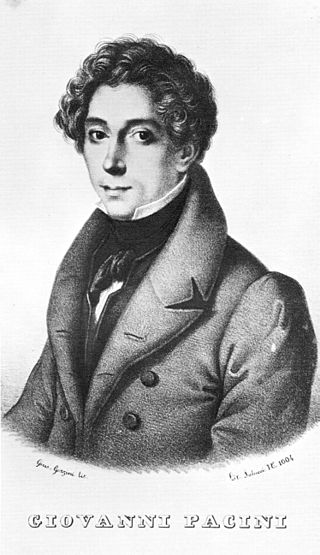
Giovanni Pacini was an Italian composer, best known for his operas. Pacini was born in Catania, Sicily, the son of the buffo Luigi Pacini, who was to appear in the premieres of many of Giovanni's operas. The family was of Tuscan origin, living in Catania when the composer was born.

Pesaro is a city and comune in the Italian region of Marche, capital of the Province of Pesaro e Urbino, on the Adriatic Sea. According to the 2011 census, its population was 95,011, making it the second most populous city in the Marche, after Ancona. Pesaro was dubbed the "Cycling City" by the Italian environmentalist association Legambiente in recognition of its extensive network of bicycle paths and promotion of cycling. It is also known as "City of Music", for it is the birthplace of the composer Gioacchino Rossini. In 2015 the Italian Government applied for Pesaro to be declared a "Creative City" in UNESCO's World Heritage Sites. In 2017 Pesaro received the European City of Sport award together with Aosta, Cagliari and Vicenza.
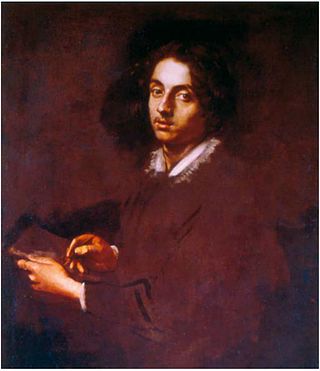
Simone Cantarini or Simone da Pesaro, called il Pesarese was an Italian painter and etcher. He is mainly known for his history paintings and portraits executed in an original style, which united aspects of Bolognese classicism with a bold naturalism.

Nicola Vaccai was an Italian composer, particularly of operas, and a singing teacher.
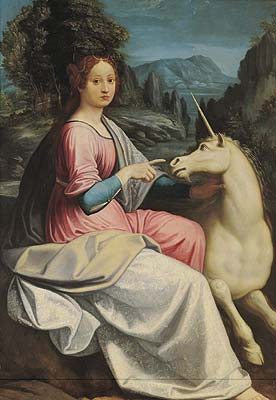
Luca Longhi was an Italian painter of the late-Renaissance or Mannerist period, active in and near Ravenna, where he mainly produced religious paintings and portraits.

Luigi Quaini (1643–1717) was an Italian painter of the Baroque period.

Telemaco Signorini was an Italian artist who belonged to the group known as the Macchiaioli.
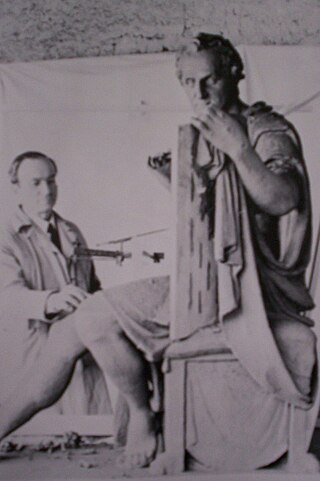
Romano Vio was an Italian sculptor. He was born in Venice and taught sculpture there.

Pelagio Palagi was an Italian painter, sculptor and interior decorator.
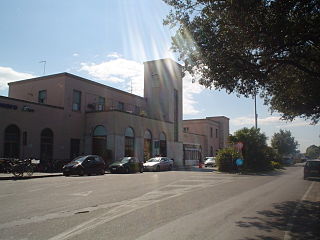
Pesaro railway station serves the city and comune of Pesaro, in the region of Marche, central Italy. Opened in 1861, it forms part of the Bologna–Ancona railway.
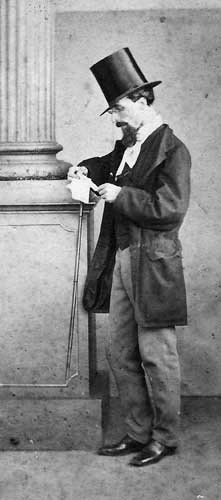
Vincenzo Cabianca was an Italian painter of the Macchiaioli group.

Angiolo Torchi was an Italian painter, mainly of landscapes. He is also known as Angelo Torchi under which Wikipedia has articles in Italian and French.

Ulvi Liegi was an Italian painter and printmaker. Part of the Post-macchiaioli movement, he painted various cityscapes of Livorno and depictions of Livornese daily life.
Giovanni Piancastelli was an Italian painter and architect.
Carlo Pizzi was an Italian painter, mainly of landscapes of his native Lombardy.

The Bologna–Ancona railway is an Italian railway that connects the city of Bologna with the city of Ancona, passing through the Po Valley to Rimini and along the Adriatic coast for the rest of the line.
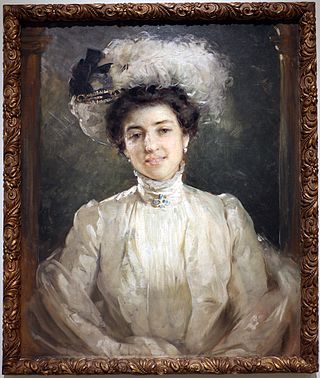
Edgardo Saporetti was an Italian painter of eclectic subjects, including portraits, landscapes, and genre subjects.

Juti Ravenna was an Italian painter.
Edoardo Collamarini (1863–1928) was an Italian architect, active mainly in Bologna, region of Emilia Romagna, Italy.
Michele Mariotti, born in 1979 in Urbino, near Pesaro, is an Italian conductor, the direttore musicale since 2014 of Teatro Comunale di Bologna. A graduate in composition of Pesaro's Conservatorio Rossini, where he also studied orchestral conducting, he made his professional opera debut with Il barbiere di Siviglia in Salerno on Oct. 12, 2005. As of April 2017, his repertory included nine Rossini and eight Verdi operas, an extraordinary achievement, as well as symphonies of Beethoven, Bruckner and Schubert, the Rossini Stabat mater, the Mozart Requiem and the Verdi Requiem.
| General | |
|---|---|
| National libraries | |
| Other | |
