
Oriel College is a constituent college of the University of Oxford in Oxford, England. Located in Oriel Square, the college has the distinction of being the oldest royal foundation in Oxford. In recognition of this royal connection, the college has also been historically known as King's College and King's Hall. The reigning monarch of the United Kingdom is the official visitor of the college.
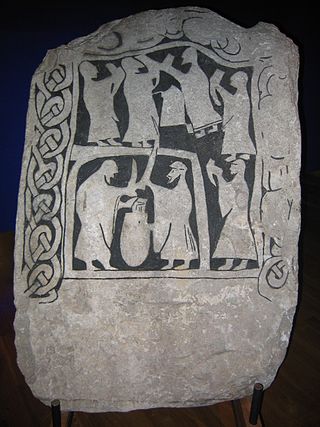
Symbel (OE) and sumbl (ON) are Germanic terms for "feast, banquet".

An agape feast or lovefeast is a term used for various communal meals shared among Christians. The name comes from the Greek word ἀγάπη (agape), which implies love in the sense of brotherly or familial affection.

Caffè latte, often shortened to just latte in English, is a coffee drink of Italian origin made with espresso and steamed milk, traditionally served in a glass. Variants include the chocolate-flavored mocha or replacing the coffee with another beverage base such as masala chai, mate, matcha, turmeric or rooibos; alternatives to milk, such as soy milk, almond milk or oat milk, are also used.

A wedding breakfast is a feast given to the newlyweds and guests after the wedding, making it equivalent to a wedding reception that serves a meal. The phrase is still used in British English.
The Parish ale or church ale was a party or festivity in an English parish at which ale was the chief drink. It was typically a fundraising occasion for the parish that might include music and dancing. Very common in the later Middle Ages, parish ales encountered some opposition after the English Reformation, though some survived until modern times in some form.

The Singapore sling is a gin-based sling cocktail from Singapore. This long drink was developed in 1915 by Ngiam Tong Boon, a bartender at the Long Bar in Raffles Hotel, Singapore. It was initially called the gin sling.
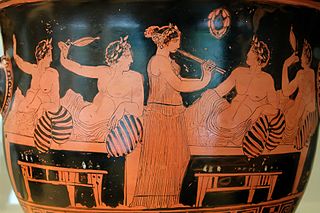
In Ancient Greece, the symposium was the part of a banquet that took place after the meal, when drinking for pleasure was accompanied by music, dancing, recitals, or conversation. Literary works that describe or take place at a symposium include two Socratic dialogues, Plato's Symposium and Xenophon's Symposium, as well as a number of Greek poems, such as the elegies of Theognis of Megara. Symposia are depicted in Greek and Etruscan art, that shows similar scenes.

Beer has been brewed in England for thousands of years. As a beer brewing country, it is known for top fermented cask beer which finishes maturing in the cellar of the pub rather than at the brewery and is served with only natural carbonation.
A month's mind is a requiem mass celebrated about one month after a person's death, in memory of the deceased.
The Ragman Rolls are the collection of instruments by which the nobility and gentry of Scotland subscribed allegiance to King Edward I of England, during the time between the Conference of Norham in May 1291 and the final award in favour of Balliol in November 1292; and again in 1296. Of the former of these records two copies were preserved in the Chapter House at Westminster Abbey, and it has been printed by Thomas Rymer. Another copy, preserved originally in the Tower of London, is now also in the National Archives. The latter record, containing the various acts of homage and fealty extorted by Edward from John Balliol and others in the course of his progress through Scotland in the summer of 1296 and in August at the parliament of Berwick, was published by Prynne from the copy in the Tower and now in the National Archives. Both records were printed by the Bannatyne Club in 1834.
Responsions was the first of the three examinations formerly required for acceptance for an academic degree at the University of Oxford. It was nicknamed Little Go or Smalls and was normally taken by students prior to or shortly after matriculation, on the basis that without standardised qualifications from school examinations, the university had to verify for itself the quality of the students that colleges were accepting. The examination consisted of comparatively simple questions on Latin, Ancient Greek, and mathematics. It was abolished in 1960.

Beer glassware comprise vessels made of glass, designed or commonly used for serving and drinking beer. Styles of glassware vary in accord with national or regional traditions; legal or customary requirements regarding serving measures and fill lines; such practicalities as breakage avoidance in washing, stacking or storage; commercial promotion by breweries; artistic or cultural expression in folk art or as novelty items or usage in drinking games; or to complement, to enhance, or to otherwise affect a particular type of beer's temperature, appearance and aroma, as in the case of its head. Drinking vessels intended for beer are made from a variety of materials other than glass, including pottery, pewter, and wood.

Robert Abbot was an Anglican bishop, academic and polemical writer. He served as Master of Balliol College, Oxford, Regius Professor of Divinity, and Bishop of Salisbury from 1615. Among his four younger brothers, George became Archbishop of Canterbury and Maurice became Lord Mayor of London.
Sconcing is a tradition at Oxford University of demanding that a person drink a tankard of ale or some other alcoholic beverage as a penalty for some breach of etiquette. Originally the penalty would have been a simple monetary fine imposed for a more serious breach of discipline, and the word is known to have been used in this sense as early as 1617.

A tamada is a Georgian toastmaster at a Georgian supra (feast) or at a wedding, corresponding to the symposiarch at the Greek symposion or to the thyle at the Anglo-Saxon sumbel.
Kentish fire is vehement and prolonged derisive cheering. The practice is so called from indulgence in it in Kent at meetings to oppose the Roman Catholic Relief Bill.

"With flying colours" is a popular idiom of the English language that is used to describe how well someone has completed a task. For example, a common use of the phrase is to refer to someone having passed a test or other examination "with flying colours," i.e. passed the test easily or with an exceptionally high score. The phrase originated in the Age of Discovery, when ships would return to port with their flags ("colours") either raised or lowered to signify that the ship had either been successful or defeated, with raised flags indicating success and lowered flags indicating defeat. Thus, "with flying colours" literally means that someone has completed a task, while idiomatically, it connotes particular success in that task.
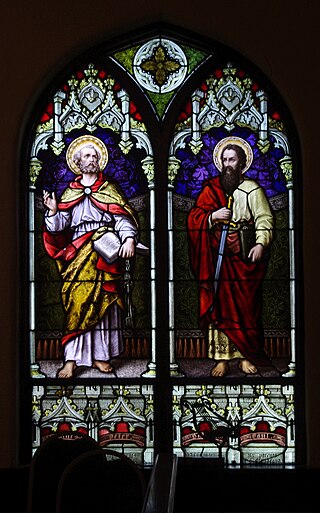
"To rob Peter to pay Paul", or other versions that have developed over the centuries such as "to borrow from Peter to pay Paul", and "to unclothe Peter to clothe Paul", are phrases meaning to take from one person or thing to give to another, especially when it results in the elimination of one debt by incurring another. There are many other variants and similar phrases in numerous languages. "Maneuvering the Apostles", which has the same meaning, was derived from this expression. In patchwork, "Rob Peter to pay Paul" is an alternative name for the Drunkard's Path patchwork block.

Burton ale is a type of strong ale which is dark and sweet. It is named after the brewing town of Burton-on-Trent.


