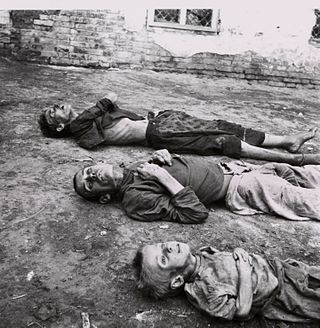
A famine is a widespread scarcity of food caused by several possible factors, including, but not limited to war, natural disasters, crop failure, widespread poverty, an economic catastrophe or government policies. This phenomenon is usually accompanied or followed by regional malnutrition, starvation, epidemic, and increased mortality. Every inhabited continent in the world has experienced a period of famine throughout history. During the 19th and 20th century, Southeast and South Asia, as well as Eastern and Central Europe, suffered the greatest number of fatalities. Deaths caused by famine declined sharply beginning in the 1970s, with numbers falling further since 2000. Since 2010, Africa has been the most affected continent in the world by famine.
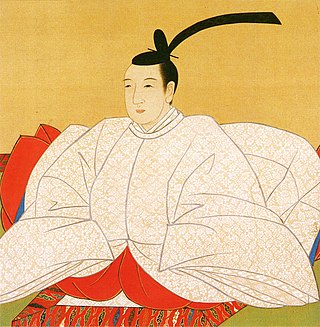
Ayahito, posthumously honored as Emperor Ninkō, was the 120th emperor of Japan, according to the traditional order of succession. Ninkō's reign spanned the years from 1817 until his death in 1846, and saw further deterioration of the power of the ruling Shōgun. Disasters, which included famine, combined with corruption and increasing Western interference, helped to erode public trust in the bakufu government. Emperor Ninkō revived certain court rituals and practices upon the wishes of his father. However, it is unknown what role, if any, the Emperor had in the turmoil which occurred during his reign.

Mizuno Tadakuni was a daimyō during late-Edo period Japan, who later served as chief senior councilor (Rōjū) in service to the Tokugawa shogunate. He is remembered for having instituted the Tenpō Reforms.

Tokugawa Ieyoshi was the 12th shōgun of the Tokugawa shogunate of Japan.

Tokugawa Ienari was the eleventh and longest-serving shōgun of the Tokugawa shogunate of Japan who held office from 1787 to 1837. He was a great-grandson of the eighth shōgun Tokugawa Yoshimune through his son Munetada (1721–1764), head of the Hitotsubashi branch of the family, and his grandson Harusada (1751–1827).

The Holodomor, also known as the Ukrainian Famine, was a man-made famine in Soviet Ukraine from 1932 to 1933 that killed millions of Ukrainians. The Holodomor was part of the wider Soviet famine of 1930–1933 which affected the major grain-producing areas of the Soviet Union.

Tenpō (天保) was a Japanese era name after Bunsei and before Kōka. The period spanned from December 1830 through December 1844. The reigning emperor was Ninko-tennō (仁孝天皇).
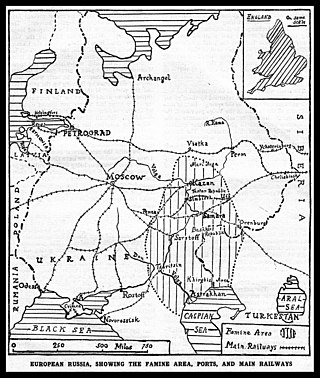
The Russian famine of 1921–1922, also known as the Povolzhye famine was a severe famine in the Russian Soviet Federative Socialist Republic that began early in the spring of 1921 and lasted until 1922. The famine resulted from the combined effects of severe drought, the continued effects of World War I, economic disturbance from the Russian Revolution, the Russian Civil War, and failures in the government policy of war communism. It was exacerbated by rail systems that could not distribute food efficiently.

The Tenpō famine, also known as the Great Tenpō famine, was a famine that affected Japan during the Edo period. Considered to have lasted from 1833 to 1837, it was named after the Tenpō era (1830–1844), during the reign of Emperor Ninkō. The death toll was estimated between 200,000 and 300,000. The ruling shōgun during the famine was Tokugawa Ienari.

American Relief Administration (ARA) was an American relief mission to Europe and later post-revolutionary Russia after World War I. Herbert Hoover, future president of the United States, was the program director.
The Tenpō Reforms were an array of economic policies introduced between 1841 and 1843 by the Tokugawa shogunate in Japan. These reforms were efforts to resolve perceived problems in military, economic, agricultural, financial and religious systems. The changes were intended to address problems in local politics, but they were also addressed more broadly to "domestic uneasiness." The perceived need for change led to the arrest of many prominent political figures and writers. The reforms became a precursor of reforms initiated after the Meiji Restoration two decades later. This reform movement was related to three others during the Edo period: the Kyōhō reforms (1722–1730), the Kansei reforms (1787–1793) and the Keiō Reforms (1864–1867).

Okutono Domain, also known as Okudono, was a feudal domain under the Tokugawa shogunate of Edo period Japan, located in Kamo District and Nukata Districts of Mikawa Province, and in Saku District, Shinano Province, Japan. The domain was also known as Ogyū Domain and later known as Tanoguchi Domain and Tatsuoka Domain. The ruling family was the Ogyū-Matsudaira clan.

Honda Tadamoto was a Japanese daimyō of the late Edo period, who ruled the Okazaki Domain from 1835 during the Tenpō famine. One of his samurai retainers was the father of Shiga Shigetaka.

Holodomor denial is the claim that the Holodomor, a 1932–33 man-made famine that killed millions in Soviet Ukraine, did not occur or diminishing its scale and significance.

The Kazakh famine of 1930–1933, also known as the Asharshylyk, was a famine during which approximately 1.5 million people died in the Kazakh Autonomous Socialist Soviet Republic, then part of the Russian Socialist Federative Soviet Republic in the Soviet Union, of whom 1.3 million were ethnic Kazakhs. An estimated 38 to 42 percent of all Kazakhs died, the highest percentage of any ethnic group killed by the Soviet famine of 1930–1933. Other research estimates that as many as 2.3 million died. A committee created by the Kazakhstan parliament chaired by Historian Manash Kozybayev concluded that the famine was "a manifestation of the politics of genocide", with 1.75 million victims.
The Kan'ei Great Famine was a famine which affected Japan during the reign of Empress Meishō in the Edo period. The estimated number of deaths due to starvation is between 50,000 and 100,000. The famine is generally considered to have begun in 1640 and lasted into 1643. It was named after the Kan'ei era (1624–1644). The ruling shōgun during the famine was Tokugawa Iemitsu.
The Kyōhō famine, was a famine on the Japanese island of Kyushu during the reign of Emperor Nakamikado in the Edo period. It is estimated that 12,172-169,000 people died from starvation. The famine, named after the Kyōhō era (1716–1736), is considered to have begun in 1732 and lasted until 1733. The ruling shōgun during the famine was Tokugawa Yoshimune.
The Kanshō famine, was a famine which affected mostly western Japan from 1459 to 1461, during the reign of Emperor Go-Hanazono in the Muromachi period. The ruling shōgun during the famine was Ashikaga Yoshimasa. The number of deaths from starvation was at least 82,000.
