
Eye Guess was an American game show created by Bob Stewart and hosted by Bill Cullen, which aired on NBC from January 3, 1966, to September 26, 1969. The game combined a general knowledge quiz with a Concentration-style memory element, where the answers were shown to the players and their recall of their positions was tested.
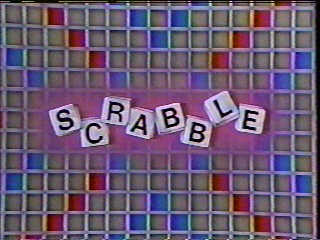
Scrabble is an American television game show based upon the Scrabble board game. Muriel Green of Exposure Unlimited developed the idea for a television game show based upon the board game concept. During 1983, Green convinced Selchow and Righter, who at that time owned the Scrabble board game, to license Exposure Unlimited to produce the game show. Exposure Unlimited co-produced the show with Reg Grundy Productions, and licensed the show to NBC. Scrabble aired on NBC from July 2, 1984, to March 23, 1990, and again from January 18 to June 11, 1993. Chuck Woolery hosted the program. Jay Stewart was the announcer for the first year. Charlie Tuna replaced him in the summer of 1985 and remained through the original run and the entirety of the 1993 revival.

Lingo is an American television game show with multiple international adaptations. Three Lingo series have aired in the United States. The first was aired in daily syndication from September 28, 1987, until March 25, 1988, and taped at the BCTV studios in the Vancouver suburb of Burnaby, British Columbia. A revival/reboot of the series debuted on Game Show Network (GSN) on August 5, 2002, and ended in 2007 after running for a total of six seasons. A slightly reworked version of the 2002 series debuted on GSN on June 6, 2011, and ended its run on August 1 of the same year.

Now You See It is an American television game show created by Frank Wayne for Mark Goodson-Bill Todman Productions. The object of Now You See It is to answer general knowledge trivia questions by finding the answers hidden in a grid, similar to a word search puzzle.

Chain Reaction is an American television game show created by Bob Stewart, in which players compete to form chains composed of two-word phrases.

The Cross-Wits is an American syndicated game show which premiered on December 15, 1975, and lasted for five seasons until its cancellation on September 12, 1980. The show was hosted by Jack Clark, with Jerri Fiala as hostess. Announcing duties were handled by John Harlan, Jay Stewart, and Jerry Bishop. The show was produced by Ralph Edwards Productions and distributed by Metromedia Producers Corporation.

The $1,000,000 Chance of a Lifetime is an American game show which offered a $1 million (annuitized) grand prize to winning contestants. The show aired in syndication from January 6, 1986, until May 22, 1987. The show was hosted by Jim Lange, and he was joined by Karen Thomas as co-host during the second season. Mark Summers was the show's announcer for the first few weeks and Johnny Gilbert announced the remainder of the series. The show was produced by XPTLA, Inc., and distributed by Lorimar-Telepictures.

High Rollers is an American television game show that involved contestants trying to win prizes by rolling dice. The format was based on the dice game shut the box.
BrainTeaser was a British game show based on the original Dutch format of Puzzeltijd, first broadcast in 2002 produced by Endemol UK subsidiary Cheetah Productions.

Caesars Challenge is an American game show that aired on NBC from June 14, 1993 to January 14, 1994 and emanated from the Circus Maximus Theatre inside Caesars Palace in Las Vegas, Nevada. Ahmad Rashād hosted the series and, in keeping with the theme of the show's location, he was assisted by a man dressed as a Roman gladiator. Dan Doherty played the role for most of the show's run, with Chad Brown and Zach Ruby handling the earliest episodes before Doherty joined the show.
Blokken (Blocks) is a Belgian quiz show based on the video game Tetris. It is broadcast by één and hosted by Belgian television personality Ben Crabbé. The show is the longest running quiz show on Belgian television, with 22 seasons. On 10 December 2017 the show aired its 5000th episode.
The Last Word is a game show seen in syndication in the United States and on the Global Television Network in Canada that was produced by Merrill Heatter Productions and ran for 65 episodes from September 18 to December 15, 1989, with reruns continuing until January 5, 1990. The host was Wink Martindale, and the co-host/announcer was Jennifer Lyall. It was taped in Vancouver, British Columbia. In the Los Angeles-produced pilot, Burton Richardson was the announcer, and Jana White operated the computer and acted as co-host. The show was distributed by Turner Program Services.
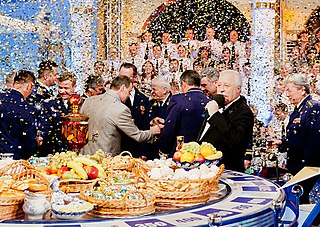
Pole Chudes was a Russian adaptation of the U.S. game show Wheel of Fortune produced by VID, provided with elements of Russian culture and hosted by Leonid Yakubovich. Current rating of the show suggests it is intended for ages 16 and above, unlike the American version which is suitable for all age groups. Channel One Russia currently intends to stop buying Pole Chudes from VID and replace it with a licensed version of Wheel of Fortune under the same name since January 2022. Originally, due to a trademark dispute with VID, the title of the new show was supposed to be Nashe Pole Chudes, however, VID later agreed to let Channel One keep the original Pole Chudes name and the full 31-year archive, while Channel One will be producing the new reboot of the show as a licensed spin-off of Wheel of Fortune.
PDQ and Baffle are American television game shows created by Heatter-Quigley Productions. Both shows' objective was for contestant/celebrity teams to guess a given word or phrase in the shortest amount of time with the fewest letters given as possible.
Boggle is an American game show that was broadcast on The Family Channel from March 7 to November 18, 1994. It was based on the board game of the same name. Wink Martindale was the host, and Randy West was the announcer.
Lingo is a British game show that aired on ITV from 12 May to 14 July 1988 based on the American show of the same name. The show combines a word guessing game with the game of chance bingo.
Family Game Night was an American television game show based on Hasbro's family of board games and EA's video game franchise of the same name. The show was hosted by Todd Newton. Burton Richardson announced for the first two seasons, until he was replaced by Stacey J. Aswad for the third season, and then Andrew Kishino beginning in the fourth season. The 60-minute program debuted on October 10, 2010, on The Hub, formerly Discovery Kids. The network would become Discovery Family on October 13, 2014; it was previewed on October 9, 2010, on its sister channel, TLC. Seasons 1 and 2 each contained 26(1) and 30(2) episodes. Seasons 3, 4 and 5 each contained 15 episodes. Season two premiered on Friday, September 2, 2011, and additional games were added. The games added to the second season included Cranium Brain Breaks, Green Scream, Ratuki Go-Round, Simon Flash, Operation Sam Dunk, Trouble Pop Quiz, and Spelling Bee. However, games from the previous season were still kept.
Spellbound is a British game show that aired on Sky One from 3 October 1994 to 30 August 1996. It was hosted by Paul Coia.
Blockbusters was an Australian children's game show, broadcast on the Seven Network, where players from two schools competed over the course of a week, in a rolling format, where games could be started in the middle of an episode, and stopped and continued on the next episode. The school team earning the most points won a major prize for their school, such as an encyclopedia. The show was hosted by Michael Pope. It ran in Australia from 1991 to 1994.

People Puzzler is an American television game show hosted by Leah Remini and broadcast by Game Show Network. It premiered on January 18, 2021.

