It is proposed that this article be deleted because of the following concern:
If you can address this concern by improving, copyediting, sourcing, renaming, or merging the page, please edit this page and do so. You may remove this message if you improve the article or otherwise object to deletion for any reason. Although not required, you are encouraged to explain why you object to the deletion, either in your edit summary or on the talk page. If this template is removed, do not replace it . The article may be deleted if this message remains in place for seven days, i.e., after 13:30, 8 August 2024 (UTC). Find sources: "Gres de Carriers" – news · newspapers · books · scholar · JSTOR Nominator: Please consider notifying the author/project: {{ subst:proposed deletion notify |Gres de Carriers|concern=I have searched for research or even a tourism page discussing the "Gres de Carriers" and have not even found any evidence of their existence. This article provide very little information on the subject. The only reference is a deleted wiki that is now in the "way back machine" and even there I find no information to support this article's existence.}} ~~~~ |
| Gres de Carriers | |
|---|---|
| Stratigraphic range: Devonian | |
| Type | Formation |
| Location | |
| Country | France |
The Gres de Carriers is a geologic formation in France. It preserves fossils dating back to the Devonian period.

Fossilworks is a portal which provides query, download, and analysis tools to facilitate access to the Paleobiology Database, a large relational database assembled by hundreds of paleontologists from around the world.
Decazella is an extinct genus of prehistoric bony fish that lived during the Gzhelian (Stephanian) age in what is now Occitania, France.

The Les Sables de Glos Formation is a sandy Jurassic-age geologic formation in France. Dinosaur remains are among the fossils that have been recovered from the formation, although none have yet been referred to a specific genus.

Albertogaudrya is an extinct genus of astrapotherian mammal that lived in present-day Patagonia and Salta, Argentina during the Eocene 48.6 to 37.2 million years ago. Fossils of Albertogaudrya have been found in the Lumbrera and Sarmiento Formations. It is named after French palaeontologist Albert Gaudry.

The Waynesville Formation is a geologic formation in Ohio and Indiana. It preserves fossils from the Late Ordovician period.

The Liberty Formation is a geologic formation in Ohio and Indiana. It preserves fossils dating back to the Ordovician period.

The Ohio Shale is a geologic formation in Ohio. It preserves fossils dating back to the Devonian period.
The Dundee Limestone is a geologic formation in Michigan, Ohio and Ontario. It preserves fossils dating back to the Devonian period.

The Cincinnati Group is a geologic group in Kentucky, Ohio and Indiana. It is Upper Ordovician.
The Osgood Formation, also known as the Osgood Shale is a geologic formation in Indiana, Kentucky, and Ohio. It preserves fossils dating back to the Silurian period.
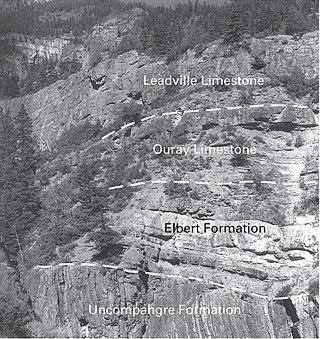
The Ouray Formation is a geologic formation in Colorado. It preserves fossils dating back to the Devonian period.
The Harding Sandstone is a geologic formation in Colorado. It preserves fossils dating back to the Ordovician period.
The Animas Formation is a geologic formation in Colorado. It preserves fossils dating back to the Paleogene period.
The Amherstburg Formation is a geologic formation in Ontario, Canada and Michigan, United States. It preserves fossils dating back to the Devonian period.
The Manitoulin Dolomite is a geologic formation in Ontario. It preserves fossils dating back to the Silurian period.
The Urgonian Limestone is a geologic formation in France. It preserves fossils dating back to the Cretaceous period. Some parts of the limestone have undergone metamorphism to produce ductile folds next to faults.
The Argiles de Châtillon is a geologic formation in France. It preserves fossils dating back to the Jurassic period. Dinosaur remains are among the fossils that have been recovered from the formation, although none have yet been referred to a specific genus.
The Menat Formation is a geologic formation in France. It preserves fossils dating back to the Paleocene. It is a maar deposit located on top of an ancient volcano, the extent is very localised with the outcropping area being around 600 by 1000 metres. Numerous species of fossil insects, plants and fish are known, as well as some isolated mammals, including the primate Plesiadapis insignis, the choristodere reptile Lazarussuchus, and birds, including members of Halcyornithidae and Messelasturidae and relatives of Songziidae.

The Niveau du gypse d'Aix Formation is a geologic formation in France. It preserves fossils dating back to the Paleogene period.
The Bois Blanc Formation is a geologic formation in Michigan. It preserves fossils dating back to the Devonian period.
 | This article about a specific stratigraphic formation in France is a stub. You can help Wikipedia by expanding it. |
 | This article related to the Devonian period is a stub. You can help Wikipedia by expanding it. |


