Related Research Articles

Year 1299 (MCCXCIX) was a common year starting on Thursday of the Julian calendar.

The year 1300 (MCCC) was a leap year starting on Friday of the Julian calendar, the 1300th year of the Common Era (CE) and Anno Domini (AD) designations, the 300th year of the 2nd millennium, the 100th and last year of the 13th century, and the 1st year of the 1300s decade. The year 1300 was not a leap year in the Proleptic Gregorian calendar.
An appanage, or apanage, is the grant of an estate, title, office or other thing of value to a younger child of a monarch, who would otherwise have no inheritance under the system of primogeniture. It was common in much of Europe.

Hethum II, also known by several other romanizations, was king of the Armenian Kingdom of Cilicia, ruling from 1289 to 1293, 1295 to 1296 and 1299 to 1303, while Armenia was a subject state of the Mongol Empire. He abdicated twice in order to take vows in the Franciscan order, while still remaining the power behind the throne as "Grand Baron of Armenia" and later as Regent for his nephew. He was the son of Leo II of Armenia and Kyranna de Lampron, and was part of the Hethumid dynasty, being the grandson of Hethum I, who had originally submitted Cilicia to the Mongols in 1247. He was assassinated with his nephew and successor Leo III by the Mongol general Bilarghu, who himself was later executed for this by the Mongol Ilkhan ruler Öljaitü.

The Ilkhanate or Il-khanate, also known as the Ilkhanids, and known to the Mongols as Hülegü Ulus, was a Mongol khanate established from the southwestern sector of the Mongol Empire. The Ilkhanid realm was officially known as land of Iran or simply Iran. It was established after Hulagu Khan, the son of Tolui and grandson of Genghis Khan, inherited the Southwest Asian part of the Mongol Empire after his brother Möngke Khan died in 1259.
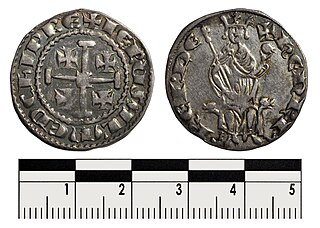
Henry II was the last crowned King of Jerusalem and also ruled as King of Cyprus. He was of the Lusignan dynasty.

Johann Hermann Schein was a German composer of the early Baroque era. He was Thomaskantor in Leipzig from 1615 to 1630. He was one of the first to import the early Italian stylistic innovations into German music, and was one of the most polished composers of the period.

Mahmud Ghazan was the seventh ruler of the Mongol Empire's Ilkhanate division in modern-day Iran from 1295 to 1304. He was the son of Arghun, grandson of Abaqa Khan and great-grandson of Hulagu Khan, continuing a long line of rulers who were direct descendants of Genghis Khan. Considered the most prominent of the Ilkhans, he is perhaps best known for converting to Islam and meeting Imam Ibn Taymiyya in 1295 when he took the throne, marking a turning point for the dominant religion of the Mongols in Western Asia. One of his many principal wives was Kököchin, a Mongol princess sent by his great-uncle Kublai Khan.
Mulay, Mûlay, Bulay was a general under the Mongol Ilkhanate ruler Ghazan at the end of the 13th century. Mulay was part of the 1299–1300 Mongol offensive in Syria and Palestine, and remained with a small force to occupy the land after the departure of Ghazan. He also participated in the last Mongol offensive in the Levant in 1303. His name has caused confusion for some historians, because of its similarity with that of the contemporary Grand Master of the Knights Templar, Jacques de Molay.

Starting in the 1240s, the Mongols made repeated invasions of Syria or attempts thereof. Most failed, but they did have some success in 1260 and 1300, capturing Aleppo and Damascus and destroying the Ayyubid dynasty. The Mongols were forced to retreat within months each time by other forces in the area, primarily the Egyptian Mamluks. Since 1260, it had been described as the Mamluk–Ilkhanid War.
Isol the Pisan, also known as Ciolo Bofeti di Anastasio or Zolus Bofeti de Anestasio, was an Italian merchant, diplomat, and military leader. For some time he resided at the court of the Mongol Ilkhan, Ghazan, in Persia, rising to become his ambassador or liaison to the Kingdom of Cyprus. His high status at Ghazan's court may stem from his being the godfather of Öljeitü at the latter's baptism.
Mongol raids into Palestine took place towards the end of the Crusades, following the temporarily successful Mongol invasions of Syria, primarily in 1260 and 1300. Following each of these invasions, there existed a period of a few months during which the Mongols were able to launch raids southward into Palestine, reaching as far as Gaza.
Nerses Balients, also Nerses Balienc or Nerses Bagh'on, was a Christian Armenian monk of the early 14th century. He is mainly known for writing a history of the Kingdom of Cilician Armenia. Though his works are regarded by modern scholars as a valuable source from the time period, they are also regarded as frequently unreliable.
Guiscard Bustari was a Florentine Italian adventurer and ambassador, who was employed by the Mongol Il Khan ruler Ghazan.

The fall of Ruad in 1302 was one of the culminating events of the Crusades in the Eastern Mediterranean. When the garrison on the tiny Isle of Ruad fell, it marked the loss of the last Crusader outpost on the coast of the Levant. In 1291, the Crusaders had lost their main power base at the coastal city of Acre, and the Muslim Mamluks had been systematically destroying any remaining Crusader ports and fortresses since then, forcing the Crusaders to relocate their dwindling Kingdom of Jerusalem to the island of Cyprus. In 1299–1300, the Cypriots sought to retake the Syrian port city of Tortosa, by setting up a staging area on Ruad, two miles (3 km) off the coast of Tortosa. The plans were to coordinate an offensive between the forces of the Crusaders, and those of the Ilkhanate. However, though the Crusaders successfully established a bridgehead on the island, the Mongols did not arrive, and the Crusaders were forced to withdraw the bulk of their forces to Cyprus. The Knights Templar set up a permanent garrison on the island in 1300, but the Mamluks besieged and captured Ruad in 1302. With the loss of the island, the Crusaders lost their last foothold in the Holy Land. Attempts at other Crusades continued for centuries, but the Europeans were never again able to occupy any territory in the Holy Land until the 20th century, during the events of World War I.
Darreh-ye Ghazan-e Sofla is a village in Alqurat Rural District, in the Central District of Birjand County, South Khorasan Province, Iran. At the 2006 census, its population was 70, in 33 families.

Mongol Armenia or Ilkhanid Armenia refers to the period in which both Armenia and the Armenian Kingdom of Cilicia became tributary and vassal to the Mongol Empire in the 1230s. Armenia and Cilicia remained under Mongol influence until around 1335.
Ghazan Dul Ali Morad is a village in Ozgoleh Rural District, Ozgoleh District, Salas-e Babajani County, Kermanshah Province, Iran. At the 2006 census, its population was 25, in 6 families.
Ghazan is a village in Sumay-ye Shomali Rural District, Sumay-ye Beradust District, Urmia County, West Azerbaijan Province, Iran. At the 2006 census, its population was 480, in 75 families.

Shanb-e-Ghazan, Ghazaniyya, or Sham-e-Ghazan is one of the historical neighborhoods of Tabriz, Iran. Shanb-e-Ghazan's historical importance is mostly due to construction of a palace which later turned to the thumb / mausoleum of Ghazan Khan, the Ilkhanid emperor in late 13 and early 14th century.
References
- Sylvia Schein, Gesta Dei per Mongolos 1300, The English Historical Review, 1979
  | This French diplomat-related article is a stub. You can help Wikipedia by expanding it. |