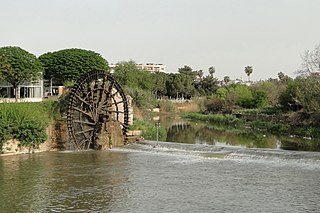
The Orontes or Asi is a 571-kilometer-long (355 mi) river in Western Asia that begins in Lebanon, flowing northwards through Syria before entering the Mediterranean Sea near Samandağ in Turkey.

Beqaa is a governorate in Lebanon.
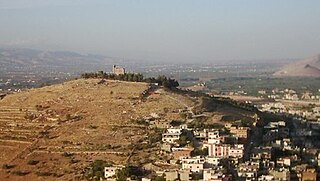
The Beqaa Valley, also transliterated as Bekaa, Biqâ and Becaa and known in Classical antiquity as Coele-Syria, is a fertile valley in eastern Lebanon. It is Lebanon's most important farming region. Industry also flourishes in Beqaa, especially that related to agriculture.

Al-Rafid is a village in the Rashaya District, in the southeastern area of the Beqaa Governorate in Lebanon. Its population is estimated to be 3,000. Its inhabitants are predominantly Sunni Muslims. The village has two mosques, two schools, two pharmacies, and a telecommunications facility.
Purity is an essential aspect of Islam. It is the opposite of najāsa, the state of being ritually impure. It is achieved by first removing physical impurities from the body, and then removing ritual impurity by means of wudu (usually) or ghusl.
El Ain, or a variant thereof, may refer to:

Aleppo Governorate is one of the fourteen governorates of Syria. It is the most populous governorate in Syria with a population of more than 4,867,000, almost 23% of the total population of Syria. The governorate is the fifth in area with an area of 18,482 km2 (7,136 sq mi), or 18,498 sq. km, about 10% of the total area of Syria. The capital is the city of Aleppo.

Latakia Governorate, also transliterated as Ladhakia Governorate, is one of the 14 governorates of Syria. It is situated in western Syria, bordering Turkey's Hatay Province to the north, Idlib and Hama Governorates to the east, Tartus Governorate to the south, and the Mediterranean Sea to the west. Its reported area varies in different sources from 2,297 km² to 2,437 km². The governorate has a population of 1,008,000.
The surname Howayek, Hoyek,Hawayek, Hayek and its variants is an Arabic surname, common among the Maronite Catholics of Lebanon. The majority of the members live in three Lebanese towns Bdadoun, Hsarat and Helta; the remainder is scattered among other smaller towns and in the diaspora.

North Levantine Arabic is a subdivision of Levantine Arabic, a variety of Arabic. It stems from the north in Turkey, specifically in the coastal regions of the Adana, Hatay, and Mersin provinces, to Lebanon, passing through the Mediterranean coastal regions of Syria as well as the areas surrounding Aleppo and Damascus. It is also known as Syro-Lebanese Arabic, though that term is sometimes used to mean all of Levantine Arabic.

Lebanon is an eastern Mediterranean country that is composed of mostly Muslims and Christians. The main two religions are Islam with (61.1% of the citizens and Christianity with 33.7% of the citizens. The Druze are about 5.2% of the citizens. The country has the most religiously diverse society of all states within the Middle East, comprising 18 recognized religious sects. But outside of Lebanon, Lebanese people are mostly Christians. It is also estimated that a large proportion of its population are refugees which affects statistics. The refugees mostly Syrian or Palestinian are predominately Sunni but also includes Christians and Shia.

Kasarnaba is a town in Baalbek District, Baalbek-Hermel Governorate, Lebanon famous for its hilly terrain and Traditional Agricultural practices.

Hadath el Jebbeh, is a town located in Bsharri District in the North Governorate of Lebanon. It was originally settled in 400 A.D., and is situated on a hill at an altitude of 1500 meters, overlooking the Kadisha valley.
Qaa is a town in Baalbek-Hermel Governorate, Lebanon.
Sohmor is a small town in the Beka'a Valley of Lebanon, situated in the Western Beqaa District and south of the Beqaa Governorate. It lies south of Lake Qaraoun on the Litani River.It lies southwest of Machgara, northeast of Ain Et Tine, north of Yohmor, west of Mazret Al Chmis and northwest of Libbaya.
Machghara, also spelled Mashghara, is a small town in the Beqaa Valley of Lebanon, situated in the Western Beqaa District and south of the Beqaa Governorate. It lies just to the northwest of Sohmor and southwest of Lake Qaraoun, south of Aitanit and north of Ain Et Tine. The Iskander Spring lies to the northeast of the village.
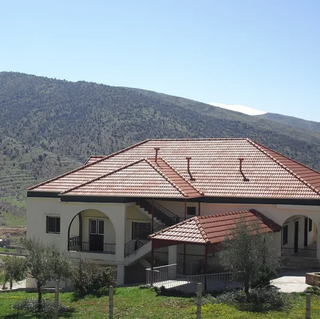
Mdoukha is a village and municipality situated 72 kilometres (45 mi) east of Beirut in the Rashaya District, Beqaa Governorate, Lebanon. The village's population is Sunni. A significant majority of the population are also Lebanese Canadians, of which 60% live in London, Ontario.
Bodai is a Lebanese town in Baalbek District, Baalbek-Hermel Governorate, situated west of the Litani River in the foothills of Mount Lebanon. Bodai is located 15 km northwest of the ancient city of Baalbek and 26 km from the Lebanese–Syrian border and is 90 kilometers (55.926 mi) away from the capital of Beirut. Bodai, which sits in the foothills of the Mount Lebanon range, has views across the Beqaa Valley toward the city of Baalbek, and the Anti-Lebanon range that divides Lebanon from Syria.

Baalbek-Hermel is a governorate of Lebanon. It comprises the districts of Baalbek and Hermel, which in turn are subdivided into a total of 74 municipalities. The capital is at Baalbek. The governorate covers an area of 3,009 km2 (1,162 sq mi) and is bounded by Akkar Governorate to the northwest, North Governorate to the west, Keserwan-Jbeil Governorate and Mount Lebanon Governorate to the southwest, Beqaa Governorate to the south, and the Syrian governorates of Homs and Rif Dimashq to the northeast and southeast. The governorate occupies the northern portion of the Beqaa Valley, Lebanon's most important agricultural area.
Tannus ibn Yusuf al-Shidyaq, also transliterated Tannous el-Chidiac, was a Maronite clerk and emissary of the Shihab emirs, the feudal chiefs and tax farmers of Ottoman Mount Lebanon, and a chronicler best known for his work on the noble families of Mount Lebanon, Akhbar al-a'yan fi Jabal Lubnan. He was born in the Keserwan area of Mount Lebanon to a long line of clerks serving the Shihab emirs and other local chieftains. Tannus was taught Arabic and Syriac grammar and throughout his career serving the Shihab emirs and as a merchant, he pursued education in the fields of medicine, jurisprudence, logic, ethics, natural sciences, Turkish and Italian.
