
Saddam Hussein Abd al-Majid al-Tikriti was an Iraqi politician and revolutionary who served as the fifth president of Iraq from 1979 to 2003. He also served as prime minister of Iraq from 1979 to 1991 and later from 1994 to 2003. He was a leading member of the revolutionary Arab Socialist Ba'ath Party and later the Baghdad-based Ba'ath Party and its regional organization, the Iraqi Ba'ath Party, which espoused Ba'athism, a mix of Arab nationalism and Arab socialism. He was responsible for numerous human rights abuses including an estimated of 250,000 arbitrary deaths and disappearances. Saddam was convicted for crimes against humanity, specifically for the Dujail Massacre and was sentenced to death by hanging.

Haifa is the third-largest city in Israel—after Jerusalem and Tel Aviv—with a population of 290,306 in 2022. The city of Haifa forms part of the Haifa metropolitan area, the third-most populous metropolitan area in Israel. It is home to the Baháʼí Faith's Baháʼí World Centre, and is a UNESCO World Heritage Site and a destination for Baháʼí pilgrimage.
Bahrain plays a modest, moderating role in regional politics and adheres to the views of the Arab League on Middle East peace and Palestinian rights. Since achieving independence in 1971, Bahrain has maintained friendly relations with most of its neighbours and with the world community. It generally pursues a policy of close consultation with neighbouring states and works to narrow areas of disagreement.

Noor Al Hussein is an American-born Jordanian philanthropist and activist who is the fourth wife and widow of King Hussein of Jordan. She was Queen of Jordan from their marriage on June 15, 1978, until Hussein's death on February 7, 1999.

The Maxim restaurant bombing was a suicide bombing which occurred on October 4, 2003, in the beachfront "Maxim" restaurant in Haifa, Israel. Twenty-one civilians were killed and 60 were injured. Among the victims were two families and four children, including a two-month-old baby.

Haifa Wehbe is a Lebanese singer and actress. She is considered one of Lebanon's most famous and successful singers, and one of the best-known artists in the Arab world.

USS Toledo (SSN-769), is a United States Navy, Los Angeles-class nuclear-powered attack submarine and the third U.S. Naval vessel to be named for the city of Toledo, Ohio. The contract to build her was awarded to Newport News Shipbuilding and Dry Dock Company in Newport News, Virginia, on 10 June 1988, and her keel was laid down on 6 May 1991. She was launched on 28 August 1993, sponsored by Mrs. Sabra Smith, and commissioned on 24 February 1995.

Hamzah bin Al Hussein, is the fourth son of King Hussein bin Talal of Jordan overall and the first by his American-born fourth wife, Queen Noor. He was named Crown Prince of Jordan in 7 February 1999, a position he held until his older half-brother, King Abdullah II, rescinded it in 28 November 2004. He is a member of the Hashemite dynasty, the royal family of Jordan since 1921, and is a 41st-generation direct descendant of Muhammad.
The Arabian Gulf Cup, often referred to simply as the Gulf Cup, is a biennial football competition governed by the Arab Gulf Cup Football Federation for its eight member nations. The history of the competition has also seen it held every three to four years due to political or organisational problems. The reigning champions are Iraq, having won their fourth title at the 25th edition, as hosts, held in 2023.
The Arab Union is a theoretical political union of the Arab states. The term was first used when the British Empire promised the Arabs a united independent state in return for revolting against the Ottoman Empire, with whom Britain was at war. It never came to fruition following the Sykes–Picot Agreement. Despite this, many in the Arab world have since called for the creation of a pan-Arab state. Egyptian President Gamal Abdel Nasser made several unsuccessful attempts to unite Egypt with other Arab countries, and briefly succeeded in forming the United Arab Republic with Syria in 1958, which dissolved in 1971. Similar attempts were made by other Arab leaders, such as Hafez al-Assad, Ahmed Hassan al-Bakr, Faisal I of Iraq, Muammar Gaddafi, Saddam Hussein, Gaafar Nimeiry and Anwar Sadat.
Anti-Iranian sentiment or Iranophobia, also called anti-Persian sentiment or Persophobia, refers to feelings and expressions of hostility, hatred, discrimination, or prejudice towards Iranian people on the basis of an irrational disdain for their national and cultural affiliation. The opposite phenomenon, in which one holds notable feelings of love or interest towards Iranian people for the same reasons, is known as Iranophilia or Persophilia.
Rafia Obaid Ghubash is a Dubai psychiatrist and epidemiologist who serves as president of the Arab Network for Women in Science and Technology, and is a former president of the Arabian Gulf University. She is known as a role model of women's empowerment.

Iraq–Israel relations refer to the bilateral ties between the State of Israel and the Republic of Iraq. Due to Iraq's non-recognition of Israel as a legitimate state since the latter's establishment in 1948, the two countries have not had any formal diplomatic relations. The Hashemite Kingdom of Iraq was a part of the Arab coalition that declared war on and invaded Israel shortly after its establishment, sparking the First–Arab Israeli War, and the two states have since then been in a continuous state of hostilities. Iraqi forces also participated in the Third Arab–Israeli War and the Fourth Arab–Israeli War in 1967 and 1973, respectively.

Bahrain, officially the Kingdom of Bahrain, is an island country in West Asia. It is situated on the Persian Gulf, and comprises a small archipelago made up of 50 natural islands and an additional 33 artificial islands, centered on Bahrain Island which makes up around 83 percent of the country's landmass. Bahrain is situated between Qatar and the northeastern coast of Saudi Arabia, to which it is connected by the King Fahd Causeway. The population of Bahrain is 1,501,635 as of May 14, 2023, based on elaborations of the United Nations data, of whom 712,362 are Bahraini nationals. Bahrain spans some 760 square kilometres (290 sq mi), and is the third-smallest nation in Asia after the Maldives and Singapore. The capital and largest city is Manama.
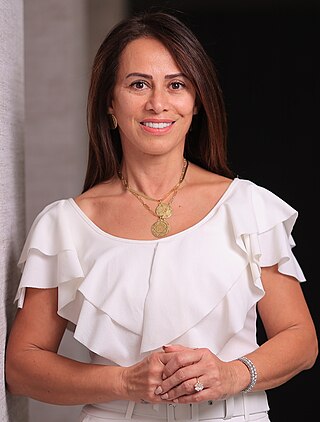
Iman Mutlaq is a Jordanian entrepreneur, businesswoman, financier and social activist. She is the founder and President of multinational financial companies; Sigma Investments and INGOT.

Edidiong Ofinome Odiong is a Nigerian-born sprinter from Bahrain. She won the 200 m at the 2016 IAAF World U20 Championships and qualified in this event for the 2016 Summer Olympics.

Hussein Ali Zein is a Lebanese footballer who plays as a right-back for Lebanese Premier League club Ahed and the Lebanon national team.

The 2002 Arab Cup Final was a football match that took place on 30 December 2002, at the Al Kuwait Sports Club Stadium in Kuwait City, Kuwait, to determine the winner of the 2002 Arab Cup. Saudi Arabia defeated Bahrain 1–0 after extra time to win their second Arab Cup consecutively.
Nuh Ibrahim, he is called "the popular poet of the 1936 revolution" and "student of the Qassam", he was a Palestinian folk poet, a singer, a composer, and a fighter. He was born in Haifa in British Mandate Palestine. He started writing poetry at an early age.


