
In human genetics, the Mitochondrial Eve is the matrilineal most recent common ancestor (MRCA) of all living humans, i.e., the most recent woman from whom all living humans descend in an unbroken line purely through their mothers and through the mothers of those mothers, back until all lines converge on one woman.
In human genetics, the Y-chromosomal most recent common ancestor is the most recent common ancestor (MRCA) from whom all currently living men are descended patrilineally. The term Y-MRCA reflects the fact that the Y chromosomes of all currently living human males are directly derived from the Y chromosome of this remote ancestor. The analogous concept of the matrilineal most recent common ancestor is known as "Mitochondrial Eve", the most recent woman from whom all living humans are descended matrilineally. As with "Mitochondrial Eve", the title of "Y-chromosomal Adam" is not permanently fixed to a single individual, but can advance over the course of human history as paternal lineages become extinct.
A haplotype is a group of alleles in an organism that are inherited together from a single parent, and a haplogroup is a group of similar haplotypes that share a common ancestor with a single-nucleotide polymorphism mutation. More specifically, a haplogroup is a combination of alleles at different chromosomes regions that are closely linked and that tend to be inherited together. As a haplogroup consists of similar haplotypes, it is usually possible to predict a haplogroup from haplotypes. Haplogroups pertain to a single line of descent. As such, membership of a haplogroup, by any individual, relies on a relatively small proportion of the genetic material possessed by that individual.
Genetics and archaeogenetics of South Asia is the study of the genetics and archaeogenetics of the ethnic groups of South Asia. It aims at uncovering these groups' genetic history. The geographic position of South Asia makes its biodiversity important for the study of the early dispersal of anatomically modern humans across Asia.
Haplogroup J is a human mitochondrial DNA (mtDNA) haplogroup. The clade derives from the haplogroup JT, which also gave rise to haplogroup T. In his book The Seven Daughters of Eve, Bryan Sykes named the originator of this mtDNA haplogroup Jasmine. Within the field of medical genetics, certain polymorphisms specific to haplogroup J have been associated with Leber's hereditary optic neuropathy.
Haplogroup T is a human mitochondrial DNA (mtDNA) haplogroup. It is believed to have originated around 25,100 years ago in the Near East.
Haplogroup V is a human mitochondrial DNA (mtDNA) haplogroup. The clade is believed to have originated over 14,000 years ago in the Near East.

Haplogroup N is a human mitochondrial DNA (mtDNA) clade. A macrohaplogroup, its descendant lineages are distributed across many continents. Like its sibling macrohaplogroup M, macrohaplogroup N is a descendant of the haplogroup L3.

In human genetics, a human mitochondrial DNA haplogroup is a haplogroup defined by differences in human mitochondrial DNA. Haplogroups are used to represent the major branch points on the mitochondrial phylogenetic tree. Understanding the evolutionary path of the female lineage has helped population geneticists trace the matrilineal inheritance of modern humans back to human origins in Africa and the subsequent spread around the globe.

In human genetics, a human Y-chromosome DNA haplogroup is a haplogroup defined by mutations in the non-recombining portions of DNA from the Y chromosome. Mutations that are shared by many people are called single-nucleotide polymorphisms (SNPs).
Haplogroup K may refer to:
Haplogroup I may refer to:
Haplogroup J may refer to:
Haplogroup L may refer to:
In genetics, a subclade is a subgroup of a haplogroup.

In human mitochondrial genetics, haplogroup Q is a human mitochondrial DNA (mtDNA) haplogroup typical for Oceania. It is a subgroup of haplogroup M29'Q.
Since the early years of genetic research, the Sami people have caught the interests of scientists. The Sami languages belong to the Uralic languages family of Eurasia. Some earlier anthropologists have suggested they might be of Asian and/or Siberian origin. The frequency of blood group and protein polymorphisms in Sami differs significantly from the general Northern European population.
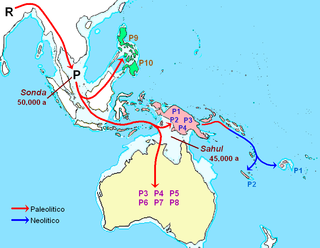
In human mitochondrial genetics, Haplogroup P is a human mitochondrial DNA (mtDNA) haplogroup.
The genetic history of the British Isles is the subject of research within the larger field of human population genetics. It has developed in parallel with DNA testing technologies capable of identifying genetic similarities and differences between populations. The conclusions of population genetics regarding the British Isles in turn draw upon and contribute to the larger field of understanding the history of humanity in the British Isles generally, complementing work in linguistics, archeology, history and genealogy.
This page is based on this
Wikipedia article Text is available under the
CC BY-SA 4.0 license; additional terms may apply.
Images, videos and audio are available under their respective licenses.
