Hardbody is named after bodybuilding, featuring a two time winner of Ms. OlympiaRachel McLish in four poses on the backglass showing her physique. It is the first pinball machine to use bodybuilding as a theme.[1] Head of pinball design at Bally, Jim Patla, re-hired Ward Pemberton to design the game; the theme was chosen because the parent company owned Bally Total Fitness.[2]
Using photos on the backglass followed Gottlieb's use of them beginning with Raven in 1985;[3][4] this is the only Bally machine to use photo art and drawn art.[5] The artist disagreed with using this approach for the backglass, but others at Bally thought it was required to remain competitive.[6]
Four alphanumeric displays are at the bottom of the backbox.[7]
The game uses a "flex save" to allow the ball to use the return lanes to reach the lower flippers.[8]
Layout
The layout is almost identical to that of a 1983 Ward Pemberton designed Bally pinball machine called BMX, using a split-level playfield, with each level having two flippers.[9]
Upper level
The upper level incudes groups of three targets labelled stations 1 and 2, with three in-line drop-targets located above station 2. There is also a loop around station 1. The gap between the upper flippers leads to the lower level.[10]
Lower level
The lower level includes banks of targets labelled stations 3 and 4. On either side of the machine is a ramp leading to the upper level. The game does not have traditional in- and out-lanes, but has a single lane on each side with a gap in each.[10]
Gameplay
The game can be set for 3 or 5 ball play[7] The game is controlled by a flipper button on either side of the machine, with a flex save button located just below each of these.[8]
The main objective is to complete the four work-out stations by hitting all the targets at each station. Lights are shown just above the lower flippers for completing sets of stations three times.[10] The four stations are arms & shoulders, chest & back, legs, and abdomen.[11]
At the start of a game the flex save feature is triggered automatically with an auto saver, but after that is triggered manually by the player.[7] When triggered a block (also known as a control gate) is raised to prevent the ball from draining out of the return lane.[8] The amount of time a control gate remains raised is dependent on the number of times they are used.[7]
Reception
In a review for Play MeterRoger Sharpe awarded the game 2.25/4. The artwork on the playfield was praised, but the flex save feature was criticized, and the machine called a "filler".[10]
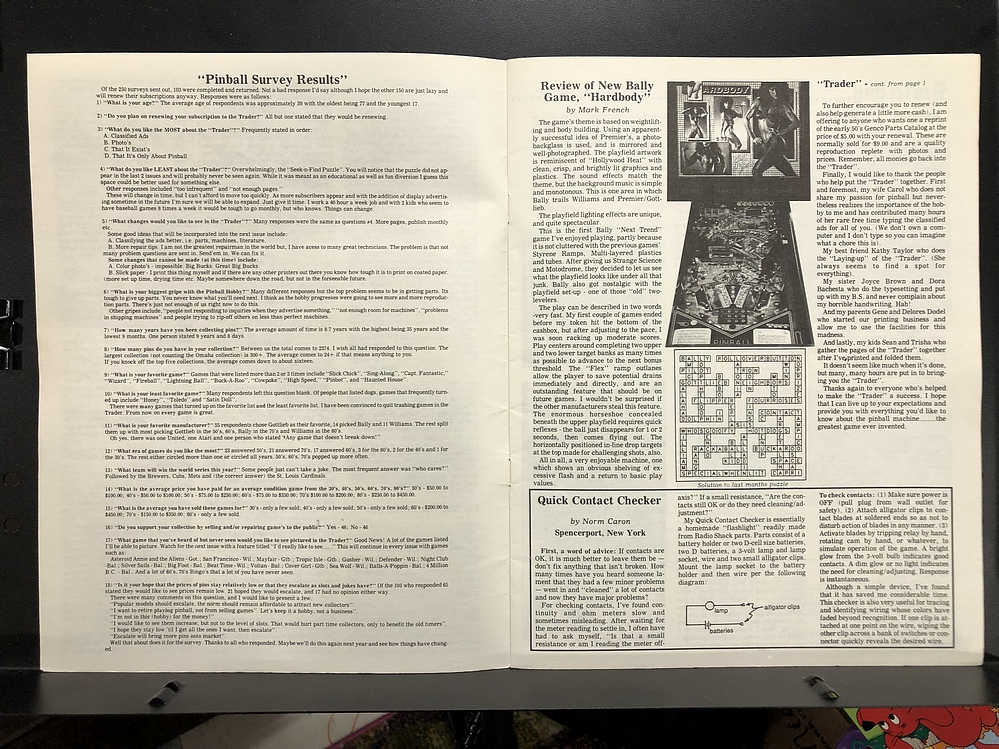
A reviewer for The Pinball Trader enjoyed the lighting and sound effects, but found the music to be "simple and monotonous". Overall it was found to be a very enjoyable and fast machine.[12]
Greg Freres declared it to be his "unfavourite game".[13]
123Shalhoub, Michael (2012). The pinball compendium, 1982 to present (Rev. and expanded 2nded.). Atglen, Pa: Schiffer Pub. p.79. ISBN978-0-7643-4107-6.
This page is based on this Wikipedia article Text is available under the CC BY-SA 4.0 license; additional terms may apply. Images, videos and audio are available under their respective licenses.