
A cactus is a member of the plant family Cactaceae, a family comprising about 127 genera with some 1750 known species of the order Caryophyllales. The word "cactus" derives, through Latin, from the Ancient Greek κάκτος, kaktos, a name originally used by Theophrastus for a spiny plant whose identity is not certain. Cacti occur in a wide range of shapes and sizes. Most cacti live in habitats subject to at least some drought. Many live in extremely dry environments, even being found in the Atacama Desert, one of the driest places on earth. Cacti show many adaptations to conserve water. Almost all cacti are succulents, meaning they have thickened, fleshy parts adapted to store water. Unlike many other succulents, the stem is the only part of most cacti where this vital process takes place. Most species of cacti have lost true leaves, retaining only spines, which are highly modified leaves. As well as defending against herbivores, spines help prevent water loss by reducing air flow close to the cactus and providing some shade. In the absence of leaves, enlarged stems carry out photosynthesis. Cacti are native to the Americas, ranging from Patagonia in the south to parts of western Canada in the north—except for Rhipsalis baccifera, which also grows in Africa and Sri Lanka.

Euphorbia is a very large and diverse genus of flowering plants, commonly called spurge, in the spurge family (Euphorbiaceae). "Euphorbia" is sometimes used in ordinary English to collectively refer to all members of Euphorbiaceae, not just to members of the genus. Some euphorbias are commercially widely available, such as poinsettias at Christmas. Some are commonly cultivated as ornamentals, or collected and highly valued for the aesthetic appearance of their unique floral structures, such as the crown of thorns plant. Euphorbias from the deserts of Southern Africa and Madagascar have evolved physical characteristics and forms similar to cacti of North and South America, so they are often incorrectly referred to as cacti. Some are used as ornamentals in landscaping, because of beautiful or striking overall forms, and drought and heat tolerance.

Night-blooming cereus is the common name referring to a large number of flowering ceroid cacti that bloom at night. The flowers are short lived, and some of these species, such as Selenicereus grandiflorus, bloom only once a year, for a single night. Other names for one or more cacti with this habit are princess of the night, Honolulu queen, Christ in the manger, dama de noche and queen of the night.

Schlumbergera is a small genus of cacti with 6-9 species found in the coastal mountains of south-eastern Brazil. Plants grow on trees or rocks in habitats that are generally shady with high humidity, and can be quite different in appearance from their desert-dwelling cousins. Most species of Schlumbergera have stems which resemble leaf-like pads joined one to the other and flowers which appear from areoles at the joints and tips of the stems. Two species have cylindrical stems more similar to other cacti. Recent phylogenetic studies using DNA have led to three species of the related genus Hatiora being transferred into Schlumbergera, though this change has yet to receive widespread acceptance.

Matucana is a genus of cacti, containing approximately 20 species of mostly globular plants. The genus is only known from Peru, mostly along the Marañón River.

Didiereaceae is a family of flowering plants found in continental Africa and Madagascar.
It contains 20 species classified in three subfamilies and six genera. Species of the family are succulent plants, growing in sub-arid to arid habitats. Several are known as ornamental plants in specialist succulent collections. The subfamily Didiereoideae is endemic to the southwest of Madagascar, where the species are characteristic elements of the spiny thickets.

Epiphyllum is a genus of 19 species of epiphytic plants in the cactus family (Cactaceae), native to Central America. Common names for these species include climbing cacti, orchid cacti and leaf cacti, though the latter also refers to the genus Pereskia.
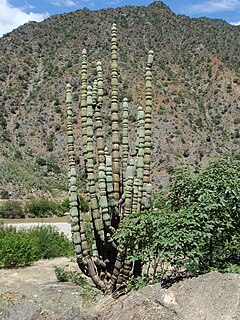
Armatocereus is a genus of mostly tree-like cacti from South America. These species have a conspicuous constriction at the end of the annual growth. The flowers are mostly white, with a more or less spiny ovary. The fruits are mostly spiny.

Ariocarpus is a small genus of succulent, subtropical plants of the family Cactaceae.

Obregonia, the artichoke cactus, is a genus of cacti with a single species, Obregonia denegrii. The species is endemic to the state of Tamaulipas in Mexico.

The term ceroid cactus is used to describe any of the species of cacti with very elongated bodies, including columnar growth cacti and epiphytic cacti.
The name is from the Latin cēreus, wax taper, referring to the stiff, upright form of the columnar species. Some species of ceroid cacti were known as torch cactus or torch-thistle, supposedly due to their use as torches by Native Americans in the past.

Blossfeldia is a genus of cactus containing only one species, Blossfeldia liliputiana, native to South America in northwestern Argentina and southern Bolivia. It grows at 1,200–3,500 m altitude in the Andes, typically growing in rock crevices, and often close to waterfalls.

Parodia is a genus of flowering plants in the cactus family Cactaceae, native to the uplands of Argentina, Peru, Bolivia, Brazil, Colombia and Uruguay. This genus has about 50 species, many of which have been transferred from Eriocactus, Notocactus and Wigginsia. They range from small globose plants to 1 m (3 ft) tall columnar cacti. All are deeply ribbed and spiny, with single flowers at or near the crown. Some species produce offsets at the base. They are popular in cultivation, but must be grown indoors where temperatures fall below 10 °C (50 °F).

Peniocereus is a genus of vining cacti, comprising about 18 species, found from the southwestern United States and Mexico. They have a large underground tuber, thin and inconspicuous stems.
Its name comes from the prefix penio- and Cereus, the large genus from which it was split.

Cylindropuntia is a genus of cacti, containing species commonly known as chollas, native to northern Mexico and the Southwestern United States. They are known for their barbed spines that tenaciously attach to skin, fur, and clothing.

A pitaya or pitahaya is the fruit of several different cactus species indigenous to the Americas. Pitaya usually refers to fruit of the genus Stenocereus, while pitahaya or dragon fruit refers to fruit of the genus Hylocereus, both in the Cactaceae family. The dragon fruit is cultivated in Southeast Asia, Florida, the Caribbean, Australia, and throughout tropical and subtropical world regions.

Aztekium ritteri is a species of cactus, in the genus Aztekium. It is one of the three species that make up the genus. The species originated in Mexico. Aztekium is a genus endemic to Mexico.
Prickly pear may refer to:
Many cacti are known to be psychoactive, containing phenethylamine alkaloids such as mescaline However, the two main ritualistic (folkloric) genera are Echinopsis, of which the most psychoactive species is the San Pedro cactus, and Lophophora, with peyote being the most psychoactive species. Several other species pertaining to other genera are also psychoactive, though not always used with a ritualistic intent.
Cereus, waxy in Latin, may refer to:


