
Emperor Shōmu was the 45th emperor of Japan, according to the traditional order of succession. Shōmu's reign spanned the years 724 through 749, during the Nara period.
In Japanese, Sanjō may refer to:
Shijō literally means star in Japanese. It may refer to:

The Nara period of the history of Japan covers the years from 710 to 794. Empress Genmei established the capital of Heijō-kyō. Except for a five-year period (740–745), when the capital was briefly moved again, it remained the capital of Japanese civilization until Emperor Kanmu established a new capital, Nagaoka-kyō, in 784, before moving to Heian-kyō, modern Kyoto, a decade later in 794.
The capital of Japan is Tokyo. Throughout history, the national capital has been in locations other than Tokyo. The oldest capital of Japan is Nara.
Bodhisena or Bodaisenna (704–760) was an Indian Buddhist scholar and monk known for traveling to Japan and China and establishing the Kegon school, the Japanese transmission of the Huayan school of Chinese Buddhism.

Yakushi-ji (薬師寺) is one of the most famous imperial and ancient Buddhist temples in Japan, and was once one of the Seven Great Temples of Nanto, located in Nara. The temple is the headquarters of the Hossō school of Japanese Buddhism. Yakushi-ji is one of the sites that are collectively inscribed as a UNESCO World Heritage Site under the name of "Historic Monuments of Ancient Nara."

Heijō Palace was the imperial residence in the Japanese capital city Heijō-kyō, during most of the Nara period. The palace, which served as the imperial residence and the administrative centre of for most of the Nara period from 710 to 794 AD, was located at the north-central location of the city in accordance with the Chinese models used for the design of the capital.

Fujiwara-kyō (藤原京) was the Imperial capital of Japan for sixteen years, between 694 and 710. It was located in Yamato Province, having been moved from nearby Asuka. However, the name itself was never used in the Nihon Shoki; during those times it was recorded as Aramashi-kyō (新益京).
Nara is the capital city of Nara Prefecture, Japan. As of 2022, Nara has an estimated population of 367,353 according to World Population Review, making it the largest city in Nara Prefecture and sixth-largest in the Kansai region of Honshu. Nara is a core city located in the northern part of Nara Prefecture bordering the Kyoto Prefecture.

Nagaoka-kyō (長岡京) was the capital of Japan from 784 to 794. Its location was in Otokuni District, Yamashiro Province, corresponding to a 4.3 x 5.3 kilometer area spanning the borders of modern cities of Mukō and Nagaokakyō, Kyoto, the town of Ōyamazaki, and the Nishikyō-ku ward of the city of Kyoto. The ruins of the palace have been found in the Kaidecho neighbourhood of the city of Mukō and have been designated as a National Historic Site since 1964, with the area under protection expanded in 2016.
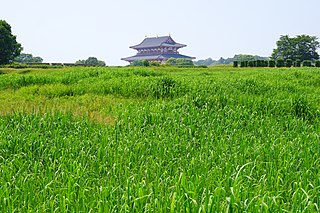
Heijō-kyō was the Capital of Japan during most of the Nara period, from 710 to 740 and again from 745 to 784. The imperial palace is a listed UNESCO World Heritage together with other places in the city of Nara.

Kuni-kyō, was the capital city of Japan between 740 and 744, whose imperial palace was built in the present-day city of Kizugawa in Kyoto Prefecture by the order of Emperor Shōmu.

Heian-kyō(平安京, lit. "peaceful/tranquil capital") was one of several former names for the city now known as Kyoto. It was the official capital of Japan for over one thousand years, from 794 to 1868 with an interruption in 1180.

The Heian Palace was the original imperial palace of Heian-kyō, then the capital of Japan. Both the palace and the city were constructed in the late 700s and were patterned on Chinese models and designs. The palace served as the imperial residence and the administrative centre for most of the Heian period (794–1185).

Wadō (和銅) was a Japanese era name after Keiun and before Reiki. This period spanned the years from January 708 through September 715. The reigning monarch was Empress Genmei.
The Kusuko Incident, also known as the Retired Emperor Heizei Incident, occurred in the early Heian period. In 810, Emperor Saga and ex-Emperor Heizei stood in opposition, but Saga's side quickly raised enough troops to resolve the confrontation, making Heizei become a monk. Heizei's lover the Naishi-no-kami (内侍) Fujiwara no Kusuko and her older brother the sangi Fujiwara no Nakanari were punished for the incident.
Daidairi refers to the greater palace or outer palace precincts of a Japanese palace. In particular, it usually refers to these regions of:

The Suzuka Barrier was a security checkpoint established during the Nara period on the ancient Tōkaidō highway connecting the capitals of Heijō-kyō and Heian-kyō with the eastern provinces of Japan. Along with Arachi Barrier in what is now Tsuruga, Fukui and Fuwa Barrier in what is now Sekigahara, Gifu, it was one of the three ancient barriers controlling ingress into the Kinai region from the east. In 1921, the ruins of the Suzuka Barrier was recognized as a National Historic Site
This page is based on this
Wikipedia article Text is available under the
CC BY-SA 4.0 license; additional terms may apply.
Images, videos and audio are available under their respective licenses.
