
Pope Eleutherius, also known as Eleutherus, was the bishop of Rome from c. 174 to his death. His pontificate is alternatively dated to 171-185 or 177-193. He is venerated as a saint in the Catholic Church.
Pope Damasus II was the Bishop of Rome and ruler of the Papal States from 17 July 1048 to his death on 9 August that same year. He was the second of the German pontiffs nominated by Emperor Henry III. A native of Bavaria, he was the third German to become pope and had one of the shortest papal reigns.

Johann Friedrich Böhmer was a German historian. His historical work was chiefly concerned with collecting and tabulating charters and other imperial documents of the Middle Ages.
Theodoric was an antipope in 1100 and 1101, in the schism that began with Wibert of Ravenna in 1080, in opposition to the excesses of Pope Gregory VII and in support of the Emperor Henry IV.
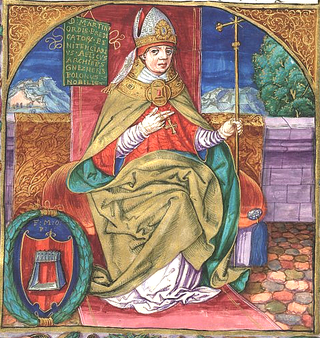
Martin of Opava, O.P. also known as Martin of Poland, was a 13th-century Dominican friar, bishop and chronicler.
Lambert of Hersfeld was a medieval chronicler. His work represents a major source for the history of the German kingdom of Henry IV and the incipient Investiture Controversy in the eleventh century.

The Royal Frankish Annals, also called the Annales Laurissenses maiores, are a series of annals composed in Latin in the Carolingian Francia, recording year-by-year the state of the monarchy from 741 to 829. Their authorship is unknown, though Wilhelm von Giesebrecht suggested that Arno of Salzburg was the author of an early section surviving in the copy at Lorsch Abbey. The Annals are believed to have been composed in successive sections by different authors, and then compiled.
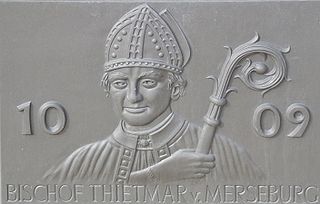
Thietmar, Prince-Bishop of Merseburg from 1009 until his death in 1018, was an important chronicler recording the reigns of German kings and Holy Roman Emperors of the Ottonian (Saxon) dynasty. Two of Thietmar's great-grandfathers, both referred to as Liuthar, were the Saxon nobles Lothar II, Count of Stade, and Lothar I, Count of Walbeck. They were both killed fighting the Slavs at the Battle of Lenzen.
The Deeds of the Saxons, or Three Books of Annals is a three-volume chronicle of 10th-century Germany, written by Widukind of Corvey. Widukind, proud of his people and history, begins his chronicon, not with Rome, but with a brief synopsis derived from the orally-transmitted history of the Saxons, with a terseness that makes his work difficult to interpret. Widukind omits Italian events in tracing the career of Henry the Fowler and he never mentioned a pope.
Henry I, was Count Palatine of Lotharingia from 1045 until 1060. He was the son of Hezzelin I, Count in Zülpichgau, and a member of the Ezzonid dynasty. Historians have given several nicknames to Heinrich: Furiosus, because he murdered his wife, and Monachus, because he was confined into an abbey to treat his insanity.
Bonizo of Sutri or Bonitho was a Bishop of Sutri and then of Piacenza in central Italy, in the last quarter of the 11th century. He was an adherent of Gregory VII and an advocate of the reforming principles of that pope. He wrote three works of polemical history, including Liber ad amicum, which detailed the struggles between civil and religious authorities. He was driven out of both of his dioceses, once by the emperor and once by opponents of Gregorian-style reform.
Henry was the leading military commander of the last years of the Carolingian Empire. He was commander-in-chief under Kings Louis the Younger and Charles the Fat. His early career was mostly restricted to East Francia, his homeland, but after Charles inherited West Francia in 884 he was increasingly active there. During his time, raids by the Vikings peaked in Francia. The sources describe at least eight separate campaigns waged by Henry against the Vikings, most of them successful.
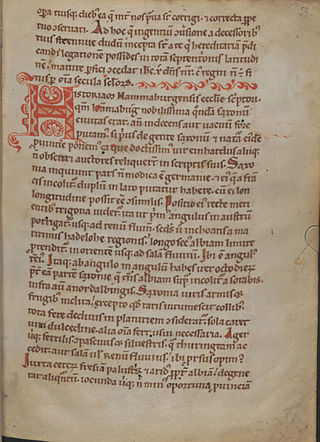
Gesta Hammaburgensis ecclesiae pontificum is a historical treatise written between 1073 and 1076 by Adam of Bremen, who made additions (scholia) to the text until his death . It is one of the most important sources of the medieval history of Northern Europe, and the oldest textual source reporting the discovery of coastal North America.

Quedlinburg Abbey was a house of secular canonesses (Frauenstift) in Quedlinburg in what is now Saxony-Anhalt, Germany. It was founded in 936 on the initiative of Saint Mathilda, the widow of the East Frankish King Henry the Fowler, as his memorial. For many centuries it and its abbesses enjoyed great prestige and influence. Quedlinburg Abbey was an Imperial Estate and one of the approximately forty self-ruling Imperial Abbeys of the Holy Roman Empire. It was disestablished in 1802/3. The church, known as Stiftskirche St Servatius, is now used by the Lutheran Evangelical Church in Germany.

Ruthard was Archbishop of Mainz from 1089 to 1109, and a leading opponent of the Emperor Henry IV and his antipope Clement III. He spent nearly eight years in exile because of his opposition, and played a part in the successful revolt of Henry V against his father.
Matthias of Neuenburg was a chronicler.

Henry V was King of Germany and Holy Roman Emperor, as the fourth and last ruler of the Salian dynasty. He was made co-ruler by his father, Henry IV, in 1098.
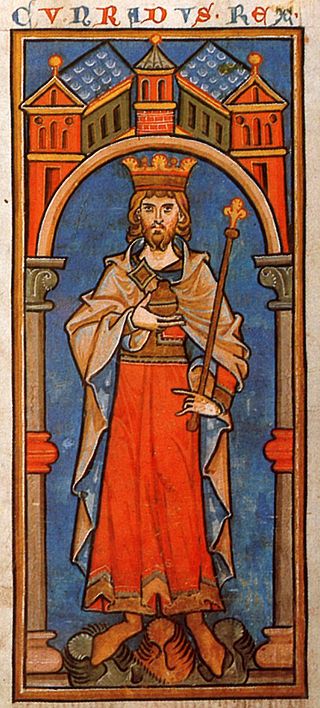
The Chronica regia Coloniensis, also called the Annales Colonienses maximi, is an anonymous medieval Latin chronicle that covers the years 576 to 1202. The original chronicle only went up to 1197, but a continuator later added the following few years' events. According to the historian Manfred Groten, the Chronica was probably first compiled about 1177 in Michaelsberg Abbey, Siegburg, and then continued in Cologne. The earliest manuscript only contains an account down to 1175.
Giovanni Codagnello was an Italian notary and historian.


