Related Research Articles

Pascual Orozco Vázquez, Jr. was a Mexican revolutionary leader who rose up to support Francisco I. Madero in late 1910 to depose long-time president Porfirio Díaz (1876-1911). Orozco was a natural military leader whose victory over the Federal Army at Ciudad Juárez was a key factor in forcing Díaz to resign in May 1911. Following Díaz's resignation and the democratic election of Madero in November 1911, Orozco served Madero as leader of the state militia in Chihuahua, a paltry reward for his service in the Mexican Revolution. Orozco revolted against the Madero government 16 months later, issuing the Plan Orozquista in March 1912. It was a serious revolt which the Federal Army struggled to suppress. When Victoriano Huerta led a coup d'état against Madero in February 1913 during which Madero was murdered, Orozco joined the Huerta regime. Orozco's revolt against Madero somewhat tarnished his revolutionary reputation, but his subsequent support of Huerta compounded the repugnance against him.

John TaliaferroThompson was a United States Army officer best remembered as the inventor of the Thompson submachine gun.

The Territory of Colorado was an organized incorporated territory of the United States that existed from February 28, 1861, until August 1, 1876, when it was admitted to the Union as the State of Colorado.
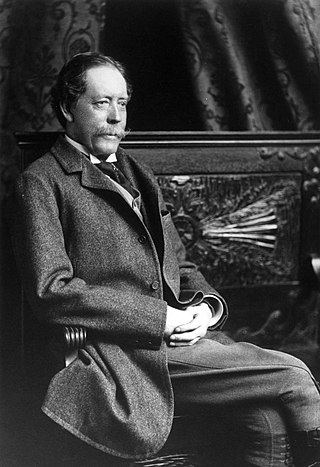
William Jackson Palmer was an American civil engineer and veteran of the American Civil War. During the Civil War, he was promoted to brevet brigadier general and received a Medal of Honor for his actions.

John Evans was an American politician, physician, founder of various hospitals and medical associations, railroad promoter, second governor of the Territory of Colorado, and namesake of Evanston, Illinois; Evans, Colorado; and formerly Mount Evans, Colorado.

Samuel Forster Tappan was an American journalist, military officer, abolitionist and a Native American rights activist. Appointed as a member of the Indian Peace Commission in 1867 to reach peace with the Plains Indians, he advocated self-determination for native tribes. He proposed the federal government replace military jurisdiction over tribal matters with a form of civil law on reservations, applied by the tribes themselves.
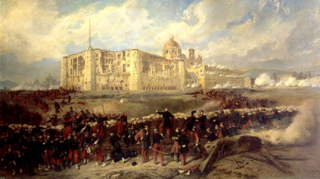
The second French intervention in Mexico, also known as the Second Franco-Mexican War (1861–1867), was a military invasion of the Republic of Mexico by the French Empire of Napoleon III, purportedly to force the collection of Mexican debts in conjunction with Great Britain and Spain. Mexican conservatives supported the invasion, since they had been defeated by the liberal government of Benito Juárez in a three-year civil war. Defeated on the battlefield, conservatives sought the aid of France to effect regime change and establish a monarchy in Mexico, a plan that meshed with Napoleon III's plans to re-establish the presence of the French Empire in the Americas. Although the French invasion displaced Juárez's Republican government from the Mexican capital and the monarchy of Archduke Maximilian was established, the Second Mexican Empire collapsed within a few years. Material aid from the United States, whose four-year civil war ended in 1865, invigorated the Republican fight against the regime of Maximilian, and the 1866 decision of Napoleon III to withdraw military support for Maximilian's regime accelerated the monarchy's collapse. Maximilian and two Mexican generals were executed by firing squad on 19 June 1867, ending this period of Mexican history.
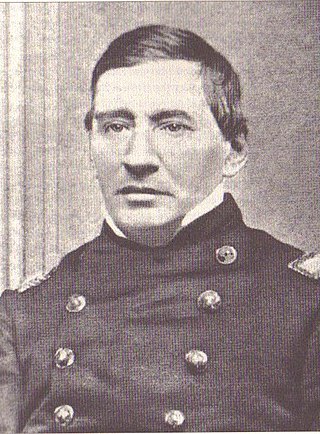
Norman S. Eddy was an American politician and military officer. He served as a member of the Indiana State Senate from 1850 to 1853 and a U.S. Representative of Indiana from 1853 to 1855. He then served as U.S. Attorney for the Territory of Minnesota from 1855 to 1861 and as Secretary of State of Indiana from 1870 to 1872.

Crown Hill National Cemetery is a U.S. National Cemetery located in Indianapolis, Marion County, Indiana. It was established in 1866 on Section 10 within Crown Hill Cemetery, a privately owned cemetery on the city's northwest side. Administered by the United States Department of Veterans Affairs, the National Cemetery encompasses 1.4 acres (0.57 ha) and serves as a burial site for Union soldiers who fought in the American Civil War.
The 14th Indiana Infantry Regiment, called "The Gallant Fourteenth," was an infantry regiment and part of the Union Army's celebrated "Gibraltar Brigade" during the American Civil War. Mustered on June 7, 1861, it was the state's first regiment organized for three years' service. The 14th Indiana served in many major campaigns and battles mostly in the Eastern Theater. During its three years of service, the regiment had a total of 222 casualties.

The Colorado Territory was formally created in 1861 shortly before the bombardment of Fort Sumter sparked the American Civil War. Although sentiments were somewhat divided in the early days of the war, Colorado was only marginally a pro-Union territory. Colorado was strategically important to both the Union and Confederacy because of the gold and silver mines there as both sides wanted to use the mineral wealth to help finance the war. The New Mexico Campaign was a military operation conducted by Confederate Brigadier General Henry Sibley to gain control of the Southwest, including the gold fields of Colorado, the mineral-rich territory of Nevada and the ports of California. The campaign was intended as a prelude to an invasion of the Colorado Territory and an attempt to cut the supply lines between California and the rest of the Union. However, the Confederates were defeated at the Battle of Glorieta Pass in New Mexico and were forced to retreat back to Texas, effectively ending the New Mexico Campaign.
Indiana, a state in the Midwest, played an important role in supporting the Union during the American Civil War. Despite anti-war activity within the state, and southern Indiana's ancestral ties to the South, Indiana was a strong supporter of the Union. Indiana contributed approximately 210,000 Union soldiers, sailors, and marines. Indiana's soldiers served in 308 military engagements during the war; the majority of them in the western theater, between the Mississippi River and the Appalachian Mountains. Indiana's war-related deaths reached 25,028. Its state government provided funds to purchase equipment, food, and supplies for troops in the field. Indiana, an agriculturally rich state containing the fifth-highest population in the Union, was critical to the North's success due to its geographical location, large population, and agricultural production. Indiana residents, also known as Hoosiers, supplied the Union with manpower for the war effort, a railroad network and access to the Ohio River and the Great Lakes, and agricultural products such as grain and livestock. The state experienced two minor raids by Confederate forces, and one major raid in 1863, which caused a brief panic in southern portions of the state and its capital city, Indianapolis.
Franklin Archibald Dick was an American lawyer, politician and military officer during the American Civil War. He served as a Republican member of the Missouri state legislature and worked with Francis P. Blair Jr. to oppose slavery in Missouri. He served as volunteer assistant adjutant general to Brigadier General Nathaniel Lyon in the struggle to prevent Missouri secession to the Confederacy that resulted in the Camp Jackson Affair. He also served as Missouri provost marshal general and lieutenant colonel under Major General Samuel Curtis. After the war, he worked as a law partner with Montgomery Blair at the Blair House in Washington, D.C.

Camp Morton was a military training ground and a Union prisoner-of-war camp in Indianapolis, Indiana, during the American Civil War. It was named for Indiana governor Oliver Morton. Prior to the war, the site served as the fairgrounds for the Indiana State Fair. During the war, Camp Morton was initially used as a military training ground. The first Union troops arrived at the camp in April 1861. After the fall of Fort Donelson and the Battle of Shiloh, the site was converted into a prisoner-of-war camp. The first Confederate prisoners arrived at Camp Morton on February 22, 1862; its last prisoners were paroled on June 12, 1865. At the conclusion of the war, the property resumed its role as the fairgrounds for the Indiana State Fair. In 1891 the property was sold and developed into a residential neighborhood known as Morton Place, a part of the Herron-Morton Place Historic District.
During the American Civil War, Indianapolis, the state capital of Indiana, was a major base of supplies for the Union. Governor Oliver P. Morton, a major supporter of President Abraham Lincoln, quickly made Indianapolis a gathering place to organize and train troops for the Union army. The city became a major railroad hub for troop transport to Confederate lands, and therefore had military importance. Twenty-four military camps were established in the vicinity of Indianapolis. Camp Morton, the initial mustering ground to organize and train the state's Union volunteers in 1861, was designated as a major prisoner-of-war camp for captured Confederate soldiers in 1862. In addition to military camps, a state-owned arsenal was established in the city in 1861, and a federal arsenal in 1862. A Soldiers' Home and a Ladies' Home were established in Indianapolis to house and feed Union soldiers and their families as they passed through the city. Indianapolis residents also supported the Union cause by providing soldiers with food, clothing, equipment, and supplies, despite rising prices and wartime hardships, such as food and clothing shortages. Local doctors aided the sick, some area women provided nursing care, and Indianapolis City Hospital tended to wounded soldiers. Indianapolis sent an estimated 4,000 men into military service; an estimated 700 died during the war. Indianapolis's Crown Hill National Cemetery was established as one of two national military cemeteries established in Indiana in 1866.

Brigadier-General William Robertson Boggs was a senior officer of the Confederate States Army during the American Civil War. He was noted as a military engineer who constructed the fortifications that protected some of the Confederacy's most important seaports.

The Augusta Arsenal was a 19th-century fortification in Augusta, Georgia. Established in 1816 and initially completed on the Georgia bank of the Savannah River in 1819, it was moved to the former Belle Vue estate in the Summerville neighborhood of Augusta in 1827 due to health concerns after several fever epidemics.

Daniel Webster Flagler was a United States Army Brigadier General. He was prominent as the Army's 9th Chief of Ordnance for the U.S. Army Ordnance Corps.

Greenlawn Cemetery was a cemetery located in Indianapolis, Indiana, from 1821 to 1931.
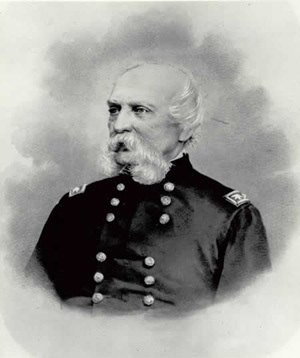
George Douglas Ramsay was a Brigadier General in the United States Army and served as the 6th Chief of Ordnance of the U.S. Army.
References
- 1 2 Indianapolis Journal, Volume 53, Number 327
- 1 2 3 Robert H. Buck, Captain, Recorder. Military Order of the Loyal Legion of the United States Commandery of the state of Colorado, Denver. April 10, 1907. Indiana State Library.
- ↑ Hyman, Max R. Journal Handbook of Indianapolis: An Outline History. The Indianapolis Journal Newspaper. Indianapolis, Ind. 1902. Page 36-38.
- ↑ Letter from the Executive Department of Indiana Adjutant General's Office, Indianapolis. December 2nd, 1865. Indiana State Library.
- 1 2 3 4 5 6 7 The Indianapolis Morning Star. Page 10. October 19, 1906.
- ↑ Letter from the State of Indiana Executive Department, Indianapolis. May 13th, 1865. Indiana State Library.
- ↑ Indiana Magazine of History, Volume LVIII, March 1962, Number 1
- ↑ Contratos hechos en los Estados-Unidos por los comisionados del gobierno de Mexico durante los anos de 1865 y 1866 (Mexico, 1868), 500-501, 504-506.
- ↑ Warren Stride, Cripple Creek and Colorado Springs Illustrated, Colorado Springs, Colorado. 1896. Page 91.
- ↑ Indianapolis Star. Indianapolis, Indiana. Part 1. Page 10. May 18, 1931.
- ↑ Elbe-Weser Triangle, German, Lutheran Baptisms, Marriages, and Burials, 1574-1945.
- ↑ Historical Society of Pennsylvania; Historic Pennsylvania Church and Town Records