The United States Armed Forces are the military forces of the United States of America. It consists of the Army, Marine Corps, Navy, Air Force, and Coast Guard. The president of the United States is the commander-in-chief of the Armed Forces and forms military policy with the Department of Defense (DoD) and Department of Homeland Security (DHS), both federal executive departments, acting as the principal organs by which military policy is carried out. All five armed services are among the seven uniformed services of the United States.
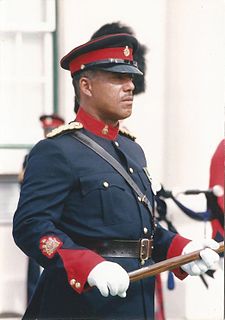
A warrant officer (WO) is an officer in a military organisation who is designated an officer by a warrant, as distinguished from a commissioned officer who is designated an officer by a commission, and a non-commissioned officer who is designated an officer, often by virtue of seniority.

Military ranks are a system of hierarchical relationships in armed forces, police, intelligence agencies or other institutions organized along military lines. The military rank system defines dominance, authority, and responsibility in a military hierarchy. It incorporates the principles of exercising power and authority into the military chain of command – the succession of commanders superior to subordinates through which command is exercised. The military chain of command constructs an important component for organized collective action.
Regimental sergeant major (RSM) is an appointment that may be held by warrant officers class 1 (WO1) in the British Army, the British Royal Marines and in the armies of many Commonwealth and former Commonwealth nations, including Australia, Kenya and New Zealand. It is also an appointment that may be held by chief warrant officers (CWO) in the Canadian Forces and warrant officers of any grade in the Singapore Armed Forces, and is a rank in itself in the Irish Defence Forces and formerly in the British Army, Royal Marines and United States Army. Only one warrant officer holds the appointment of RSM in a regiment or battalion, making him the senior warrant officer; in a unit with more than one WO1, the RSM is considered to be "first amongst equals". The RSM is primarily responsible for maintaining standards and discipline and acts as a parental figure to their subordinates and also to junior officers, even though they technically outrank the RSM.

A noncommissioned officer (NCO) is a military officer who has not earned a commission. Non-commissioned officers usually obtain their position of authority by promotion through the enlisted ranks. In contrast, commissioned officers usually enter direct from a military academy, and are often expected to have a university degree.
Brigadier is a military rank, the seniority of which depends on the country. In some countries, it is a senior rank above colonel, equivalent to a brigadier general, typically commanding a brigade of several thousand soldiers. In other countries, it is a non-commissioned rank.
A chief petty officer is a senior non-commissioned officer in many navies and coast guards.
A petty officer (PO) is a non-commissioned officer in many navies and is given the NATO rank denotion OR-5. In many nations, they are typically equal to a corporal or sergeant in comparison to other military branches. Often they may be superior to a seaman, generally the lowest ranks in a navy, and subordinate to a more senior non-commissioned officer, such as a chief petty officer.
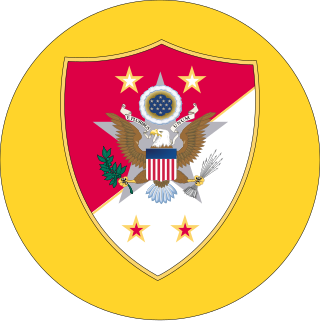
The Sergeant Major of the Army (SMA) is a unique non-commissioned rank and position of office in the United States Army. The holder of this rank and position is the most senior enlisted member of the Army unless an Army Sergeant Major is serving as the senior enlisted advisor to the Chairman of the Joint Chiefs of Staff, in which case they would be the most senior enlisted member and the SMA will be the second-most senior enlisted member of the Army. The SMA is appointed to serve as a spokesman to address the issues of enlisted soldiers to all officers, from warrant officers and lieutenants to the Army's highest positions. As such, they are the senior enlisted advisor to the Chief of Staff of the U.S. Army. The exact duties vary depending on the chief of staff, though much of the SMA's time is spent traveling throughout the Army, observing training and talking with soldiers and their families.
Ensign is a junior rank of a commissioned officer in the armed forces of some countries, normally in the infantry or navy. As the junior officer in an infantry regiment was traditionally the carrier of the ensign flag, the rank acquired the name. This rank has generally been replaced in army ranks by second lieutenant. Ensigns were generally the lowest ranking commissioned officer, except where the rank of subaltern existed. In contrast, the Arab rank of ensign, لواء, liwa', derives from the command of units with an ensign, not the carrier of such a unit's ensign, and is today the equivalent of a major general.
The mess is an area where military personnel socialize, eat, and live. The term is also used to indicate the groups of military personnel who belong to separate messes, such as the Officers' mess, the CPOs' mess, the Enlisted mess. In some civilian societies this military usage has been extended to the eating arrangements of other disciplined services such as fire fighting and police forces.
The coxswain is the person in charge of a boat, particularly its navigation and steering. The etymology of the word gives a literal meaning of "boat servant" since it comes from cock, a cockboat or other small vessel kept aboard a ship, and swain, an Old English term derived from the Old Norse sveinn meaning boy or servant.

Modern Russian military ranks trace their roots to Table of Ranks established by Peter the Great. Most of the rank names were borrowed from existing German/Prussian, French, English, Dutch, and Polish ranks upon the formation of Russian regular army in the late 17th century.
Mustang is a military slang term used in the United States Armed Forces to refer to a commissioned officer who began his or her career as an enlisted service member prior to commissioning. Mustang officers are generally older, theoretically more experienced than their peers-in-grade who have entered the military via commissioning from one of the service academies, Officer Candidate School, or the Reserve Officer Training Corps.
In the United States Army, United States Marine Corps, and United States Air Force, major general is a two-star general officer rank, with the pay grade of O-8. Major general ranks above brigadier general and below lieutenant general. A major general typically commands division-sized units of 10,000 to 15,000 soldiers. Major general is equivalent to the two-star rank of rear admiral in the United States Navy and United States Coast Guard, and is the highest permanent peacetime rank in the uniformed services. Higher ranks are technically temporary and linked to specific positions, although virtually all officers promoted to those ranks are approved to retire at their highest earned rank.

In the United States Navy, United States Coast Guard, United States Public Health Service Commissioned Corps (USPHS), and National Oceanic and Atmospheric Administration Commissioned Officer Corps, captain is the senior-most commissioned officer rank below that of flag officer. The equivalent rank is colonel in the United States Army, Air Force, and Marine Corps.
The King's Birthday Honours 1943 were appointments by King George VI to various orders and honours to reward and highlight good works by people of the British Empire. They were published on 2 June 1943 for the United Kingdom and Canada.
The 1940 Birthday Honours were appointments by King George VI to various orders and honours to reward and highlight good works by citizens of the British Empire. The appointments were made to celebrate the official birthday of The King, and were published on 9 July 1940.

