A creator deity or creator god is a deity or god responsible for the creation of the Earth, world, and universe in human religion and mythology. In monotheism, the single God is often also the creator. A number of monolatristic traditions separate a secondary creator from a primary transcendent being, identified as a primary creator.

Prajapati is a Vedic deity of Hinduism. In later literature, the place of Prajapati is taken by the creator god Brahma, but the term also connotes many different gods, depending on the Hindu text, ranging from being the creator god to being same as one of the following: Viswakarma, Agni, Indra, Daksha and many others, reflecting the diverse Hindu cosmology. In classical and medieval era literature, Prajapati is equated to the metaphysical concept called Brahman as Prajapati-Brahman, or alternatively Brahman is described as one who existed before Prajapati.
Purusha is a complex concept whose meaning evolved in Vedic and Upanishadic times. Depending on source and historical timeline, it means the cosmic being or self, consciousness, and universal principle. Author Steven Rosen says, "The Bhagavata Purana and the Mahabharata boldly proclaim Vishnu as ultimate Purusha described in Purusha Sukta prayer". According to Indologist W. Norman Brown, "The verses of Purusha Sukta are definitely a reference to Vishnu, who, through his three steps, is all pervading ".
Religious cosmology is an explanation of the origin, evolution, and eventual fate of the universe, from a religious perspective. This may include beliefs on origin in the form of a creation myth, subsequent evolution, current organizational form and nature, and eventual fate or destiny. There are various traditions in religion or religious mythology asserting how and why everything is the way it is and the significance of it all. Religious cosmologies describe the spatial lay-out of the universe in terms of the world in which people typically dwell as well as other dimensions, such as the seven dimensions of religion; these are ritual, experiential and emotional, narrative and mythical, doctrinal, ethical, social, and material.

The Vedas are a large body of religious texts originating in ancient India. Composed in Vedic Sanskrit, the texts constitute the oldest layer of Sanskrit literature and the oldest scriptures of Hinduism.

Vishvakarman (Sanskrit: विश्वकर्मन्, Viśvakarman; lit. "Maker of building .or Vishwakarma is the divine architecture god in contemporary Hinduism. He is described to be extremely talented, who created miracles like Lanka, Dwarka, Indraprastha, Vajra, Sudarshan chakra and Tilottama. According to the Rigveda, Vishvakarma was the personification of ultimate reality, the abstract creative power inherent in deities, living and nonliving being in this universe.
Hindu cosmology is the description of the universe and its states of matter, cycles within time, physical structure, and effects on living entities according to Hindu texts.

The Aitareya Upanishad is a Mukhya Upanishad, associated with the Rigveda. It comprises the fourth, fifth and sixth chapters of the second book of Aitareya Aranyaka, which is one of the four layers of Rig vedic text.

Purusha sukta is hymn 10.90 of the Rigveda, dedicated to the Purusha, the "Cosmic Being". Author Steven Rosen says, "The Bhagavata Purana and the Mahabharata boldly proclaim Vishnu as ultimate Purusha described in Purusha Sukta prayer". According to Indologist W. Norman Brown, "The verses of Purusha Sukta are definitely a reference to Vishnu, who, through his three steps, is all pervading ".
The tenth mandala of the Rigveda has 191 hymns. Together with Mandala 1, it forms the latest part of the Rigveda, containing much mythological material, including the Purusha sukta (10.90) and the dialogue of Sarama with the Panis (10.108), and notably containing several dialogue hymns. The subjects of the hymns cover a wider spectrum than in the other books, dedicated not only to deities or natural phenomena, including deities that are not prominent enough to receive their own hymns in the other books, but also to objects like dice (10.34), herbs (10.97), press-stones and abstract concepts like liberality, creation, knowledge (10.71), speech, spirit (10.58), faith (10.151), a charm against evil dreams (10.164).

Brahmā is a leading god (deva) and heavenly king in Buddhism. He was adopted from other Indian religions such as Hinduism that considered him a protector of teachings (dharmapala), and he is never depicted in early Buddhist texts as a creator god. In Buddhist tradition, it was the deity Brahma Sahampati who appeared before the Buddha and urged him to teach, once the Buddha attained enlightenment but was unsure if he should teach his insights to anyone.
The concept of God in Hinduism varies in its diverse traditions. Hinduism spans a wide range of beliefs such as henotheism, monotheism, polytheism, panentheism, pantheism, pandeism, monism, atheism and nontheism.
Kalpa is a Sanskrit word meaning a relatively long period of time in Hindu and Buddhist cosmology.
The Nāsadīya Sūkta, also known as the Hymn of Creation, is the 129th hymn of the 10th mandala of the Rigveda (10:129). It is concerned with cosmology and the origin of the universe.
Hinduism includes a range of viewpoints about the origin of life, and evolution. There is no single story of creation, due to dynamic diversity of Hinduism, and these are derived from various sources like Vedas, some from the Brahmanas, some from Puranas; some are philosophical, based on concepts, and others are narratives. The Rigveda mentions the Hiranyagarbha as the source of the creation of the Universe, similar to the world egg motif found in the creation myths of many other civilizations. It also contains a myth of proto-Indo-European origin, in which the creation arises out of the dismemberment of a cosmic being who is sacrificed by the gods. As for the creation of the primordial gods themselves, the Nasadiya Sukta of Rigveda takes a near-agnostic stand, stating that the gods came into being after the world's creation, and nobody knows when the world first came into being. In the later Puranic texts, the creator god Brahma is described as performing the act of 'creation', or more specifically of 'propagating life within the universe'. Some texts consider him equivalent to the Hiranyagarbha or the Purusha, while others state that he arose out of these. Brahma is a part of the trinity of gods that also includes Vishnu and Shiva, who are responsible for 'preservation' and 'destruction' respectively.

Since the emergence of the Big Bang theory as the dominant physical cosmological paradigm, there have been a variety of reactions by religious groups regarding its implications for religious cosmologies. Some accept the scientific evidence at face value, some seek to harmonize the Big Bang with their religious tenets, and some reject or ignore the evidence for the Big Bang theory.
Nontheistic religions are traditions of thought within a religious context—some otherwise aligned with theism, others not—in which nontheism informs religious beliefs or practices. Nontheism has been applied and plays significant roles in Hinduism, Buddhism, and Jainism. While many approaches to religion exclude nontheism by definition, some inclusive definitions of religion show how religious practice and belief do not depend on the presence of (a) god(s). For example, Paul James and Peter Mandaville distinguish between religion and spirituality, but provide a definition of the term that avoids the usual reduction to "religions of the book":
Religion can be defined as a relatively-bounded system of beliefs, symbols and practices that addresses the nature of existence, and in which communion with others and Otherness is lived as if it both takes in and spiritually transcends socially-grounded ontologies of time, space, embodiment and knowing.
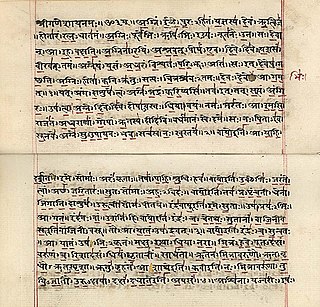
The Rigveda or Rig Veda is an ancient Indian collection of Vedic Sanskrit hymns. It is one of the four sacred canonical texts (śruti) of Hinduism known as the Vedas.

The Avyakta Upanishad is a Sanskrit text and a minor Upanishad of Hinduism. It is one of 16 Upanishads attached to the Samaveda, and classified under the 17 Vaishnava Upanishad.

The Subala Upanishad, also called Subalopanishad (सुबालोपनिषत्), is an Upanishad written in Sanskrit. It is attached to the Shukla Yajurveda, and classified as one of the Samanya Upanishads of Hinduism.

