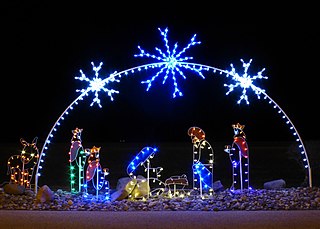
Christmas is an annual festival commemorating the birth of Jesus Christ, observed primarily on December 25 as a religious and cultural celebration by billions of people around the world. A feast central to the Christian liturgical year, it is preceded by the season of Advent or the Nativity Fast and initiates the season of Christmastide, which historically in the West lasts twelve days and culminates on Twelfth Night. Christmas Day is a public holiday in many countries, is celebrated religiously by a majority of Christians, as well as culturally by many non-Christians, and forms an integral part of the holiday season organized around it.

December is the twelfth and final month of the year in the Julian and Gregorian calendars. It is also the last of seven months to have a length of 31 days.

Easter, also called Pascha, Zatik (Armenian) or Resurrection Sunday is a Christian festival and cultural holiday commemorating the resurrection of Jesus from the dead, described in the New Testament as having occurred on the third day of his burial following his crucifixion by the Romans at Calvary c. 30 AD. It is the culmination of the Passion of Jesus, preceded by Lent, a 40-day period of fasting, prayer, and penance.
A holiday is a day set aside by custom or by law on which normal activities, especially business or work including school, are suspended or reduced. Generally, holidays are intended to allow individuals to celebrate or commemorate an event or tradition of cultural or religious significance. Holidays may be designated by governments, religious institutions, or other groups or organizations. The degree to which normal activities are reduced by a holiday may depend on local laws, customs, the type of job held or personal choices.
January is the first month of the year in the Julian and Gregorian calendars and the first of seven months to have a length of 31 days. The first day of the month is known as New Year's Day. It is, on average, the coldest month of the year within most of the Northern Hemisphere and the warmest month of the year within most of the Southern Hemisphere. In the Southern hemisphere, January is the seasonal equivalent of July in the Northern hemisphere and vice versa.
A moveable feast or movable feast is an observance in a Christian liturgical calendar, borrowed from the Hebrew Lunisolar calendar, which therefore occurs on a different date in different years.
A religious festival is a time of special importance marked by adherents to that religion. Religious festivals are commonly celebrated on recurring cycles in a calendar year or lunar calendar.

Allhallowtide, Hallowtide, Allsaintstide, or the Hallowmas season, is the Western Christian season encompassing the triduum of All Saints' Eve (Halloween), All Saints' Day and All Souls' Day, as well as the International Day of Prayer for the Persecuted Church and Remembrance Sunday in some traditions. The period begins on 31 October annually. Allhallowtide is a "time to remember the dead, including martyrs, saints, and all faithful departed Christians." The present date of Hallowmas and thus also of its vigil (Hallowe'en) was established for Rome perhaps by Pope Gregory III (731–741) and was made of obligation throughout the Frankish Empire by Louis the Pious in 835. Elsewhere, other dates were observed even later, with the date in Ireland being 20 April. In the early 11th century, the modern date of All Souls' Day was popularized, after Abbot Odilo established it as a day for the monks of Cluny and associated monasteries to pray for the dead.
Public holidays in India, also known as statutory holidays, consist of a variety of cultural, nationalistic, and religious holidays that are legislated in India at the union or state levels. While many of these holidays are honored and acknowledged nationwide, State legislation varies in regard to which are officially recognized.
There are eleven public holidays in Singapore. These public holidays have been recognised since Singapore's 1966 Holidays Act.

The Feast of the Ascension of Jesus Christ, also called Ascension Day, Ascension Thursday, or sometimes Holy Thursday, commemorates the Christian belief of the bodily Ascension of Jesus into heaven. It is one of the ecumenical feasts of Christian churches, ranking with the feasts of the Passion, of Easter, and Pentecost. Following the account of Acts 1:3 that the risen Jesus appeared for 40 days prior to his Ascension, Ascension Day is traditionally celebrated on a Thursday, the fortieth day of Easter; although some Christian denominations have moved the observance to the following Sunday. In the Catholic Church in the United States, the day of observance varies by ecclesiastical province. In 2021, it also coincides with Eid Al-Fitr and the Feast of Our Lady of Fatima.

Public holidays are celebrated by the entire population of Egypt. Holidays in Egypt have many classifications. Some holidays are religious and others are secular, while some can be fixed holidays on the calendar while others are movable. There are four Islamic holidays and two Christian holidays. The national day of Egypt is celebrated on July, 23 which coincides with the annual celebration of the Egyptian revolution of 1952 when the modern republic of Egypt was declared, ending the period of the Kingdom of Egypt.
Principal Feasts are a type of observance in some churches of the Anglican Communion, including the Church of England, the Episcopal Church, and the Anglican Church of Canada. All Principal Feasts are also Principal Holy Days, sharing equal status with those Principal Holy Days which are not Principal Feasts. They are considered to be the most significant type of observance, the others being Festivals, Lesser Festivals, and Commemorations. As with all Principal Holy Days, their observance is obligatory. The Anglican Principal Feasts and Principal Holy Days are somewhat comparable to Roman Catholic Solemnities and Holy days of obligation.

The Feast of the Annunciation, contemporarily the Solemnity of the Annunciation, and also called Lady Day, the Feast of the Incarnation, or Conceptio Christi, commemorates the visit of the archangel Gabriel to the Virgin Mary, during which he informed her that she would be the mother of Jesus Christ, the Son of God. It is celebrated on 25 March each year. In the Roman Catholic Church, when 25 March falls during the Paschal Triduum, it is transferred forward to the first suitable day during Eastertide. In Eastern Orthodoxy and Eastern Catholicism, it is never transferred, even if it falls on Pascha (Easter). The concurrence of these two feasts is called Kyriopascha.
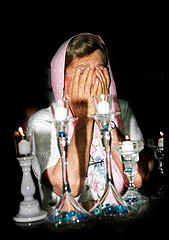
In Abrahamic religions, the Sabbath or Shabbat is a day set aside for rest and worship. According to the Book of Exodus, the Sabbath is a day of rest on the seventh day, commanded by God to be kept as a holy day of rest, as God rested from creation. The practice of observing the Sabbath (Shabbat) originates in the biblical commandment "Remember the sabbath day, to keep it holy".
Lists of holidays by various categorizations.

Christian observances of Jewish holidays is a practice evidenced since the time of Christ. Specific practices vary among denominations: these holidays may be honored in their original form in recognition of Christianity's Jewish roots, or altered to suit Christian theology. Symbolic and thematic features of Jewish services are commonly interpreted in a Christian light: for example, the Paschal Lamb of the Passover Seder being viewed as a symbol of Christ's sacrifice.
Wray or Worai is the first month of the Afghan calendar. It has 31 days and starts with the beginning of the spring season.

