Strike action, also called labor strike, labour strike, or simply strike, is a work stoppage, caused by the mass refusal of employees to work. A strike usually takes place in response to employee grievances. Strikes became common during the Industrial Revolution, when mass labor became important in factories and mines. In most countries, strike actions were quickly made illegal, as factory owners had far more power than workers. Most Western countries partially legalized striking in the late 19th or early 20th centuries.
The United Food and Commercial Workers International Union (UFCW) is a labor union representing approximately 1.3 million workers in the United States and Canada in industries including retail; meatpacking, food processing and manufacturing; hospitality; agriculture; cannabis; chemical trades; security; textile, and health care. UFCW is affiliated with the Canadian Labour Congress (CLC) and the AFL-CIO; it disaffiliated from the AFL-CIO in 2005 but reaffiliated in 2013.
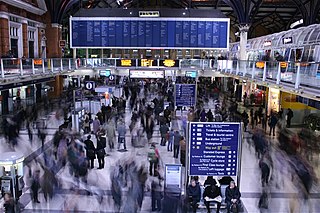
United Kingdom labour law regulates the relations between workers, employers and trade unions. People at work in the UK benefit from a minimum charter of employment rights, which are found in various Acts, Regulations, common law and equity. This includes the right to a minimum wage of £8.21 for over 25-year-olds under the National Minimum Wage Act 1998. The Working Time Regulations 1998 give the right to 28 days paid holidays, breaks from work, and attempts to limit excessively long working hours. The Employment Rights Act 1996 gives the right to leave for child care, and the right to request flexible working patterns. The Pensions Act 2008 gives the right to be automatically enrolled in a basic occupational pension, whose funds must be protected according to the Pensions Act 1995.

Terence Vincent Powderly was an American labor union leader, politician and attorney, best known as head of the Knights of Labor in the late 1880s. Born in Carbondale, Pennsylvania, he was later elected mayor of Scranton, Pennsylvania, for three 2-year terms, starting in 1878. A Republican, he served as the United States Commissioner General of Immigration in 1897. The Knights of Labor was one of the largest American labor organizations of the 19th century, but Powderly was a poor administrator and could barely keep it under control. His small central office could not supervise or coordinate the many strikes and other activities sponsored by union locals. Powderly believed that the Knights was an educational tool to uplift the workingman, and he downplayed the use of strikes to achieve workers' goals.

William Z. Foster was a radical American labor organizer and Marxist politician, whose career included serving as General Secretary of the Communist Party USA from 1945 to 1957. He was previously a member of the Socialist Party of America and the Industrial Workers of the World, leading the drive to organize the packinghouse industry during World War I and the steel strike of 1919.

United States labor law sets the rights and duties for employees, labor unions, and employers in the United States. Labor law's basic aim is to remedy the "inequality of bargaining power" between employees and employers, especially employers "organized in the corporate or other forms of ownership association". Over the 20th century, federal law created minimum social and economic rights, and encouraged state laws to go beyond the minimum to favor employees. The Fair Labor Standards Act of 1938 requires a federal minimum wage, currently $7.25 but higher in 28 states, and discourages working weeks over 40 hours through time-and-a-half overtime pay. There are no federal or state laws requiring paid holidays or paid family leave: the Family and Medical Leave Act of 1993 creates a limited right to 12 weeks of unpaid leave in larger employers. There is no automatic right to an occupational pension beyond federally guaranteed social security, but the Employee Retirement Income Security Act of 1974 requires standards of prudent management and good governance if employers agree to provide pensions, health plans or other benefits. The Occupational Safety and Health Act of 1970 requires employees have a safe system of work.

The International Longshoremen's Association (ILA) is a labor union representing longshore workers along the East Coast of the United States and Canada, the Gulf Coast, the Great Lakes, Puerto Rico, and inland waterways. The ILA has approximately 200 local affiliates in port cities in these areas.

English tort law concerns the compensation for harm to people's rights to health and safety, a clean environment, property, their economic interests, or their reputations. A "tort" is a wrong in civil, rather than criminal law, that usually requires a payment of money to make up for damage that is caused. Alongside contracts and unjust enrichment, tort law is usually seen as forming one of the three main pillars of the law of obligations.
Citizenship of the European Union is afforded to qualifying citizens of European Union member states. It was created by the 1992 Maastricht Treaty, at the same time as the creation of the European Union (EU). European Union citizenship is additional to national citizenship, and affords EU citizens with rights, freedoms and legal protections available under EU law.
The Amalgamated Meat Cutters (AMC), officially the Amalgamated Meat Cutters and Butcher Workmen of North America, 1896-1979, was a labor union that represented retail butchers and packinghouse workers. In 1979, the AMCBW merged with the Retail Clerks International Union to form the United Food and Commercial Workers (UFCW)
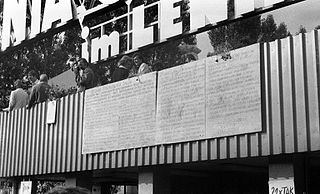
The 21 demands of MKS was a list of demands issued on 17 August 1980 by the Interfactory Strike Committee in Poland.
Opposition to trade unions comes from a variety of groups in society and there are many different types of argument on which this opposition is based.
Overtime bans are a type of strike in which workers refuse to engage in overtime work, being any work that falls outside of contracted hours. They do this in order to leverage their employer into negotiating various working conditions. Often organised in unions, workers may choose this form of industrial action to bargain for a higher rate of pay, better working conditions or to discourage an employer from making redundancies. Unlike a full strike in which employees are usually in breach of their contract, workers engaging in overtime bans are typically well protected. Employers cannot legally to withhold normal wages during an overtime ban if employees are not breaching the terms of their employment contracts by refusing to do overtime work. However, the legalities of overtime bans do vary between countries. Overtime bans are effective where “industries and organisations run on such habitually high levels of overtime or goodwill that overtime bans … can have a significant and immediate impact upon the availability of a good or service". Historically, unions have at times received criticism on ethical grounds for choosing to enact overtime bans. The literature records the occurrence of such bans from the 1800s and there is documentation of their use in four continents.

Andrew James Little is a New Zealand politician and former trade union official currently serving as Minister of Justice and Courts and Minister for Treaty of Waitangi Negotiations since 2017. He is also the Minister for the Government Communications Security Bureau and the New Zealand Security Intelligence Service. Little was previously Leader of the Opposition from 2014 to 2017.

The New Zealand Employment Relations Act 2000 is a statute of the Parliament of New Zealand. It was substantially amended by the Employment Relations Amendment Act 2001 and by the ERAA 2004.
Pearson v. Chung, better known as the "pants lawsuit," is a civil case filed in 2005 by Roy L. Pearson, Jr., at the time an administrative law judge, in the District of Columbia in the United States, following a dispute with a dry cleaning company over a lost pair of trousers. Pearson filed suit against Soo Chung, Jin Nam Chung, and Ki Y. Chung, the owners of Custom Cleaners in Washington, D.C., initially demanding $67 million for inconvenience, mental anguish, and attorney's fees for representing himself, as a result of their failure, in Pearson's opinion, to live up to a "satisfaction guaranteed" sign that was displayed in the store. The case drew international attention when it went to trial in 2007, and has been held up as an example of frivolous litigation and the need for tort reform in the United States.
The Posted Workers Directive96/71/EC is an EU directive concerned with the free movement of workers within the European Union. It makes an exception to the Convention on the Law Applicable to Contractual Obligations 1980, which ordinarily requires that workers are protected by the law of the member state in which they work.
Inequality of bargaining power in law, economics and social sciences refers to a situation where one party to a bargain, contract or agreement, has more and better alternatives than the other party. This results in one party having greater power than the other to choose not to take the deal and makes it more likely that this party will gain more favourable terms and grant them more negotiating power. Inequality of bargaining power is generally thought to undermine the freedom of contract, resulting in a disproportionate level of freedom between parties, and that it represents a place at which markets fail.

The Rosella or International Transport Workers Federation v Viking Line ABP (2007) C-438/05 is an EU law case, relevant to all labour law within the European Union, including UK labour law, which held that there is a positive right to strike. However, it also held that the right to strike could infringe a business's freedom of establishment under the Treaty on the Functioning of the European Union article 49. The decision has been criticised for the Court's inarticulate line of reasoning, and its disregard of fundamental human rights.
South African labour law regulates the relationship between employers, employees and trade unions in the Republic of South Africa.