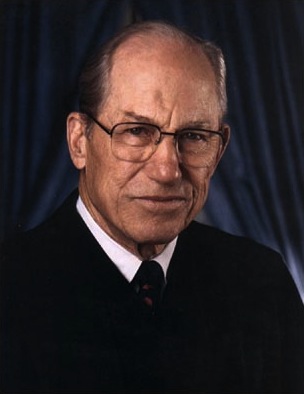
Byron Raymond "Whizzer" White was an American lawyer, jurist, and professional football player who served as an associate justice of the Supreme Court of the United States from 1962 until 1993. By his retirement, he was the Supreme Court's only sitting Democrat and the last-living member of the progressive Warren Court.

Le Mars is a city and the county seat of Plymouth County, Iowa, United States. It is located on the Floyd River northeast of Sioux City. The population was 10,571 at the time of the 2020 census. Le Mars is located within America Township and is part of the Sioux City metropolitan area.
Edy's Pie is an American brand of chocolate-covered vanilla ice cream bar wrapped in foil. It was the first such dessert sold in the United States. It is marketed by Dreyer's, a division of Froneri.
United States v. Carolene Products Company, 304 U.S. 144 (1938), was a case of the United States Supreme Court that upheld the federal government's power to prohibit filled milk from being shipped in interstate commerce. In his majority opinion for the Court, Associate Justice Harlan F. Stone wrote that economic regulations were "presumptively constitutional" under a deferential standard of review known as the "rational basis test".
Butter Brickle is a chocolate-coated toffee first sold on November 20, 1924, by candy manufacturer John G. Woodward Co. of Council Bluffs, Iowa, and toffee pieces for flavoring ice cream, manufactured by The Fenn Bros. Ice Cream and Candy Co. of Sioux Falls, South Dakota.

Frosty Treats, Inc. v. Sony Computer Entertainment America, Inc., 426 F.3d 1001, is a trademark case in which the United States Court of Appeals for the Eighth Circuit held that the name of one of the largest ice cream truck franchise companies in the United States was neither distinctive nor famous enough to receive protection against being used in a violent video game.

An ice cream bar is a frozen dessert featuring ice cream on a stick. The confection was patented in the US in the 1920s, with one invalidated in 1928.

The ice cream wars were turf wars in the East End of Glasgow, Scotland, in the 1980s between rival criminal organisations selling drugs and stolen goods from ice cream vans. Van operators were involved in frequent violence and intimidation tactics, the most notable example of which involved a driver and his family who were killed in an arson attack that resulted in a twenty-year court battle. The conflicts generated widespread public outrage, and earned the Strathclyde Police the nickname of "Serious Chimes Squad" for its perceived failure to address them.
United States v. Oppenheimer, 242 U.S. 85 (1916), was a landmark Supreme Court decision applying the common law concept of res judicata to criminal law cases.
Cross v. United States, 242 U.S. 4 (1916), was a United States Supreme Court case regarding remuneration for clerks of the court for the copying and docketing of naturalization claims.
Swift & Co. v. United States, 196 U.S. 375 (1905), was a case in which the United States Supreme Court ruled that the Commerce Clause allowed the federal government to regulate monopolies if it has a direct effect on commerce. It marked the success of the Presidency of Theodore Roosevelt in destroying the "Beef Trust". This case established a "stream of commerce" argument that allows Congress to regulate things that fall into either category. In particular it allowed Congress to regulate the Chicago slaughterhouse industry. Even though the slaughterhouse supposedly dealt with only intrastate matters, the butchering of meat was merely a "station" along the way between cow and meat. Thus, as it was part of the greater meat industry that was between the several states, Congress can regulate it. The Court's decision halted price fixing by Swift & Company and its allies.

Cold Stone Creamery, Inc. is an American international ice cream parlor chain. Headquartered in Scottsdale, Arizona, the company is owned and operated by Kahala Brands. The company's main product is premium ice cream made with approximately 12–14% butterfat, made on location and customized for patrons at time of order. Cold Stone has also expanded its menu with other ice cream-related products, including: ice cream cakes, pies, cookie sandwiches, smoothies, shakes, and iced or blended coffee drinks.
Robert George Doumar was a United States district judge of the United States District Court for the Eastern District of Virginia.
Minerals Separation v. Hyde, 242 U.S. 261 (1916), is a United States Supreme Court case on the patent protection of froth flotation.
The Royal Ice Cream sit-in was a nonviolent protest in Durham, North Carolina, that led to a court case on the legality of segregated facilities. The demonstration took place on June 23, 1957 when a group of African American protesters, led by Reverend Douglas E. Moore, entered the Royal Ice Cream Parlor and sat in the section reserved for white patrons. When asked to move, the protesters refused and were arrested for trespassing. The case was appealed unsuccessfully to the County and State Superior Courts.
Carbice Corp. v. American Patents Development Corp., 283 U.S. 27 (1931), is a decision of the United States Supreme Court extending the patent misuse doctrine against tie-ins to cases in which patents were used to tie the purchase of unpatented elements of patented combinations. The Court had previously held that it was unlawful to require the purchase of supplies as a condition of a patent license, where the supplies were not claimed as part of the patented combination.
Herbert v. Shanley Co., 242 U.S. 591 (1917), was a United States Supreme Court case in which the Court held hotels and restaurants that perform music must compensate composers, even if the venue is not separately charging patrons to hear the music.
Adams v. Milwaukee, 228 U.S. 572 (1913), was a United States Supreme Court case in which the Court held that the local ordinance ordering the confiscation of tainted milk was constitutional.