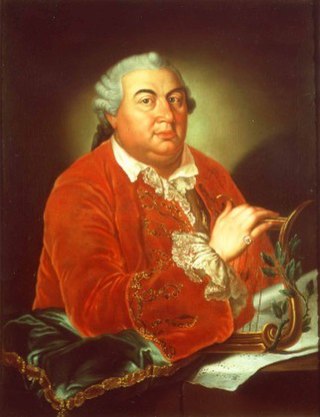
Niccolò Jommelli was an Italian composer of the Neapolitan School. Along with other composers mainly in the Holy Roman Empire and France, he was responsible for certain operatic reforms including reducing ornateness of style and the primacy of star singers somewhat.
Iphigénie en Tauride is a 1779 opera by Christoph Willibald Gluck in four acts. It was his fifth opera for the French stage. The libretto was written by Nicolas-François Guillard.

Francesco Solimena was a prolific Italian painter of the Baroque era, one of an established family of painters and draughtsmen.

Francesco Feo was an Italian composer, known chiefly for his operas. He was born and died in Naples, where most of his operas were premièred.

Giuseppe Aprile was an Italian castrato singer and music teacher. He was also known as 'Sciroletto' or 'Scirolino'.
Ifigenia in Tauride can refer to:
A majo is a male member of the lower class of Spanish society in the 18th and 19th centuries.

Giuseppe Maria Orlandini was an Italian baroque composer particularly known for his more than 40 operas and intermezzos. Highly regarded by music historians of his day like Francesco Saverio Quadrio, Jean-Benjamin de La Borde and Charles Burney, Orlandini, along with Vivaldi, is considered one of the major creators of the new style of opera that dominated the second decade of the 18th century.
Iphigenia is a figure in Greek mythology.
Ifigenia in Tauride is an opera in three acts by Niccolò Jommelli set to a libretto by the Mannheim court poet Mattia Verazi. It premiered on 30 May 1771 at the Teatro di San Carlo in Naples to celebrate the name day of Ferdinand I of the Two Sicilies. The story is based on Iphigenia in Tauris by Euripides.
Pasquale Errichelli was an Italian composer and organist based in the city of Naples. Trained at the Conservatorio della Pietà dei Turchini, his compositional output consists of 7 operas, 2 cantatas, 1 symphony, 3 sonatas, several concert arias, and the oratorio Gerosolina protetta. He was for many years the organist at the Cattedrale di Napoli.
Giuseppe de Majo was an Italian composer and organist. He was the father of the composer Gian Francesco de Majo. His compositional output consists of 10 operas, an oratorio, a concerto for 2 violins, and a considerable amount of sacred music.

Gian Francesco de Majo was an Italian composer. He is best known for his more than 20 operas. He also composed a considerable amount of sacred works, including oratorios, cantatas, and masses.
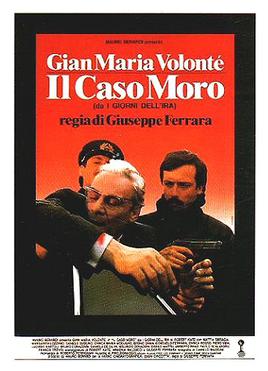
The Moro Affair is a 1986 Italian crime film directed by Giuseppe Ferrara about the kidnapping of Aldo Moro in 1978.

In music history, the Neapolitan School is a group, associated with opera, of 17th and 18th-century composers who studied or worked in Naples, Italy, the best known of whom is Alessandro Scarlatti, with whom "modern opera begins". Francesco Provenzale is generally considered the school's founder. Others significant composers of this school are Giambattista Pergolesi, Domenico Cimarosa and Giovanni Paisiello.
It is with the Neapolitan school...that the History of Modern Music commences—insofar as that music speaks the language of the feelings, emotions, and passions.
Mattia Verazi was an Italian librettist primarily active at the court of Charles Theodore in Mannheim. He became known as the leader of a group of librettists who challenged the conventions of opera seria in the mid-18th century and was a long-time collaborator of composer Niccolò Jommelli. He also produced the libretti for Salieri's Europa riconosciuta, Sacchini's Calliroe, and J. C. Bach's Temistocle

Ifigenia in Tauride is an opera in three acts by Tommaso Traetta to a libretto by Marco Coltellini. It premiered on 4 October 1763 at Schönbrunn Palace, Vienna. The opera was revived at the Schwetzingen Festival in December 2013 conducted by Wolfgang Katschner.
Ipermestra is an opera libretto by Pietro Metastasio first set by Johann Adolph Hasse 8 January 1744, and in the November of the same year by Christoff Willibald Gluck.

Ifigenia in Tauride is an opera in five acts composed by Leonardo Vinci to a libretto by Benedetto Pasqualigo. It premiered on 26 December 1724 at the Teatro San Giovanni Grisostomo in Venice, with Faustina Bordoni in the title role. The opera was Vinci's first success in Venice and his only five-act opera.


