Related Research Articles

In Islam, the ulama, also spelled ulema, are scholars of Islamic doctrine and law. They are considered the guardians, transmitters, and interpreters of religious knowledge in Islam.

A shrine is a sacred space dedicated to a specific deity, ancestor, hero, martyr, saint, daemon, or similar figure of respect, wherein they are venerated or worshipped. Shrines often contain idols, relics, or other such objects associated with the figure being venerated. A shrine at which votive offerings are made is called an altar.

Qom is a city in the Central District of Qom County, Qom province, Iran, serving as capital of the province, the county, and the district. It is the seventh largest metropolis and also the seventh largest city in Iran. The city is 140 km (87 mi) to the south of Tehran, and on the banks of the Qom River.
A hawza or ḥawzah ʿilmīyah is the collective term for a madrasa where Shi'a Muslim scholars are educated.

Mohammad Reyshahri, also known as Mohammad Mohammadi-Nik, was an Iranian politician and cleric who was the first Minister of Intelligence, serving from 1984 to 1989 in the cabinet of Prime Minister Mir-Hossein Mousavi.

Banū Tamīm is an Arab tribe that originated in Najd in the Arabian Peninsula. It is mainly present in Saudi Arabia, Qatar, Kuwait, Iraq, Jordan and Lebanon, a strong presence in Algeria, and Morocco, Palestine, Tunisia, and Libya. It is also present in many other parts of the Arab world such as Egypt and Khuzestan in Iran. The word Tamim in Arabic means strong and solid. It can also mean those who strive for perfection.

Hajiyeh Seyyedeh Nosrat Begum Amin, also known as Banu Amin, Lady Amin, was Iran's most outstanding female jurisprudent, theologian and great Muslim mystic (‘arif) of the 20th century, a Lady Mujtahideh. She received numerous ijazahs (permissions) of ijtihad, among them from Ayatollahs Muḥammad Kazim Ḥusayni Shīrāzī (1873-1947) and Grand Ayatullah ‘arif (1859-1937), the founder of the Qom seminaries (hawza).
Akhbarism is a minority Sect of Twelver Shia Islam. The term is usually used in contrast to the majority branch of Twelver Shia – the Usuli. Like the Usulis, they follow the Quran and Hadith, but unlike them, Akhbari rejects the use of reasoning by trained Islamic jurisprudents (faqih) to derive verdicts in Islamic law, maintaining it is forbidden (haram) to follow the legal rulings of anyone but one of the "Fourteen Infallibles" of Twelver Islam.
Usulism is the majority school of Twelver Shia Islam in opposition to the minority Akhbarism. The Usulis favor the use of ijtihad (reasoning) in the creation of new rules of jurisprudence; in assessing hadith to exclude traditions they believe unreliable; and in considering it obligatory to obey a mujtahid when seeking to determine Islamically correct behavior.

The Shrine of Fatima Masumeh is located in Qom, which is considered by Twelver Shia Muslims to be the second most sacred city in Iran after Mashhad.
Ayatollah Zohreh Sefati is a female Mujtahida. Sefati is a member of the Women's Socio-Cultural Council and a representative to the Supreme Council of Cultural Reforms.
Zīnah al-Sādāt Humāyūnī, also Alavīyah Humāyūnī, Zinatossadat Alevi Homayooni or Homayuni, was a female religious scholar from Isfahan, Iran, who is the most prominent student of Iran's leading mujtaheda of the 20th century, Banu Amin.
Hāshimīyah al-Tujjar was a Lady Mujtahideh in 20th century Iran.
Makhzan al-Irfan fi Tafsir al-Quran is a 15 volume tafsir by the Twelver Shia Islamic scholar and the only mujtahida of 20th century Banu Amin.
Amina Begum Bint al-Majlisi was a female Safavid mujtahideh. She was the daughter of the great Safavid religious scholar Mulla Muhammad Taqi Majlisi and granddaughter of the mujtahideh Zubaiyda, who was in turn the daughter of the great philosopher Mulla Sadra. Amina's brother was Mulla Muhammad Baqir Majlisi, the author of the well-known work Bihar al-anvar, to which Amina contributed. She married a student of her father's, Mohammad Salih al-Mazandarani. She was the mother of Persian poets and scholars, Mohammad Hadi Mazandarani and Mohammad Sa'id Ashraf Mazandarani.

Forty Hadith is a 1940 book written by Ruhollah Khomeini, the founder of the Islamic Republic of Iran. It describes his personal interpretations of the forty traditions attributed to Muhammad, the Prophet of Islam, and The Twelve Imams.
Shu'ayb bin Salih or Saleh-ibn-Shu'ayb is a/the individual who is considered amongst the personalities who will make uprising before al-Mahdi's reappearance, and his uprising is pondered among the signs of the reappearance of the twelfth/last Imam of Shia Islam, al-Mahdi; according to some Islamic narrations.
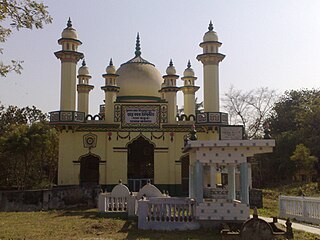
Moḥammad Abū Bakr Ṣiddīque al-Qurayshī was a Bengali Islamic scholar and the inaugural Pir of Furfura Sharif in West Bengal. He is regarded by his followers, who are scattered across eastern India and Bangladesh, as a mujaddid (reviver) of Islam in the region, due to his significant contributions in religious propagation via the establishment of mosques and madrasas, publication of newspapers and education development in neglected areas. He was the founding president of the sociopolitical Anjuman-i-Wazin-i-Bangla organisation, which advocated for causes such as the Khilafat Movement and Pakistan Movement. Siddique died in 1943, and his shrine is greatly venerated as one of West Bengal's most prominent Sufi centres.
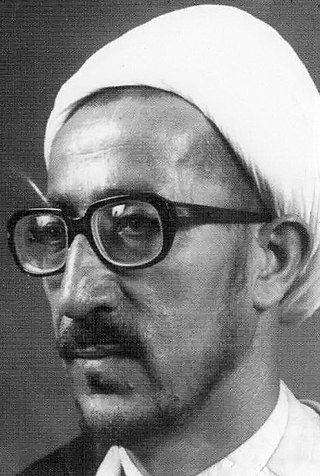
Abd al-Rahim Aqiqi Bakhshayishi was an Iranian Islamic jurist, religious writer, journalist and translator, widely known for his biographies of Twelver Shia scholars. Born in Bakhshayesh village of Heris County to an Azeri farmer family. He completed his religious studies in Qom with prominent scholars and graduated from Tehran University in 1971. From religious journalism, he started his independent writing and activities in 1961. A pro-Khomeini during 1979 revolution, Aqiqi was also active in the Islam Da'wah as a Twelver Shia faqih. He died in Qom at the age of seventy and left many works and translations from Arabic to Persian.
References
- ↑ بانو-مجتهده-امین-علامه-قرن-بیستمjahannews.com Archived 2013-10-03 at the Wayback Machine
- ↑ "Noor portal". Archived from the original on 2012-10-19. Retrieved 2012-10-20.
- ↑ Bāqirī Bīdʾhindī, Nāṣir. Bānū-yi nimūnah: gilwahāyī az ḥayāt-i bānū-yi mujtahidah Amīn Iṣfahānī, (Daftar-i Tablīqat-i Islāmī-yi Ḥawzah-yi ʿilmīyah-yi - Islamic Propagation Office of the Religious Seminaries Qom), Markaz-i Intishārāt, Qom 1382 [2003], p. 43.