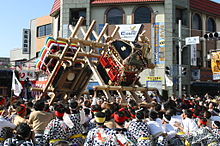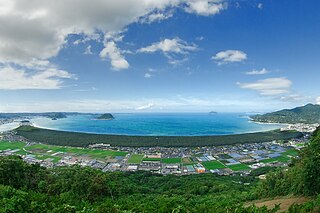
Saga Prefecture is a prefecture of Japan located on the island of Kyushu. Saga Prefecture has a population of 809,248 and has a geographic area of 2,440 km2. Saga Prefecture borders Fukuoka Prefecture to the northeast and Nagasaki Prefecture to the southwest.

Saijō is a city in Ehime Prefecture, Japan. As of 1 September 2022, the city had an estimated population of 106,016 in 58803 households and a population density of 210 persons per km2. The total area of the city is 509.98 square kilometres (196.90 sq mi).

Imari is a city located in Saga Prefecture on the island of Kyushu, Japan. As of 1 June 2024, the city had an estimated population of 51,875 in 23874 households, and a population density of 200 persons per km2. The total area of the city is 255.26 km2 (98.56 sq mi). Imari is most notable because of Imari porcelain, which is the European collectors' name for Japanese porcelain wares made in the town of Arita, Saga Prefecture. The porcelain was exported from the port of Imari specifically for the European export trade.

Kongō Gumi Co., Ltd. is a Japanese construction company, purportedly founded in 578 A.D., making it the world's oldest documented company. The company mainly works on the design, construction, restoration, and repair of shrines, temples, castles, and cultural heritage buildings. While Kongō Gumi historically specialized in traditional architecture, increased competition from major construction companies due to the growing use of concrete in shrines and temples resulted in the company becoming a subsidiary of the Takamatsu Construction Group in January 2006.
Kakegoe (掛け声) usually refers to shouts and calls used in performances of traditional Japanese music, Kabuki theatre, and in martial arts such as kendo.

Mobile Suit Gundam: The Origin is a Japanese manga series written and illustrated by Yoshikazu Yasuhiko. It is a retelling of the story from the 1979 anime television series Mobile Suit Gundam, of which Yasuhiko was the original character designer.

The Kishiwada Danjiri Matsuri (岸和田だんじり祭), held in Kishiwada, Osaka, is one of the most famous Danjiri Matsuri festivals in Japan. The festival is a parade involving large wooden shrine floats that are pulled at a high speed by a large team of men.

The Figma (フィグマ) series is a Japanese action figure line produced by Max Factory and distributed by Good Smile Company. The product series was created by Max Factory CEO MAX Watanabe and Masaki Asai, as a "counter" to the Revoltech line, with a focus on articulation. Each figma comes with various accessories such as exchangeable faceplates and hands, and other optional parts.

Persona 3 The Movie: #2 Midsummer Knight's Dream is a 2014 Japanese animated film and the second installment in a film series based on the Persona 3 video game by Atlus. The film is directed by Tomohisa Taguchi and written by Jun Kumagai. It is based on the original story by Atlus and distributed by Aniplex. The plot follows Makoto Yuki as he arrives in Iwatodai City, where he finds himself using a mysterious power called Persona to lead the SEES group into battles against entities known as Shadows. As they begin to unravel the mysteries of what's known as the Dark Hour, Makoto and his new friends face many foes and challenges while the pieces of a much greater threat start falling into place. A sequel, titled Persona 3 The Movie: #3 Falling Down, was released on April 4, 2015.
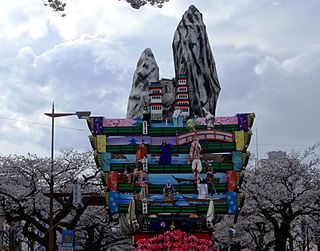
The Hitachi Furyumono (日立風流物) is a parade in Hitachi city, Japan. It is held during Hitachi Sakura Matsuri (日立さくらまつり), the annual cherry blossom festival in April, and the Great Festival at the local Kamine Shrine once in every seven years in May. It is inscribed on the UNESCO Intangible Cultural Heritage Lists as a part of "Yama, Hoko, Yatai, float festivals in Japan", 33 traditional Japan festivals.
Chinen Castle is a Ryukyuan gusuku in Nanjō, Okinawa. It is the second oldest castle in the Ryukyu Islands. The ruins consist of the old castle to the east being made out of rock and the other newer castle to the west being made out of ashlar masonry.

Moto-Sumiyoshi Shrine is a Japanese Shinto shrine in Higashinada ward, Kobe. It is one of the biggest shrines in western Kobe. It is next to Sumiyoshi Station. The shrine has existed since the 13th century.

Ryosuke Mizumachi is a former Japanese professional basketball player who played for the Akita Northern Happinets of the B.League in Japan.

Kinrande is a Japanese porcelain style where gold is applied on the surface and there are a number of variations. It originated from China during the Jiajing (1521–1566) and Wanli (1573–1620) periods of the Ming dynasty.
The 2019 J1 League, also known as the 2019 Meiji Yasuda J1 League for sponsorship reasons, was the 27th season of the J1 League – the top Japanese professional league for association football clubs since its establishment in 1992. This was fifth season of J1 League as renamed from J. League Division 1.
Yasuhiko Takahashi is a Japanese wheel gymnastics acrobat. He has won 3 World Champion Titles, 7 Japanese Champion Titles. He also works for the basketball team, Akita Northern Happinets. At the age of 19, he was injured as a baseball player, and shifted to a wheel athlete. His technique of fast spinnig is called "Oisa Tornade". Oisa is festival shout of Kakunodate Matsuri.
Zero Range Combat is a Japanese martial art inspired by military combatives.
Kashima (鹿島) is a small island off the coast of Hōjō, Matsuyama, in Ehime Prefecture, Japan. Aptly named "Deer Island," Kashima is home to a flourishing population of Sika deer. The island is about 1.5 km in circumference and 114 meters high at its peak with a 400-meter long white sand beach. Having inhabited the island for thousands of years, Kashima's deer are a designated "natural treasure of Ehime Prefecture." They are accessible for feeding and photos in an enclosure on the east end of the island, north of the ferry pier.
Yuta Kishi is a Japanese singer, actor and television personality. His film and television roles have included Toi in Oniichan, Gacha, Yūsuke Kaji in Defying Kurosaki-kun, Shu Maiko in Nisekoi, Arata Fukazawa in Night Doctor and Inokichi Myojin in Hissatsu Shigotonin.