
The president of Pakistan is the head of state of the Islamic Republic of Pakistan. The president is the nominal head of the executive and the supreme commander of the Pakistan Armed Forces. The presidency is a ceremonial position in Pakistan. The president is bound to act on advice of the prime minister and cabinet. Asif Ali Zardari is the current president since 10 March 2024.
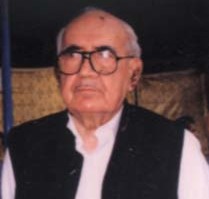
Ghulam Ishaq Khan, commonly known by his initials GIK, was a Pakistani bureaucrat, politician and statesman who served as the seventh president of Pakistan from 1988 to 1993. He previously served as Chairman of the Senate from 1985 to 1988 under president Muhammad Zia-ul-Haq, and was sworn in shortly after Zia's death.

The Chairman Joint Chiefs of Staff Committee (CJCSC) is, in principle, the highest-ranking and senior most uniformed military officer, typically at four-star rank, in the Pakistan Armed Forces who serves as a principal staff officer (PSO) and a chief military adviser to the civilian government led by elected prime minister of Pakistan and the National Security Council. The role of advisement is also extended to the elected members in the bicameral parliament and the ministry of Defence. The chairman leads the meetings and coordinates the combined efforts of the Joint Chiefs of Staff Committee (JCSC), comprising the chairman, the chief of the Army Staff and chief of the Air Staff and the chief of the Naval Staff, commandant of marines, director general Coast Guards and Strategic Plans Division, and commanders of the service branches in the Civil Armed Forces and the National Guard.
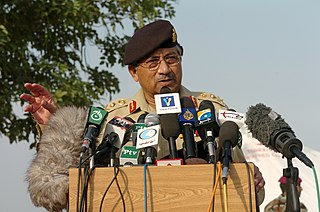
The 1999 military takeover in Pakistan was a bloodless coup d'état initiated by the military staff at the Joint Staff HQ working under the Chairman of the Joint Chiefs of Staff Committee and Chief of Army Staff General Pervez Musharraf. The instigators seized control of the civilian government of the popularly elected Prime Minister Nawaz Sharif on 12 October 1999. On 14 October, General Musharraf, acting as the country's Chief Executive, issued a controversial provisional order that suspended the Constitution of Pakistan.

Admiral Fasih BokhariNI(M) HI(M) SI(M) SBt PGAT was a Pakistani admiral who served as the Chief of Naval Staff from 1997 to 1999. He was a well-known pacifist and a prominent political figure as the Chief of Naval Staff from 1997 until his voluntary resignation in 1999, which stemmed from his staunch opposition to the then-Pakistani President Pervez Musharraf's instigation of the Kargil War with India, a conflict that Bokhari reportedly saw as an act of inappropriate and uncoordinated aggression from Pakistan and one that subsequently led him into a bitter dispute with Musharraf. Bokhari also served as the chairman of the National Accountability Bureau, a Pakistani anti-corruption agency.

The National Accountability Bureau is Pakistan's anti-corruption agency. Its chairman is Nazir Ahmed Butt, a retired general.
Waheed Arshad, HI(M), Tbt, afwc, fsc(t), psc, is a retired three-star general in the Pakistan Army who served as the Chief of General Staff (CGS) at the General Headquarters from 2010 to 2013. His previous appointments at the GHQ include; IG Training and Evaluation (IGT&E), Vice Chief of General Staff (VCGS) and DG Planning at COAS Secretariat. Waheed Arshad also served as the chief Army spokesman heading the Inter Services Public Relations from 2007 to 2008.

Tariq Parvez is a Pakistani former Police officer and a bureaucrat who served as Home Minister in the Punjab government, only to oversee the general elections held in 2013. He began as a police officer and rose to become the director-general of Pakistan's Federal Investigation Agency from 2005 to 2008. After his retirement, he planned to engage in counterterrorism efforts and join a think-tank.

Aftab Ghulam Nabi KaziSPk, SK, also known as AGN Kazi, was a Pakistani civil servant and a bureaucrat during the Cold War and during the post cold war. Kazi was born in Sindh, Bombay Presidency, in 1919 to an academic family. He started his career in the Indian Civil Service in 1944 and served as the Deputy Commissioner of Bihar and Orissa. After the partition of India, Kazi migrated to Pakistan and joined the Provincial Government of Sindh, and held positions such as Secretary of Finance and Secretary to the Governor.
General Khawaja Ziauddin Abbasi, also known as Ziauddin Butt, is a retired four-star rank army general in the Pakistan Army, who served as the Chief of Army Staff (COAS), for few hours, until Chairman joint chiefs General Pervez Musharraf reasserted the command and control of the military despite his termination on 12 October 1999.

Ahmad Shuja Pasha, HI(M) is a retired three-star rank army general of the Pakistan Army. He was the director-general of the Inter-Services Intelligence (ISI), the main intelligence service of Pakistan from October 2008 until March 2012. He was due to reach the age of superannuation on 18 March 2011 but received an extension of one year, and retired in March 2012. Pasha was replaced by Lieutenant General Zaheerul Islam. In 2011, Pasha was named as one of the world's 100 most influential people by Time magazine.

Javed Ashraf Qazi, HI(M), SBt, is a Pakistani military officer and politician who served as a member of the senator during Musharraf administration. He also served as a cabinet minister, first as Communications Minister (2000–2002) and then as Education Minister (2004–2007). Previously, during his army career, Qazi headed the ISI from 1993 to 1995 and Military Intelligence from 1990 to 1991.
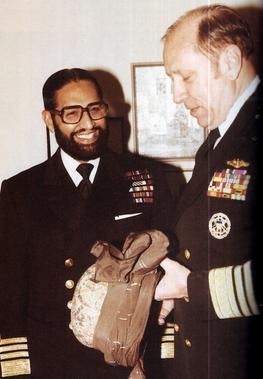
Admiral Mohammad ShariffNI(M) HJ HI(M) LoM, was a Pakistani senior admiral who served as the 2nd Chairman of Joint Chiefs of Staff Committee and a memoirist who was at the center of all the major decisions made in Pakistan in the events involving the war with India in 1971, the enforcement of martial law in the country in 1977, and the decision in covertly intervening against Soviet Union in Afghanistan.
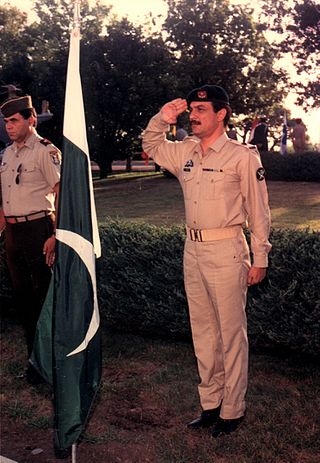
Shahid Aziz is a Pakistani military author and a public official who served as the Chairman of National Accountability Bureau (NAB) from 2004 to 2007, and university administrator of the Federal Urdu University in 2014–16. Aziz, a soldier who was trained in the United States in infantry tactics, saw military actions in war theater with India in 1999 through 2001. After retiring from the military, Aziz was the chairman of the National Accountability Bureau but was forced to resign amid controversy.
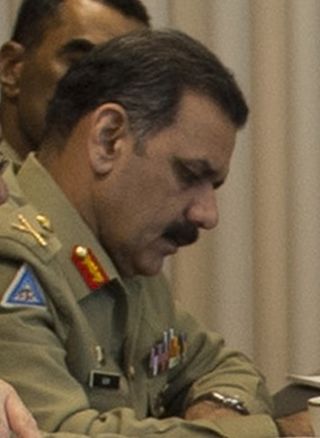
Asim Saleem BajwaHI(M) TBt is a retired Pakistani three-star general who served as the chairman of China-Pakistan Economic Corridor Authority from November 2019 to August 2021 and the special assistant to then Prime Minister Imran Khan on the Ministry of Information and Broadcasting from 28 April 2020 to 12 October 2020. On 11 December 2016, Bajwa was appointed as Inspector General Arms at GHQ, where he served until his appointment to the position of Commander Southern Command and XII Corps in September 2017. Previously, he also served as Director General of the ISPR from 2012 to 2016.
Naveed Mukhtar is a retired three-star Pakistan Army lieutenant general and former spymaster who served as the Director General of the ISI in office from 11 December 2016 until his retirement on 25 October 2018. Before his appointment as Director General of the ISI, Mukhtar commanded the V Corps. He is credited with having played a pivotal role in the success of Operation Lyari.
Bilal Akbar is a retired three-star general of the Pakistan Army who later served as a Pakistan Ambassador to Saudi Arabia.

Asif GhafoorHI(M) is a retired three-star ranking general in the Pakistani Army, who most recently served as the president of the National Defence University uptill 2024. Previously, Ghafoor served as the Corps Commander Quetta and the 20th director general of the Inter-Services Public Relations (ISPR).
Sikandar Sultan Raja is a retired Pakistani civil servant who has been the Chief Election Commissioner of Pakistan since January 2020. Raja belongs to the Pakistan Administrative Service and is batchmates with Rizwan Ahmed, Hussain Asghar and Fawad Hasan Fawad.
Faiz HameedHI(M) is a retired three-star general of the Pakistan Army, awaiting court martial. Faiz was the country's top Spy-master and served as the 29th Director General of the ISI from 2019 to 2022. He was commissioned in the Baloch Regiment having served as GOC 16th Infantry Division Pano Akil. He last served as Commander of the XXXI Corps before taking premature retirement on 10 December 2022.
