
The Indian independence movement was a series of historic events in South Asia with the ultimate aim of ending British colonial rule. It lasted until 1947, when the Indian Independence Act 1947 was passed.

Subhas Chandra Bose was an Indian nationalist whose defiance of British authority in India made him a hero among many Indians, but his wartime alliances with Nazi Germany and Fascist Japan left a legacy vexed by authoritarianism, anti-Semitism, and military failure. The honorific 'Netaji' was first applied to Bose in Germany in early 1942—by the Indian soldiers of the Indische Legion and by the German and Indian officials in the Special Bureau for India in Berlin. It is now used throughout India.

The All India Forward Bloc (abbr.AIFB) is a left-wing nationalist political party in India. It emerged as a faction within the Indian National Congress in 1939, led by Subhas Chandra Bose. The party re-established as an independent political party after the independence of India. During the 1951–1952 and 1957 Indian general election, the party was known as Forward Bloc (Marxist). It has its main stronghold in West Bengal. The party's current Secretary-General is G. Devarajan. Veteran Indian politicians Sarat Chandra Bose (brother of Subhas Chandra Bose) and Chitta Basu had been the stalwarts of the party in independent India.

The Indian Football Association, abbreviated as IFA, is the organisation that administers football in the Indian state of West Bengal. It is the oldest football association in India and was founded in 1893. Among the founders was former English international Elphinstone Jackson.

The Indian Statistical Institute (ISI) is a public research university headquartered in Kolkata, West Bengal, India. It was declared an Institute of National Importance by the Government of India under the Indian Statistical Institute Act, 1959. Established in 1931, it functions under the Ministry of Statistics and Programme Implementation of the Government of India.

Indian nationalism is an instance of territorial nationalism, which is inclusive of all of the people of India, despite their diverse ethnic, linguistic and religious backgrounds. Indian nationalism can trace roots to pre-colonial India, but was fully developed during the Indian independence movement which campaigned for independence from British rule. Indian nationalism quickly rose to popularity in India through these united anti-colonial coalitions and movements. Independence movement figures like Mahatma Gandhi, Subhas Chandra Bose, and Jawaharlal Nehru spearheaded the Indian nationalist movement. After Indian Independence, Nehru and his successors continued to campaign on Indian nationalism in face of border wars with both China and Pakistan. After the Indo-Pakistan War of 1971 and the Bangladesh Liberation War, Indian nationalism reached its post-independence peak. However by the 1980s, religious tensions reached a melting point and Indian nationalism sluggishly collapsed in the following decades. Despite its decline and the rise of religious nationalism, Indian nationalism and its historic figures continue to strongly influence the politics of India and reflect an opposition to the sectarian strands of Hindu nationalism and Muslim nationalism.

Sir Surendranath Banerjee, often known as Rashtraguru was an Indian nationalist leader during the British Rule. He founded a nationalist organization called the Indian National Association to bring Hindus and Muslims together for political action. He was one of the founding members of the Indian National Congress. Surendranath supported Montagu–Chelmsford Reforms, unlike Congress, and with many liberal leaders he left Congress and founded a new organisation named Indian National Liberation Federation in 1919.

The Indian Association was the first avowed nationalist organization founded in British India by Surendranath Banerjee and Ananda Mohan Bose in 1876. The objectives of this Association were "promoting by every legitimate means the political, intellectual and material advancement of the people". The Association attracted educated Indians and civics leaders from all parts of the country, and became an important forum for India's aspirations for independence. It later merged with the Indian National Congress.

Hindu School is a state government-administered school in Kolkata (Calcutta), India. Founded in 1817, it is the oldest modern educational institution in Asia. The institution played a key role during Bengal Renaissance period. It is located on College Street, in the vicinity of Hare School, College Square, Presidency University, Sanskrit College, Calcutta Medical College and the University of Calcutta.
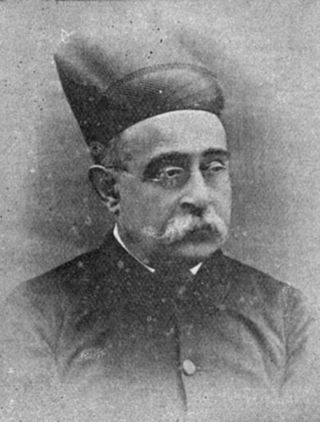
Sir Dinshaw Edulji Wacha was a Parsi politician from Bombay (Mumbai). He was one of the founding members of the Indian National Congress. Wacha was also the president of the Congress in 1901.
The Bangkok Conference was a conference held on 23 June 1942 by Indian Nationalist groups and local Indian Independence leagues at Bangkok to proclaim the formation of the All-India Independence league. The conference further saw the adoption by the league of a thirty-four set resolution known as the Bangkok resolutions that attempted to define the role of the league in the Independence movement, relations with the nascent Indian National Army, and clarify the grounds and conditions for obtaining Japanese support for it. The resolution further attempted to clarify the relations of Japan and the Greater East Asia Co-Prosperity Sphere with a free India.
Lalmohan Ghosh was the sixteenth President of the Indian National Congress and Bengali barrister and also Co-Founder of Indian National Congress.

Mahendralal Sarkar CIE was a Bengali medical doctor (MD), the second MD graduated from the Calcutta Medical College, social reformer, and propagator of scientific studies in nineteenth-century India. He was the founder of the Indian Association for the Cultivation of Science.

Ananda Mohan Bose was an Indian politician, academic, social reformer, and lawyer during the British Raj. He co-founded the Indian National Association, one of the earliest Indian political organizations, and later became a senior leader of the Indian National Congress. In 1874, he became the first Indian Wrangler of the Cambridge University. He was also a prominent religious leader of Brahmoism and with Sivanath Sastri a leading light of Adi Dharm.

Bhupendra Nath Bose was an Indian politician and President of the Indian National Congress in 1914.

Gazulu Lakshminarasu ChettyCSI was an Indian merchant and political activist who founded the Madras Native Association, one of the earliest Indian political associations, and the first Indian-owned newspaper in Madras, The Crescent. He was also the second Indian to be appointed a member of the Madras Legislative Council, succeeding V. Sadagopacharlu on his death. Lakshminarasu Chetty was born in 1806 to a wealthy indigo merchant Sidhulu Chetty in Madras. On completion of his initial education, Chetty entered the family trade and succeeded as a businessman. He entered politics and devoted money for social and philanthropic causes.
The Cambridge School of historiography was a school of thought which approached the study of the British Empire from the imperialist point of view. It emerged especially at the University of Cambridge in the 1960s. John Andrew Gallagher (1919–80) was especially influential, particularly in his article with Ronald Robinson on "The Imperialism of Free Trade".
The Early Nationalists, also known as the Moderates, were a group of political leaders in India active between 1885 and 1907. Their emergence marked the beginning of the organised national movement in India. Some of the important moderate leaders were Pherozeshah Mehta and Dadabhai Naoroji. With members of the group drawn from educated middle-class professionals including lawyers, teachers and government officials, many of them were educated in England.
Nisith Ranjan Ray(19 November, 1910 – 7 September,1994) was an Indian historian, social activist and the founder of the Society for Preservation, Calcutta, an organisation working for the preservation of the cultural heritage of Kolkata.
Basanti Devi was an Indian independence activist during the British rule in India. She was the wife of activist Chittaranjan Das. After Das' arrest in 1921 and death in 1925, she took an active part in various political and social movements and continued with social work post-independence. She was awarded the Padma Vibhushan in 1973.

