The chart below shows the current enlisted rank insignia of the United States Army, with seniority, and pay grade, increasing from right to left. The enlisted ranks of corporal (E-4) and higher are considered non-commissioned officers (NCOs). The rank of specialist is also in pay grade E-4, but does not hold non-commissioned officer status; it is common that a soldier may never hold the rank of corporal, and instead be promoted from specialist to sergeant, attaining junior NCO status at that time.
The Sergeant Major of the Army (SMA) is a unique non-commissioned rank and position of office in the United States Army. The holder of this rank and position is the most senior enlisted member of the Army, unless an Army enlisted Soldier is serving as the Senior Enlisted Advisor to the Chairman. The SMA is appointed to serve as a spokesman to address the issues of enlisted soldiers to all officers, from warrant officers and lieutenants to the Army's highest positions. As such, they are the senior enlisted advisor to the Chief of Staff of the U.S. Army. The exact duties vary depending on the chief of staff, though much of the SMA's time is spent traveling throughout the Army, observing training and talking with soldiers and their families.
A United States military occupation code, or a military occupational specialty code, is a nine-character code used in the United States Army and United States Marine Corps to identify a specific job. In the United States Air Force, a system of Air Force Specialty Codes (AFSC) is used. In the United States Navy, a system of naval ratings and designators are used along with the Navy Enlisted Classification (NEC) system. A system of ratings is also used in the United States Coast Guard.

The U.S. military issues instructor badges to specially training military personnel who are charged with teaching military recruits the skills they need to perform as members of the U.S. Armed Forces or teach continuing education courses for noncommissioned officers and officers in the military. With the exception of the U.S. Army and U.S. Coast Guard, these badges are considered temporary military decorations and must be surrendered upon completion of one's duty as a military instructor. Because of this, the U.S. Air Force, U.S. Navy, and U.S. Marine Corps award Drill Instructor Ribbons as a permanent decoration to recognize service members who have qualified and performed as military instructors.

Mess dress uniform is the most formal type of uniforms used by military personnel, police personnel, and other uniformed services members. It frequently consists of a mess jacket, trousers, white dress shirt and a black bow tie, along with orders and medals insignia. Design may depend on regiment or service branch, e.g. army, navy, air force, marines, etc. In Western dress codes, mess dress uniform is the supplementary alternative equivalent to the civilian black tie for evening wear or black lounge suit for day wear although military uniforms are the same for day and evening wear. Mess dress uniforms are typically less formal than full dress uniform, but more formal than service dress uniform.
The Career Counselor Badge is a military badge of the United States Army and Navy which was first established in the early 1970s. The badge recognizes those enlisted personnel who have been selected as promotion and career advancement coordinators, and Retention NCO's in the Army. The Navy and Army are the only branches of service to bestow a Career Counselor Badge.
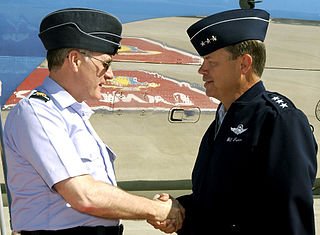
A side cap is a military cap that can be folded flat when not being worn. It is also known as a garrison cap or flight cap in the United States, wedge cap in Canada, or field service cap in the United Kingdom. In form the side cap is comparable to the glengarry, a folding version of the Scottish military bonnet. It has been associated with various military forces since the middle of the 19th century, as well as various civilian organizations.

An aiguillette, also spelled aguillette, aiglet or aglet, is a cord with metal tips or lace tags, or the decorative tip itself.

A shoulder sleeve insignia is an embroidered patch worn on some uniforms of the United States Army. It is used by major formations of the U.S. Army; each formation has a unique formation patch. The U.S. Army is unique among the U.S. Armed Forces in that all soldiers are required to wear the patch of their headquarters as part of their military uniforms.
The United States Army in World War II used a variety of standard and non-standard dress and battle uniforms, which often changed depending upon the theater of war, climatic environment, and supply exigencies.
This page details the uniforms and insignia of the Israel Defense Forces, excluding rank insignia. For ranks, see Israel Defense Forces ranks and insignia.

In the United States Army, soldiers may wear insignia to denote membership in a particular area of military specialism and series of functional areas. Army branch insignia is similar to the line officer and staff corps officer devices of the U.S. Navy as well as to the Navy enlisted rating badges. The Medical, Nurse, Dental, Veterinary, Medical Service, Medical Specialist, Chaplains, and Judge Advocate General's Corps are considered "special branches", while the others are "basic branches".

The United States Marine Corps (USMC) prescribes several types of military uniform to distinguish its service members from other armed services, depending on the situation.

The uniforms of the United States Air Force are the standardized military uniforms worn by airmen of the United States Air Force to distinguish themselves from the other services.

United States Army Basic Combat Training (BCT) is the recruit training program of the United States Army, for service in the U.S. Army, U.S. Army Reserve, or the Army National Guard.
The uniforms of the United States Army distinguish soldiers from other service members. U.S. Army uniform designs have historically been influenced by British and French military traditions, as well as contemporary U.S. civilian fashion trends. The two primary uniforms of the modern U.S. Army are the Army Combat Uniform, used in operational environments, and the Army Green Service Uniform worn during everyday professional wear and during formal and ceremonial occasions that do not warrant the wear of the more formal blue service uniform.
The military uniforms of the Union Army in the American Civil War were widely varied and, due to limitations on supply of wool and other materials, based on availability and cost of materials. The ideal uniform was prescribed as a dark blue coat with lighter pants, with a black hat. Officer's ranks were denoted with increasing levels of golden decoration. Specific jobs, companies, and units had markedly different styles at times, often following European customs such as that of the Zouaves. Officers uniforms tended to be highly customized and would stray from Army standard. Ironically, several main pieces of gear had been created by order of Confederate president Jefferson Davis before the war, when he was United States Secretary of War.

In the United States Army, tabs are cloth and/or metal arches displaying a word or words signifying a special skill that are worn on U.S. Army uniforms. On the Army Combat Uniform and Army Service Uniform, the tabs are worn above a unit's Shoulder Sleeve Insignia (SSI) and are used to identify a unit's or a soldier's special skill(s) or are worn as part of a unit's SSI as part of its unique heritage. Individual tabs are also worn as small metal arches above or below medals or ribbons on dress uniforms.

The United States Army has used berets as headgear with various uniforms beginning in World War II. Since June 14, 2001, a black beret is worn by all U.S. Army troops unless the soldier is approved to wear a different distinctive beret. A maroon beret has been adopted as official headdress by the Airborne forces, a tan beret by the 75th Ranger Regiment, a brown beret by the Security Force Assistance Brigades, and a green beret by the Special Forces.

The Heer as the German army and part of the Wehrmacht inherited its uniforms and rank structure from the Reichsheer of the Weimar Republic (1921–1935). There were few alterations and adjustments made as the army grew from a limited peacetime defense force of 100,000 men to a war-fighting force of several million men.


