Information privacy is the relationship between the collection and dissemination of data, technology, the public expectation of privacy, contextual information norms, and the legal and political issues surrounding them. It is also known as data privacy or data protection.
Medical privacy, or health privacy, is the practice of maintaining the security and confidentiality of patient records. It involves both the conversational discretion of health care providers and the security of medical records. The terms can also refer to the physical privacy of patients from other patients and providers while in a medical facility, and to modesty in medical settings. Modern concerns include the degree of disclosure to insurance companies, employers, and other third parties. The advent of electronic medical records (EMR) and patient care management systems (PCMS) have raised new concerns about privacy, balanced with efforts to reduce duplication of services and medical errors.

The Health Insurance Portability and Accountability Act of 1996 is a United States Act of Congress enacted by the 104th United States Congress and signed into law by President Bill Clinton on August 21, 1996. It aimed to alter the transfer of healthcare information, stipulated the guidelines by which personally identifiable information maintained by the healthcare and healthcare insurance industries should be protected from fraud and theft, and addressed some limitations on healthcare insurance coverage. It generally prohibits healthcare providers and businesses called covered entities from disclosing protected information to anyone other than a patient and the patient's authorized representatives without their consent. The bill does not restrict patients from receiving information about themselves. Furthermore, it does not prohibit patients from voluntarily sharing their health information however they choose, nor does it require confidentiality where a patient discloses medical information to family members, friends or other individuals not employees of a covered entity.

The terms medical record, health record and medical chart are used somewhat interchangeably to describe the systematic documentation of a single patient's medical history and care across time within one particular health care provider's jurisdiction. A medical record includes a variety of types of "notes" entered over time by healthcare professionals, recording observations and administration of drugs and therapies, orders for the administration of drugs and therapies, test results, X-rays, reports, etc. The maintenance of complete and accurate medical records is a requirement of health care providers and is generally enforced as a licensing or certification prerequisite.
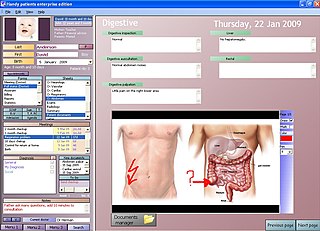
An electronic health record (EHR) is the systematized collection of patient and population electronically stored health information in a digital format. These records can be shared across different health care settings. Records are shared through network-connected, enterprise-wide information systems or other information networks and exchanges. EHRs may include a range of data, including demographics, medical history, medication and allergies, immunization status, laboratory test results, radiology images, vital signs, personal statistics like age and weight, and billing information.
eHealth describes healthcare services which are supported by digital processes, communication or technology such as electronic prescribing, Telehealth, or Electronic Health Records (EHRs). The use of electronic processes in healthcare dated back to at least the 1990s. Usage of the term varies as it covers not just "Internet medicine" as it was conceived during that time, but also "virtually everything related to computers and medicine". A study in 2005 found 51 unique definitions. Some argue that it is interchangeable with health informatics with a broad definition covering electronic/digital processes in health while others use it in the narrower sense of healthcare practice using the Internet. It can also include health applications and links on mobile phones, referred to as mHealth or m-Health. Key components of eHealth include electronic health records (EHRs), telemedicine, health information exchange, mobile health applications, wearable devices, and online health information. These technologies enable healthcare providers, patients, and other stakeholders to access, manage, and exchange health information more effectively, leading to improved communication, decision-making, and overall healthcare outcomes.
A personal health record (PHR) is a health record where health data and other information related to the care of a patient is maintained by the patient. This stands in contrast to the more widely used electronic medical record, which is operated by institutions and contains data entered by clinicians to support insurance claims. The intention of a PHR is to provide a complete and accurate summary of an individual's medical history which is accessible online. The health data on a PHR might include patient-reported outcome data, lab results, and data from devices such as wireless electronic weighing scales or from a smartphone.
Privacy law is a set of regulations that govern the collection, storage, and utilization of personal information from healthcare, governments, companies, public or private entities, or individuals.

The Canadian Institute for Health Information (CIHI) is an independent, not-for-profit organization that provides essential information on Canada's health systems and the health of Canadians. CIHI provides comparable and actionable data and information that are used to accelerate improvements in health care, health system performance and population health across Canada.
Protected health information (PHI) under U.S. law is any information about health status, provision of health care, or payment for health care that is created or collected by a Covered Entity, and can be linked to a specific individual. This is interpreted rather broadly and includes any part of a patient's medical record or payment history.
A Summary Care Record (SCR) is an electronic patient record, a summary of National Health Service patient data held on a central database covering England, part of the NHS National Programme for IT. The purpose of the database is to make patient data readily available anywhere that the patient seeks treatment, for example if they are staying away from their home town or if they are unable to give information for themselves. Despite opposition from some quarters, by September 2010, 424 GP practices across at least 36 primary care trusts had uploaded 2.7 million Summary Care Records. On 10 October 2010, the Health Secretary announced that the coalition government would continue with the introduction, but that the records would 'hold only the essential medical information needed in an emergency – that is medication, allergen and [drug] reactions'. By March 2013, more than 24 million SCRs had been created across England.
Privacy for research participants is a concept in research ethics which states that a person in human subject research has a right to privacy when participating in research. Some typical scenarios this would apply to include, or example, a surveyor doing social research conducts an interview with a participant, or a medical researcher in a clinical trial asks for a blood sample from a participant to see if there is a relationship between something which can be measured in blood and a person's health. In both cases, the ideal outcome is that any participant can join the study and neither the researcher nor the study design nor the publication of the study results would ever identify any participant in the study. Thus, the privacy rights of these individuals can be preserved.

De-identification is the process used to prevent someone's personal identity from being revealed. For example, data produced during human subject research might be de-identified to preserve the privacy of research participants. Biological data may be de-identified in order to comply with HIPAA regulations that define and stipulate patient privacy laws.
The Health Information Technology for Economic and Clinical Health Act, abbreviated the HITECH Act, was enacted under Title XIII of the American Recovery and Reinvestment Act of 2009. Under the HITECH Act, the United States Department of Health and Human Services resolved to spend $25.9 billion to promote and expand the adoption of health information technology. The Washington Post reported the inclusion of "as much as $36.5 billion in spending to create a nationwide network of electronic health records." At the time it was enacted, it was considered "the most important piece of health care legislation to be passed in the last 20 to 30 years" and the "foundation for health care reform."
Digital health is a discipline that includes digital care programs, technologies with health, healthcare, living, and society to enhance the efficiency of healthcare delivery and to make medicine more personalized and precise. It uses information and communication technologies to facilitate understanding of health problems and challenges faced by people receiving medical treatment and social prescribing in more personalised and precise ways. The definitions of digital health and its remits overlap in many ways with those of health and medical informatics.
In Electronic Health Records (EHR's) data masking, or controlled access, is the process of concealing patient health data from certain healthcare providers. Patients have the right to request the masking of their personal information, making it inaccessible to any physician, or a particular physician, unless a specific reason is provided. Data masking is also performed by healthcare agencies to restrict the amount of information that can be accessed by external bodies such as researchers, health insurance agencies and unauthorised individuals. It is a method used to protect patients’ sensitive information so that privacy and confidentiality are less of a concern. Techniques used to alter information within a patient's EHR include data encryption, obfuscation, hashing, exclusion and perturbation.

Health information on the Internet refers to all health-related information communicated through or available on the Internet.
Privacy in education refers to the broad area of ideologies, practices, and legislation that involve the privacy rights of individuals in the education system. Concepts that are commonly associated with privacy in education include the expectation of privacy, the Family Educational Rights and Privacy Act (FERPA), the Fourth Amendment, and the Health Insurance Portability and Accountability Act of 1996 (HIPAA). Most privacy in education concerns relate to the protection of student data and the privacy of medical records. Many scholars are engaging in an academic discussion that covers the scope of students’ privacy rights, from student in K-12 and even higher education, and the management of student data in an age of rapid access and dissemination of information.
Post-mortem privacy is a person's ability to control the dissemination of personal information after death. An individual's reputation and dignity after death is also subject to post-mortem privacy protections. In the US, no federal laws specifically extend post-mortem privacy protection. At the state level, privacy laws pertaining to the deceased vary significantly, but in general do not extend any clear rights of privacy beyond property rights. The relative lack of acknowledgment of post-mortem privacy rights has sparked controversy, as rapid technological advancements have resulted in increased amounts of personal information stored and shared online.
DNA encryption is the process of hiding or perplexing genetic information by a computational method in order to improve genetic privacy in DNA sequencing processes. The human genome is complex and long, but it is very possible to interpret important, and identifying, information from smaller variabilities, rather than reading the entire genome. A whole human genome is a string of 3.2 billion base paired nucleotides, the building blocks of life, but between individuals the genetic variation differs only by 0.5%, an important 0.5% that accounts for all of human diversity, the pathology of different diseases, and ancestral story. Emerging strategies incorporate different methods, such as randomization algorithms and cryptographic approaches, to de-identify the genetic sequence from the individual, and fundamentally, isolate only the necessary information while protecting the rest of the genome from unnecessary inquiry. The priority now is to ascertain which methods are robust, and how policy should ensure the ongoing protection of genetic privacy.
