Related Research Articles

Erving Goffman was a Canadian-born American sociologist, social psychologist, and writer, considered by some "the most influential American sociologist of the twentieth century".

Symbolic interactionism is a sociological theory that develops from practical considerations and alludes to humans' particular use of shared language to create common symbols and meanings, for use in both intra- and interpersonal communication. According to Macionis, symbolic interactionism is "a framework for building theory that sees society as the product of everyday interactions of individuals". In other words, it is a frame of reference to better understand how individuals interact with one another to create symbolic worlds, and in return, how these worlds shape individual behaviors. It is a framework that helps understand how society is preserved and created through repeated interactions between individuals. The interpretation process that occurs between interactions helps create and recreate meaning. It is the shared understanding and interpretations of meaning that affect the interaction between individuals. Individuals act on the premise of a shared understanding of meaning within their social context. Thus, interaction and behavior is framed through the shared meaning that objects and concepts have attached to them. From this view, people live in both natural and symbolic environments.
Impression management is a conscious or subconscious process in which people attempt to influence the perceptions of other people about a person, object or event by regulating and controlling information in social interaction. It was first conceptualized by Erving Goffman in 1959 in The Presentation of Self in Everyday Life, and then was expanded upon in 1967.

Labeling theory posits that self-identity and the behavior of individuals may be determined or influenced by the terms used to describe or classify them. It is associated with the concepts of self-fulfilling prophecy and stereotyping. Labeling theory holds that deviance is not inherent in an act, but instead focuses on the tendency of majorities to negatively label minorities or those seen as deviant from standard cultural norms. The theory was prominent during the 1960s and 1970s, and some modified versions of the theory have developed and are still currently popular. Stigma is defined as a powerfully negative label that changes a person's self-concept and social identity.
Microsociology is one of the main levels of analysis of sociology, concerning the nature of everyday human social interactions and agency on a small scale: face to face. Microsociology is based on subjective interpretative analysis rather than statistical or empirical observation, and shares close association with the philosophy of phenomenology. Methods include symbolic interactionism and ethnomethodology; ethnomethodology in particular has led to many academic sub-divisions and studies such as micro-linguistical research and other related aspects of human social behaviour. Macrosociology, by contrast, concerns the social structure and broader systems.
Dramaturgy is a sociological perspective that analyzes micro-sociological accounts of everyday social interactions through the analogy of performativity and theatrical dramaturgy, dividing such interactions between "actors", "audience" members, and various "front" and "back" stages.
Face is a class of behaviors and customs, associated with the morality, honor, and authority of an individual, and its image in social groups.
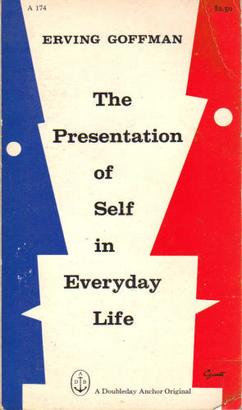
The Presentation of Self in Everyday Life is a 1956 sociological book by Erving Goffman, in which the author uses the imagery of theatre to portray the importance of human social interaction. This approach became known as Goffman's dramaturgical analysis.
Randall Collins is an American sociologist who has been influential in both his teaching and writing. He has taught in many notable universities around the world and his academic works have been translated into various languages. Collins is currently the Dorothy Swaine Thomas Professor of Sociology, Emeritus at the University of Pennsylvania. He is a leading contemporary social theorist whose areas of expertise include the macro-historical sociology of political and economic change; micro-sociology, including face-to-face interaction; and the sociology of intellectuals and social conflict. Collins's publications include The Sociology of Philosophies: A Global Theory of Intellectual Change (1998), which analyzes the network of philosophers and mathematicians for over two thousand years in both Asian and Western societies. His current research involves macro patterns of violence including contemporary war, as well as solutions to police violence. He is considered to be one of the leading non-Marxist conflict theorists in the United States, and served as the president of the American Sociological Association from 2010 to 2011.

Asylums: Essays on the Condition of the Social Situation of Mental Patients and Other Inmates is a 1961 collection of four essays by the sociologist Erving Goffman.
Civil inattention is the process whereby strangers who are in close proximity demonstrate that they are aware of one another, without imposing on each other – a recognition of the claims of others to a public space, and of their own personal boundaries.
Ray L. Birdwhistell was an American anthropologist who founded kinesics as a field of inquiry and research. Birdwhistell coined the term kinesics, meaning "facial expression, gestures, posture and gait, and visible arm and body movements". He estimated that "no more than 30 to 35 percent of the social meaning of a conversation or an interaction is carried by the words." Stated more broadly, he argued that "words are not the only containers of social knowledge." He proposed other technical terms, including kineme, and many others less frequently used today. Birdwhistell had at least as much impact on the study of language and social interaction generally as just nonverbal communication because he was interested in the study of communication more broadly than is often recognized. Birdwhistell understood body movements to be culturally patterned rather than universal. His students were required to read widely, sources not only in communication but also anthropology and linguistics. "Birdwhistell himself was deeply disappointed that his general communicative interests and goals were not appropriately understood." Collaborations with others, including initially Margaret Mead and Gregory Bateson, and later, Erving Goffman and Dell Hymes had huge influence on his work. For example, the book he is best known for, Kinesics and Context, "would not have appeared if it had not been envisaged by Erving Goffman" and he explicitly stated "the paramount and sustaining influence upon my work has been that of anthropological linguistics", a tradition most directly represented at the University of Pennsylvania by Hymes.
The following events related to sociology occurred in the 1980s.
Impression formation in social psychology refers to the processes by which different pieces of knowledge about another are combined into a global or summary impression. Social psychologist Solomon Asch is credited with the seminal research on impression formation and conducted research on how individuals integrate information about personality traits. Two major theories have been proposed to explain how this process of integration takes place. The Gestalt approach views the formation of a general impression as the sum of several interrelated impressions. As an individual seeks to form a coherent and meaningful impression of another individual, previous impressions significantly influence the interpretation of subsequent information. In contrast to the Gestalt approach, the cognitive algebra approach asserts that individuals' experiences are combined with previous evaluations to form a constantly changing impression of a person. A related area to impression formation is the study of person perception, making dispositional attributions, and then adjusting those inferences based on the information available.
In clinical and abnormal psychology, institutionalization or institutional syndrome refers to deficits or disabilities in social and life skills, which develop after a person has spent a long period living in mental hospitals, prisons or other remote institutions. In other words, individuals in institutions may be deprived of independence and of responsibility, to the point that once they return to "outside life" they are often unable to manage many of its demands; it has also been argued that institutionalized individuals become psychologically more prone to mental health problems.

Identity management theory is an intercultural communication theory from the 1990s. It was developed by William R. Cupach and Tadasu Todd Imahori on the basis of Erving Goffman's Interaction ritual: Essays on face-to-face behavior (1967). Cupach and Imahori distinguish between intercultural communication and intracultural communication.
In psychology, sociology and gender studies, "doing gender" is the idea that gender, rather than being an innate quality of individuals, is a social construct that actively surfaces in everyday human interaction. This term was used by Candace West and Don Zimmerman in their article "Doing Gender", published in 1987 in Gender and Society. According to this paper, an individual's performance of gender is intended to construct gendered behavior as naturally occurring. This façade furthers a system through which individuals are judged in terms of their failure or success to meet gendered societal expectations, called the accountability structure. The concept of doing gender was later expanded in the book Doing Gender, Doing Difference, edited by Sarah Fenstermaker and Candace West.
Gender Advertisements is a 1979 book by Erving Goffman.
Anne Warfield Rawls is an American sociologist, social theorist and ethnomethodologist. She is Professor of Sociology at Bentley University, Professor for Interaction, Work and Information at the University of Siegen, Germany and Director of the Harold Garfinkel Archive, Newburyport, MA. Rawls has been teaching courses on social theory, social interaction, ethnomethodology and systemic racism for over forty years. She has also written extensively on Émile Durkheim and Harold Garfinkel, explaining their argument that equality is needed to ground practices in democratic publics, and showing how inequality interferes with the cooperation and reflexivity necessary to successfully engage in complex practices.
Stigma: Notes on the Management of Spoiled Identity is a 1963 book by Erving Goffman.
References
- ↑ Tiryakian, Edward A. (1968). "Review of Interaction Ritual: Essays on Face-to-Face Behavior". American Sociological Review. 33 (3): 462–463. doi:10.2307/2091926. JSTOR 2091926.
- ↑ Hughes, Everett C. (November 1969). "Interaction Ritual: Essays on Face-to-Face Behavior. Erving Goffman". American Journal of Sociology. 75 (3): 425–426. doi:10.1086/224800.
- ↑ Strodtbeck, Fred L. (July 1970). "Interaction Ritual: Essays on Face-to-Face Behavior. Erving Goffman". American Journal of Sociology. 76 (1): 177–179. doi:10.1086/224921.
- ↑ Meltzer, B. N. (1 September 1968). "INTERACTION RITUAL: ESSAYS IN FACE-TO-FACE BEHAVIOR. By Erving Goffman. Chicago: Aldine Publishing Company, 1967. 270 pp. $5.75". Social Forces. 47 (1): 110–111. doi:10.2307/2574751. JSTOR 2574751. ProQuest 1291019823.
- ↑ Prisching, Manfred (2022). "Interaction Ritual. Essays on Face-to-Face Behavior". Goffman-Handbuch. pp. 309–315. doi:10.1007/978-3-476-05871-3_42. ISBN 978-3-476-05870-6.
- 1 2 3 Trevino, A. Javier (2003). Goffman's Legacy. Lanham, Md.:Rowman & Littlefield Publishers. p. 37. ISBN 978-0-7425-1977-0.
 | This article about a sociology-related book is a stub. You can help Wikipedia by expanding it. |