Related Research Articles
The Third Great Awakening refers to a historical period proposed by William G. McLoughlin that was marked by religious activism in American history and spans the late 1850s to the early 20th century. It influenced pietistic Protestant denominations and had a strong element of social activism. It gathered strength from the postmillennial belief that the Second Coming of Christ would occur after mankind had reformed the entire Earth. It was affiliated with the Social Gospel movement, which applied Christianity to social issues and gained its force from the awakening, as did the worldwide missionary movement. New groupings emerged, such as the Holiness movement and Nazarene and Pentecostal movements, and also Jehovah's Witnesses, Spiritualism, Theosophy, Thelema, and Christian Science. The era saw the adoption of a number of moral causes, such as the abolition of slavery and prohibition.

The Church of the Nazarene is a Christian denomination that emerged in North America from the 19th-century Wesleyan-Holiness movement within Methodism. It is headquartered in Lenexa, Kansas. With its members commonly referred to as Nazarenes, it is the largest denomination in the world aligned with the Wesleyan-Holiness movement and is a member of the World Methodist Council.
The Holiness movement is a Christian movement that emerged chiefly within 19th-century Methodism, and to a lesser extent influenced other traditions such as Quakerism, Anabaptism, and Restorationism. The movement is historically distinguished by its emphasis on the doctrine of a second work of grace, generally called entire sanctification or Christian perfection and by the belief that the Christian life should be free of sin. For the Holiness movement, "the term 'perfection' signifies completeness of Christian character; its freedom from all sin, and possession of all the graces of the Spirit, complete in kind." A number of evangelical Christian denominations, parachurch organizations, and movements emphasize those beliefs as central doctrine.
The conservative holiness movement is a loosely defined group of theologically conservative Christian denominations with the majority being Methodists whose teachings are rooted in the theology of John Wesley, and a minority being Quakers (Friends) that emphasize the doctrine of George Fox, as well as River Brethren who emerged out of the Radical Pietist revival, and Holiness Restorationists in the tradition of Daniel Sidney Warner. Schisms began to occur in the 19th century and this movement became distinct from parent Holiness bodies in the mid-20th century amid disagreements over modesty in dress, entertainment, and other "old holiness standards" reflective of the related emphases on the Wesleyan–Arminian doctrine of outward holiness or the Quaker teaching on the testimony of simplicity or the River Brethren and Restorationist teachings on nonconformity to the world, depending on the denomination. Christian denominations aligned with the conservative holiness movement share a belief in Christian perfection, though they differ on various doctrines, such as the celebration of the sacraments and observance of ordinances, which is related to the denominational tradition—Methodist, Quaker, Anabaptist or Restorationist. Many denominations identifying with the conservative holiness movement, though not all, are represented in the Interchurch Holiness Convention; while some denominations have full communion with one another, other bodies choose to be isolationist.

The Nazarene Theological College (NTC), located in Didsbury, south Manchester, is an affiliated college of the University of Manchester. It offers theological degrees in various specialised disciplines across BA, MA, MPhil, and PhD. NTC has its roots in the Church of the Nazarene and belongs to the World Methodist Council.
A Bible college, sometimes referred to as a Bible institute or theological institute or theological seminary, is an evangelical Christian or Restoration Movement Christian institution of higher education which prepares students for Christian ministry with theological education, Biblical studies and practical ministry training.
Donald Dean Owens is an American general superintendent emeritus in the Church of the Nazarene, and also a retired ordained minister, missionary, professor, and seminary and college president. Owens is the founding president of the forerunner of Korea Nazarene University, and Asia-Pacific Nazarene Theological Seminary in Taytay, Rizal, Philippines (1983–1984), and served as the pioneer missionary for the Church of the Nazarene in the Republic of Korea (1954–1966), and as a missionary for four years in the Philippines (1981–1985), where he was the first Regional Director of both the Asia Region (1981–1985) and the South Pacific Region (1981–1983) of the Church of the Nazarene. Owens was the 2nd President of MidAmerica Nazarene College in Olathe, Kansas, for 4 years from 1985. In June 1989 Owens was elected the 28th General Superintendent of the Church of the Nazarene, and after being re-elected in 1993, served until his retirement in June 1997.

Asia-Pacific Nazarene Theological Seminary (APNTS) is a graduate-level theological institution located near Metro Manila in the Philippines. APNTS is a seminary in the Wesleyan theological tradition and affiliated with the Church of the Nazarene through its Division of World Mission. Its mission is to prepare "men and women for Christ-like leadership and excellence in ministries." Its institutional vision is: "Bridging cultures for Christ, APNTS equips each new generation of leaders to disseminate the gospel of Jesus Christ throughout Asia, the Pacific, and the world.

Ambrose University is a private Christian liberal arts university located in Calgary, Alberta, Canada.
The Nazarene Theological College (NTC) is a theological college located in the Thornlands suburb of Redland City in Queensland, Australia. NTC is a member institution of the Sydney College of Divinity.

Olive May Winchester (1879–1947) was an American ordained minister and a pioneer biblical scholar and theologian in the Church of the Nazarene, who was in 1912 the first woman ordained by any trinitarian Christian denomination in the United Kingdom, the first woman admitted into and graduated from the Bachelor of Divinity course at the University of Glasgow, and the first woman to complete a Doctor of Theology degree from the divinity school of Drew University.
Floyd Timothy Cunningham is an American historian and ordained minister, who has been a global missionary in the Philippines for the Church of the Nazarene since 1983, who served as the fifth president of Asia-Pacific Nazarene Theological Seminary from July 1, 2008, until April 3, 2013. Cunningham serves currently as Distinguished Professor of the History of Christianity at APNTS, and is the author of Holiness Abroad: Nazarene Missions in Asia, the editor and co-author of Our Watchword & Song: The Centennial History of the Church of the Nazarene, and the author of dozens of articles in academic journals and magazines. Cunningham is a Life member of the Philippine National Historical Society, a member of the American Society of Church History, the Wesleyan Theological Society, and the American Historical Association since 1980.

Scottish religion in the nineteenth century includes all forms of religious organisation and belief in Scotland in the 19th century. This period saw a reaction to the population growth and urbanisation of the Industrial Revolution that had undermined traditional parochial structures and religious loyalties. The established Church of Scotland reacted with a programme of church building from the 1820s. Beginning in 1834 the "Ten Years' Conflict" ended in a schism from the established Church of Scotland led by Dr Thomas Chalmers known as the Great Disruption of 1843. Roughly a third of the clergy, mainly from the North and Highlands, formed the separate Free Church of Scotland. The evangelical Free Church and other secessionist churches grew rapidly in the Highlands and Islands and urban centres. There were further schisms and divisions, particularly between those who attempted to maintain the principles of Calvinism and those that took a more personal and flexible view of salvation. However, there were also mergers that cumulated in the creation of a United Free Church in 1900 that incorporated most of the secessionist churches.

The evangelical revival in Scotland was a series of religious movements in Scotland from the eighteenth century, with periodic revivals into the twentieth century. It began in the later 1730s as congregations experienced intense "awakenings" of enthusiasm, renewed commitment and rapid expansion. This was first seen at Easter Ross in the Highlands in 1739 and most famously in the Cambuslang Wark near Glasgow in 1742. Most of the new converts were relatively young and from the lower groups in society. Unlike awakenings elsewhere, the early revival in Scotland did not give rise to a major religious movement, but mainly benefited the secession churches, who had broken away from the Church of Scotland. In the late eighteenth century and early nineteenth century the revival entered a second wave, known in the US as the Second Great Awakening. In Scotland this was reflected in events like the Kilsyth Revival in 1839. The early revival mainly spread in the Central Belt, but it became active in the Highlands and Islands, peaking towards the middle of the nineteenth century. Scotland gained many of the organisations associated with the revival in England, including Sunday Schools, mission schools, ragged schools, Bible societies and improvement classes.

Scottish Protestant missions are organised programmes of outreach and conversion undertaken by Protestant denominations within Scotland, or by Scottish people. Long after the triumph of the Church of Scotland in the Lowlands, Highlanders and Islanders clung to a form of Christianity infused with animistic folk beliefs and practices. From 1708 the Society in Scotland for Propagating Christian Knowledge (SSPCK) began working in the area. In 1797 James Haldane founded the non-denominational Society for the Propagation of the Gospel at Home. Dozens of lay preachers, divinity students and English preachers were sent to the region. In the early nineteenth century a variety of organisations were formed to support evangelism to the region.
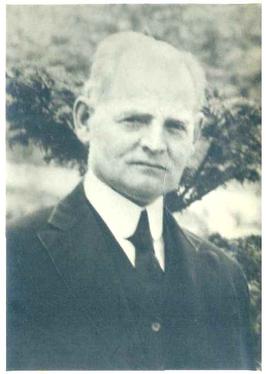
Robert Alexander Hardie was a Canadian physician and Methodist evangelist who for 45 years served as a missionary in Korea. He is recognized as the catalyst for the Wŏnsan Revival (1903) and also inspired the Great Pyongyang Revival (1907) in what is now North Korea.
References
- ↑ "TheGlasgowStory: Moody and Sankey".
- ↑ "International Christian College to Close - News - Life and Work". www.lifeandwork.org. Retrieved 19 February 2019.
- ↑ "Scottish School of Christian Mission donates The Grogan Library to NTC". NTC. 2 July 2018. Retrieved 19 February 2019.
