
The 12th century is the period from 1101 to 1200 in accordance with the Julian calendar. In the history of European culture, this period is considered part of the High Middle Ages and overlaps with what is often called the "'Golden Age' of the Cistercians". The Golden Age of Islam experienced significant development, particularly in Islamic Spain.
Year 1402 (MCDII) was a common year starting on Sunday of the Julian calendar.
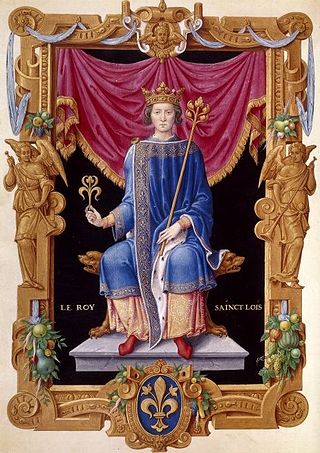
Year 1269 (MCCLXIX) was a common year starting on Tuesday of the Julian calendar.

The Holy Roman Emperor, originally and officially the Emperor of the Romans during the Middle Ages, and also known as the Roman-German Emperor since the early modern period, was the ruler and head of state of the Holy Roman Empire. The title was held in conjunction with the title of king of Italy from the 8th to the 16th century, and, almost without interruption, with the title of king of Germany throughout the 12th to 18th centuries.
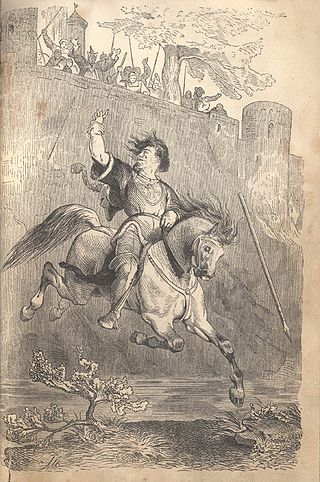
A robber baron or robber knight was an unscrupulous feudal landowner who, protected by his fief's legal status, imposed high taxes and tolls out of keeping with the norm without authorization by some higher authority. Some resorted to actual banditry. The German term for robber barons, Raubritter, was coined by Friedrich Bottschalk in 1810.
A reign is the period of a person's or dynasty's occupation of the office of monarch of a nation, of a people or of a spiritual community. In most hereditary monarchies and some elective monarchies there have been no limits on the duration of a sovereign's reign or incumbency, nor is there a term of office. Thus, a reign usually lasts until the monarch dies, unless the monarchy itself is abolished or the monarch abdicates or is deposed.

Conrad, a member of the Hohenstaufen dynasty, was the only son of Emperor Frederick II from his second marriage with Queen Isabella II of Jerusalem. He inherited the title of King of Jerusalem upon the death of his mother in childbed. Appointed Duke of Swabia in 1235, his father had him elected King of Germany and crowned King of Italy in 1237. After the emperor was deposed and died in 1250, he ruled as King of Sicily until his death.
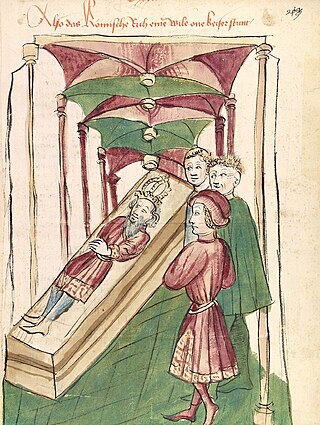
An interregnum is a period of discontinuity or "gap" in a government, organization, or social order. Archetypally, it was the period of time between the reign of one monarch and the next, and the concepts of interregnum and regency therefore overlap. Historically, longer and heavier interregna have been typically accompanied by widespread unrest, civil and succession wars between warlords, and power vacuums filled by foreign invasions or the emergence of a new power. A failed state is usually in interregnum.

King of Italy was the title given to the ruler of the Kingdom of Italy after the fall of the Western Roman Empire. The first to take the title was Odoacer, a barbarian warlord, in the late 5th century, followed by the Ostrogothic kings up to the mid-6th century. With the Frankish conquest of Italy in the 8th century, the Carolingians assumed the title, which was maintained by subsequent Holy Roman Emperors throughout the Middle Ages. The last Emperor to claim the title was Charles V in the 16th century. During this period, the holders of the title were crowned with the Iron Crown of Lombardy.
A personal union is a combination of two or more monarchical states that have the same monarch while their boundaries, laws, and interests remain distinct. A real union, by contrast, involves the constituent states being to some extent interlinked, such as by sharing some limited governmental institutions. Unlike a personal union, in a federation or a unitary state, a central (federal) government spanning all member states exists, with the degree of self-governance distinguishing the two. The ruler in a personal union does not need to be a hereditary monarch.

An imperial crown is a crown worn by an emperor. In the European cultural area, it also symbolizes the power of the empire in heraldic depictions. The craftsmanship corresponded to the king's crown, with precious stones and pearls set into the precious metal frame for decoration. Their external form differed from crowns of the same period and the same reign. The use of Christian symbols to emphasize the divine rule of the emperor is the reason for the deviation.
The reliable sources of British history do not use the term "British Emperor," nor did the government. The term "British Empire" is an unofficial designation and does not imply there was a person called "emperor." The term "emperor" has sometimes informally been retroactively applied to a few mythical and historical rulers of Great Britain, Ireland or the United Kingdom. It was sometimes used informally to designate either Plantagenet and Tudor caesaropapism. The term "Emperor of India" was officially a title for Queen Victoria and her successors down to 1948. There was never an official entity named "Empire of India." See British Raj for the part of India that Britain controlled.
The following outline is provided as an overview of and topical guide to the Middle Ages:
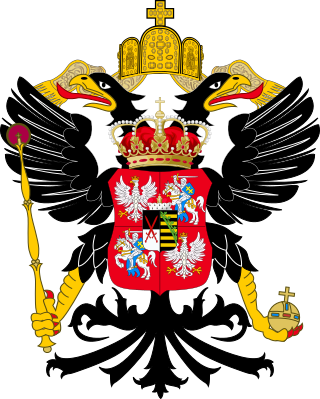
An imperial vicar was a prince charged with administering all or part of the Holy Roman Empire on behalf of the emperor. Later, an imperial vicar was invariably one of two princes charged by the Golden Bull with administering the Holy Roman Empire during an interregnum.

An imperial castle or Reichsburg was a castle built by order of the King of the Romans or the Holy Roman Emperor on land that was owned by the crown (Reichsgut).

Imperial Army or Imperial Troops was a name used for several centuries, especially to describe soldiers recruited for the Holy Roman Emperor during the early modern period. The Imperial Army of the Emperor should not be confused with the Army of the Holy Roman Empire, which could only be deployed with the consent of the Imperial Diet. The Imperialists effectively became a standing army of troops under the Habsburg Emperors from the House of Austria, which is why they were also increasingly described in the 18th century as "Austrians", although its troops were recruited not just from the Archduchy of Austria but from all over the Holy Roman Empire.
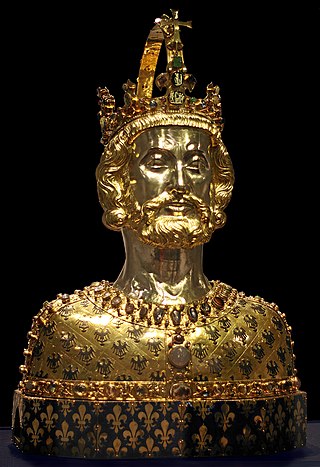
King is the title given to a male monarch in a variety of contexts. A king is an absolute monarch if he holds the powers of government without control, or the entire sovereignty over a nation; he is a limited monarch if his power is restrained by fixed laws; and he is an absolute, when he holds the whole legislative, judicial, and executive power, or when the legislative or judicial powers, or both, are vested in other people by the king. Kings are hereditary sovereigns when they hold the powers of government by right of birth or inheritance, and elective when raised to the throne by choice.
In the Holy Roman Empire, the Great Interregnum was a period of time, from 1246 until 1273, following the throne dispute of Frederick II where the succession of the Holy Roman Empire was contested and fought over between pro- and anti-Hohenstaufen factions. Starting around 1250 with the death of Frederick II, the conflict over who was the rightful emperor and King of the Romans would continue into the 1300s until Charles IV of Luxembourg was elected emperor and secured succession for his son Wenceslaus. This period saw a multitude of emperors and kings be elected or propped up by rival factions and princes, with many kings and emperors having short reigns or reigns that became heavily contested by rival claimants.

The imperial election of 1273 was an imperial election held to select the emperor of the Holy Roman Empire. It took place in Frankfurt on October 1.

