Inverkeithing Friary

Last updated
Inverkeithing Friary
Hospitium of the Grey Friars Inverkeithing.jpg
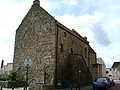
Inverkeithing Friary from South aspect.
LocationQueen Street, Inverkeithing
Coordinates 56°01′47″N3°23′54″W / 56.02977°N 3.39843°W / 56.02977; -3.39843
BuiltBefore 1385
Listed Building – Category A
Official nameQueen Street, The Friary including Well and Vaulted Cellars
Designated11 December 1972
Reference no.LB35100
Fife UK location map.svg
Red pog.svg
Shown in Fife

Inverkeithing Friary, formally known as the Hospitium of the Grey Friars, is a 14th-century friary building and gardens located Inverkeithing, Fife, Scotland. [1]

Contents

The surviving friary building is considered to be the finest remaining example of a medieval friary building in Scotland. [2] The building was restored in the 1930s and is now a Category A listed historic site by Historic Environment Scotland. [3]

The building now features as a focal point on the Fife Pilgrim Way, a long-distance footpath commemorating the journey of pilgrims through Fife during the medieval era. [4] It is now used as a community centre.

History

The friary could date from the late 13th century, with a charter in 1268 mentioning the building of a church and convent for the Franciscans. It may have been founded by Philip Mowbray, Lord of Barnbougle on the opposite shore of the Forth. There are no further mentions of the friary until 1384, but at the time, it would have been a thriving hub for pilgrims to Dunfermline and St Andrews, comprising accommodations, cloisters, storage cellars, and a chapel. The friary was sold to a private buyer in 1559 during the Scottish Reformation and remodeled into a tenement. [5]

Architecture

The hospitium visible today once formed the west end of the friary, and it was the only building preserved during the 16th-century alterations, while the rest of the complex was used as a quarry. An antiquarian renovation in 1932–1935 restored the 14th-century details for which there was evidence, and otherwise retained the 17th-century finishes. The building was originally cruciform, but only its central part remains, including several tunnel vaults formerly used for storage. [3]

Gardens

The friary building features gardens overlooking the Firth of Forth, some of which formed the former courtyard of the friary. The foundations of the north range of the complex, together with a well and several cellars, can be seen in the gardens, as well as a former well grated with a grille. [3] [6]

Photographs

References

  1. "Inverkeithing, Queen Street, Friary And Museum | Canmore". canmore.org.uk. Retrieved 2025-03-14.
  2. "Fife business - Hospitium of the Grey Friars". Welcome to Fife - View Business. Retrieved 2025-03-14.
  3. 1 2 3 "QUEEN STREET, THE FRIARY INCLUDING WELL AND VAULTED CELLARS (LB35100)". portal.historicenvironment.scot. Archived from the original on 2024-11-30. Retrieved 2025-08-14.
  4. "North Queensferry to Dunfermline". Fife Coast & Countryside Trust. Retrieved 2025-08-15.
  5. Bradley, Ian (2019). The Fife Pilgrim Way: In the Footsteps of Monks, Miners and Martyrs. La Vergne: Birlinn. ISBN   978-1-78027-592-5.
  6. "Inverkeithing, Queen Street, ... | Place | trove.scot". www.trove.scot. Retrieved 2025-11-27.