Related Research Articles

Gherla is a municipality in Cluj County, Romania. It is located 45 kilometres (28 mi) from Cluj-Napoca on the river Someșul Mic, and has a population of 19,873 as of 2021. Three villages are administered by the city: Băița, Hășdate (Szamoshesdát) and Silivaș (Vizszilvás).

Țaga is a commune in Cluj County, Transylvania, Romania. It is composed of five villages: Năsal (Noszoly), Sântejude (Vasasszentegyed), Sântejude-Vale, Sântioana (Vasasszentiván), and Țaga.

Tudor Gheorghe is a Romanian musician, actor, and poet known primarily for his politically charged musical career and his collaborations with well-known figures of late 20th-century Romanian poetry. His recording work is sometimes associated with anti communist activism and has received much critical acclaim over the years. The son of an Iron Guard member, he was banned from performing and recording in 1987 after a concert at Sala Palatului in Bucharest, following a number of run-ins with Romania's communist authorities throughout the 1970s and 1980s.

The Lucian Blaga National Theatre is in Cluj-Napoca, Romania, sharing its building with the Romanian Opera.
The Transylvania State Philharmonic Orchestra or Cluj-Napoca Philharmonic, based in Cluj-Napoca, has grown to a valuable institution of music, having a sustained presence in the Romanian and European cultural space.
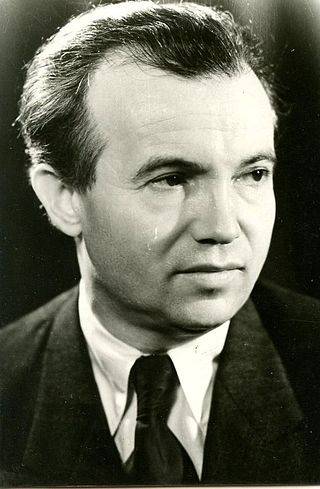
Mihai Beniuc was a Romanian socialist realist poet, dramatist, and novelist.

Alimpiu Barbuloviciu was the Vicar Forane of the Greek Catholic Vicariate of Șimleu Silvaniei (1873–1913) and the head of the branch of Astra in Sălaj County.

Fotbal Club Unirea Dej, commonly known as Unirea Dej, is a Romanian professional football club based in Dej, Cluj County, that competes in the Liga III, the third tier of the Romanian football.

Gherla Prison is a penitentiary located in the Romanian city of Gherla, in Cluj County. The prison dates from 1785; it is infamous for the treatment of its political inmates, especially during the Communist regime. In Romanian slang, the generic word for a prison is "gherlă", after the institution.
Victor Deleu was a politician from Romania.
Ioan Dragomir was a Romanian bishop of the Greek-Catholic Church.

Ion Gavrilă Ogoranu was a member of the fascist paramilitary organization Iron Guard, who between 1948 and 1955, after the Soviet occupation of Romania and the establishment of the Romanian People's Republic, became the leader of an underground anti-communist paramilitary group in the Făgăraș Mountains.

Emil Simon was a Romanian conductor and composer.
Fotbal Club Armătura Zalău, commonly known as Armătura Zalău, was a Romanian professional football club based in Zalău, Sălaj County. The club was founded in 1946 as CS Zalău and since 1975 was owned by IAIFO.
Sport Club Municipal Zalău, commonly known as SCM Zalău, is a Romanian professional football club based in Zalău, Sălaj County. This team represents the football section of the multi-sport club SCM Zalău, which also include athletics, boxing, tennis, table tennis, Greco-Roman wrestling and handball (youth).
Events from the year 1959 in Romania. During the year, the country hosted the first International Mathematical Olympiad.
References
- ↑ Aris-Cristian Petreuș, Reuniunea Corală "Camerata Academica Porolissensis" – Zalău, 40 de ani de activitate neîntreruptă, Editura MediaMusica, Cluj-Napoca 2011, p. 44.
- ↑ Aris-Cristian Petreuș, Op. Cit. pp. 27–28.
- ↑ "DECRET nr. 1.097 din 10 decembrie 2004 privind conferirea Ordinului si Medaliei Meritul pentru Invatamant".