Related Research Articles

In Greco-Roman mythology, Aeneas was a Trojan hero, the son of the Trojan prince Anchises and the Greek goddess Aphrodite. His father was a first cousin of King Priam of Troy, making Aeneas a second cousin to Priam's children. He is a minor character in Greek mythology and is mentioned in Homer's Iliad. Aeneas receives full treatment in Roman mythology, most extensively in Virgil's Aeneid, where he is cast as an ancestor of Romulus and Remus. He became the first true hero of Rome. Snorri Sturluson identifies him with the Norse god Víðarr of the Æsir.
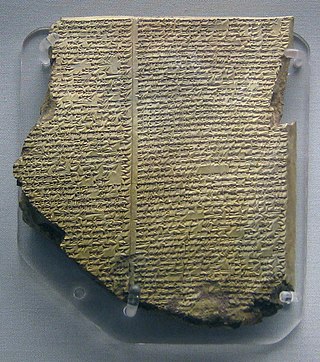
An epic poem, or simply an epic, is a lengthy narrative poem typically about the extraordinary deeds of extraordinary characters who, in dealings with gods or other superhuman forces, gave shape to the mortal universe for their descendants.
In Greek mythology, the Nereids or Nereides are sea nymphs, the 50 daughters of the 'Old Man of the Sea' Nereus and the Oceanid Doris, sisters to their brother Nerites. They often accompany Poseidon, the god of the sea, and can be friendly and helpful to sailors.

Publius Vergilius Maro, usually called Virgil or Vergil in English, was an ancient Roman poet of the Augustan period. He composed three of the most famous poems in Latin literature: the Eclogues, the Georgics, and the epic Aeneid. A number of minor poems, collected in the Appendix Vergiliana, were attributed to him in ancient times, but modern scholars consider his authorship of these poems to be dubious.

Titus Lucretius Carus was a Roman poet and philosopher. His only known work is the philosophical poem De rerum natura, a didactic work about the tenets and philosophy of Epicureanism, which usually is translated into English as On the Nature of Things—and somewhat less often as On the Nature of the Universe. Very little is known about Lucretius's life; the only certainty is that he was either a friend or client of Gaius Memmius, to whom the poem was addressed and dedicated. De rerum natura was a considerable influence on the Augustan poets, particularly Virgil and Horace. The work was almost lost during the Middle Ages, but was rediscovered in 1417 in a monastery in Germany by Poggio Bracciolini and it played an important role both in the development of atomism and the efforts of various figures of the Enlightenment era to construct a new Christian humanism.
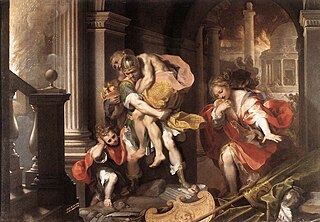
The Aeneid is a Latin epic poem that tells the legendary story of Aeneas, a Trojan who fled the fall of Troy and travelled to Italy, where he became the ancestor of the Romans. Written by the Roman poet Virgil between 29 and 19 BC, the Aeneid comprises 9,896 lines in dactylic hexameter. The first six of the poem's twelve books tell the story of Aeneas' wanderings from Troy to Italy, and the poem's second half tells of the Trojans' ultimately victorious war upon the Latins, under whose name Aeneas and his Trojan followers are destined to be subsumed.

In Greek mythology, Neoptolemus, originally called Pyrrhus at birth, was the son of the warrior Achilles and the princess Deidamia, and the brother of Oneiros. He became the mythical progenitor of the ruling dynasty of the Molossians of ancient Epirus. In a reference to his pedigree, Neoptolemus was sometimes called Achillides or, from his grandfather's or great-grandfather's names, Pelides or Aeacides.
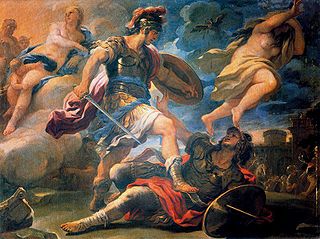
Turnus was the legendary King of the Rutuli in Roman history, and the chief antagonist of the hero Aeneas in Virgil's Aeneid.
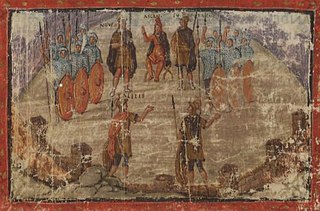
The Vergilius Vaticanus, also known as Vatican Virgil, is a Late Antique illuminated manuscript containing fragments of Virgil's Aeneid and Georgics. It was made in Rome in around 400 CE, and is one of the oldest surviving sources for the text of the Aeneid. It is the oldest and one of only three ancient illustrated manuscripts of classical literature.

The Georgics is a poem by Latin poet Virgil, likely published in 29 BCE. As the name suggests the subject of the poem is agriculture; but far from being an example of peaceful rural poetry, it is a work characterized by tensions in both theme and purpose.

The Eclogues, also called the Bucolics, is the first of the three major works of the Latin poet Virgil.

In Greek and Roman mythology, Nisus and Euryalus are a pair of friends serving under Aeneas in the Aeneid, the Augustan epic by Virgil. Their foray among the enemy, narrated in book nine, demonstrates their stealth and prowess as warriors, but ends as a tragedy: the loot Euryalus acquires attracts attention, and the two die together. Virgil presents their deaths as a loss of admirable loyalty and valor. They also appear in Book 5, during the funeral games of Anchises, where Virgil takes note of their amor pius, a love that exhibits the pietas that is Aeneas's own distinguishing virtue.
William Francis Jackson Knight (1895–1964) was an English classical scholar.
The Sortes Vergilianae is a form of divination by bibliomancy in which advice or predictions of the future are sought by interpreting passages from the works of the Roman poet Virgil. The use of Virgil for divination may date to as early as the second century AD, and is part of a wider tradition that associated the poet with magic. The system seems to have been modeled on the ancient Roman sortes as seen in the Sortes Homericae, and later the Sortes Sanctorum.
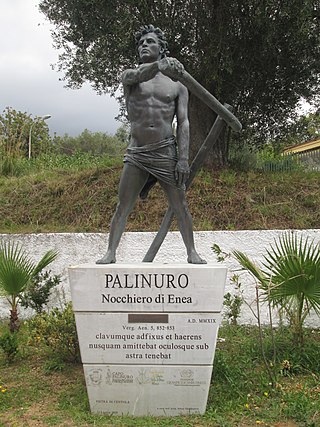
Palinurus (Palinūrus), in Roman mythology and especially Virgil's Aeneid, is the coxswain of Aeneas' ship. Later authors used him as a general type of navigator or guide. Palinurus is an example of human sacrifice; his life is the price for the Trojans landing in Italy.
An epic catalogue is a long, detailed list of objects, places or people that is a characteristic of epic poetry.
The term alliteration was invented by the Italian humanist Giovanni Pontano (1426–1503), in his dialogue Actius, to describe the practice common in Virgil, Lucretius, and other Roman writers of beginning words or syllables with the same consonant or vowel. He gives examples such as Sale Saxa Sonābant "the rocks were resounding with the salt-water" or Anchīsēn Agnōvit Amīcum "he recognised his friend Anchises" or Multā Mūnīta Virum Vī "defended by a great force of men".

Corynaeus is the name of one or more characters in Virgil's Aeneid (29–19 BCE). The first mention of Corynaeus in the poem is as a Trojan follower of Aeneas, who performs funerary rites for Misenus. Characters of the same name are then specified both as being killed by an archer, and later fighting in the final battle. This apparent contradiction is often explained by defining them as two separate characters.

Eclogue 9 is a pastoral poem by the Latin poet Virgil, one of his series of ten poems known as the Eclogues. This eclogue describes the meeting of two countrymen Lycidas and Moeris. Moeris has been turned out of his farm and is taking some kid goats to town for the new occupant; young Lycidas is astonished, for he had heard that Menalcas had secured the safety of the district by his poetry, but Moeris replies that, so far from that being so, he and Menalcas himself had barely escaped with their lives: they then proceed to recall passages of Menalcas' poetry. Lycidas wants to continue singing to lighten the journey but the distressed Moeris begs him to cease, promising that they will sing again when Menalcas returns.
Eclogue 10 is a pastoral poem by the Latin poet Virgil, the last of his book of ten poems known as the Eclogues written approximately 42–39 BC. The tenth Eclogue describes how Cornelius Gallus, a Roman officer on active service, having been jilted by his girlfriend Lycoris, is imagined as an Arcadian shepherd, and either bewails his lot or seeks distraction in hunting "with the Nymphs" amid "Parthenian glades" and "hurling Cydonian arrows from a Parthian bow".
References
- ↑ Segal, Charles (1971). "The Song of Iopas in the Aeneid". Hermes. 99 (3): 336–349. JSTOR 4475696.
- ↑ Carranza, Paul (2002). "Philosophical Songs: The "Song of Iopas" in the "Aeneid" and the Francesca Episode in Inferno 5". Dante Studies, with the Annual Report of the Dante Society (120): 35–51. JSTOR 40166572.
- 1 2 Perkell, Christine G. (1999). "Aeneid 1: An Epic Program". In Christine G. Perkell (ed.). Reading Vergil's Aeneid: An Interpretive Guide. U of Oklahoma P. pp. 29–59. ISBN 9780806131399.
- ↑ Adler, Eve (2004). Vergil's Empire: Political Thought in the Aeneid. Rowman & Littlefield. pp. 9–16. ISBN 9780585455099.
- ↑ Timothy Power: VERGIL’S CITHARODES: CRETHEUS AND IOPAS RECONSIDERED in VergiliusVol. 63 (2017), pp. 93-124. Published by The Vergilian Society