
Look up ivorian in Wiktionary, the free dictionary.
Ivorian may refer to:
Ivorian may refer to:

The date of the first human presence in Ivory Coast has been difficult to determine because human remains have not been well preserved in the country's humid climate.

Ivory Coast, also known as Côte d'Ivoire, officially the Republic of Côte d'Ivoire, is a country on the southern coast of West Africa. Its capital is Yamoussoukro, in the centre of the country, while its largest city and economic centre is the port city of Abidjan. It borders Guinea to the northwest, Liberia to the west, Mali to the northwest, Burkina Faso to the northeast, Ghana to the east, and the Gulf of Guinea to the south. Its official language is French, and indigenous languages are also widely used, including Bété, Baoulé, Dioula, Dan, Anyin, and Cebaara Senufo. In total, there are around 78 different languages spoken in Ivory Coast. The country has a religiously diverse population, including numerous followers of Christianity, Islam and indigenous faiths such as Animism.

Koudou Laurent Gbagbo is an Ivorian politician who was the President of Côte d'Ivoire from 2000 until his arrest in April 2011. A historian, Gbagbo was imprisoned in the early 1970s and again in the early 1990s, and he lived in exile in France during much of the 1980s as a result of his union activism. Gbagbo founded the Ivorian Popular Front (FPI) in 1982 and ran unsuccessfully for president against Félix Houphouët-Boigny at the start of multi-party politics in 1990. He won a seat in the National Assembly of Côte d'Ivoire in 1990.

The music of Ivory Coast includes music genres of many ethnic communities, often characterised by vocal polyphony especially among the Baoulé, talking drums especially among the Nzema people and by the characteristic polyrhythms found in rhythm in Sub-Saharan Africa.
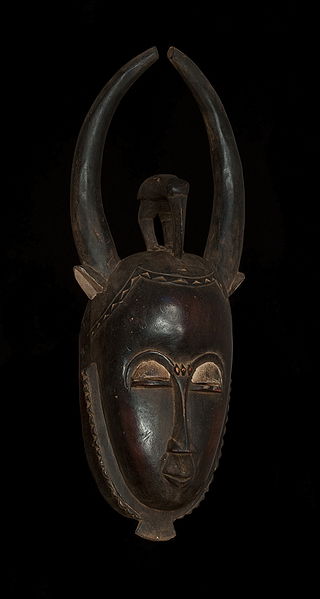
The Baule or Baoulé are a Kwa people and one of the largest ethnicities in Côte d'Ivoire. The Kwa family branch is a part of Niger-Congo phylum. This branch consists of around 50 different languages spoken by about 25 million people in the west coast of Africa stretching from Ivory Coast to western Nigeria. Most notably, in southeastern Ivory Coast, south Togo, south Benin, and south Ghana. The largest Kwa languages are: Ewe, Akan and Baule. The Baoulé are traditionally farmers who live in the centre of Côte d'Ivoire, in a French braid shaped region between the rivers Bandama and N'Zi. This area broadly encompasses the regions around the cities of Bouaké and Yamoussoukro. The Baoulé have come to play a relatively important role in the recent history of Côte d'Ivoire: the State's first President, Félix Houphouët-Boigny, was a Baoulé; additionally, since the Ivorian cocoa boom of the 1960-1970s, the Baoulé have also become one of the most widespread ethnicity throughout the country, especially in the Southern forests where they are amongst the most numerous planters of cocoa, rubber, and coffee and sometimes seem to outnumber the local native ethnic groups.

Alassane Dramane Ouattara is an Ivorian politician who has been President of Ivory Coast since 2010. An economist by profession, Ouattara worked for the International Monetary Fund (IMF) and the Central Bank of West African States, and he was the Prime Minister of Côte d'Ivoire from November 1990 to December 1993, appointed to that post by President Félix Houphouët-Boigny. Ouattara became the President of the Rally of the Republicans (RDR), an Ivorian political party, in 1999.
The diverse culture of Ivory Coast, a coastal West African country bordered by Ghana, Liberia, Mali, Burkina Faso, and Guinea, is exemplified by a multitude of ethnic groups, events, festivals, music, and art.
Hip hop is a major part of the popular music of Côte d'Ivoire, and has been fused with many of the country's native styles, such as zouglou.
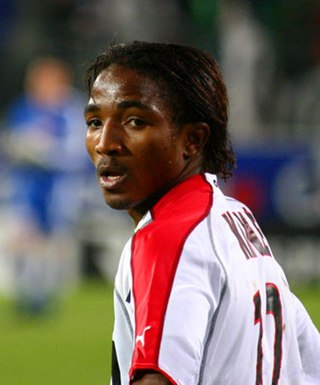
Bakari Koné is an Ivorian former professional footballer who played as a winger.
Konan may refer to:
Coulibaly is a common Bambara language surname in West Africa, especially in Mali and Ivory Coast. It may refer to:

Religion in Ivory Coast is diverse, with no particular religion representing the majority of the population. According to the 2021 census, Islam is professed by 42.5% of the total population, while adherents of Christianity represented 39.8% of the population. In addition, 12.6% of Ivorians reported to be Irreligious and 2.2% claimed to follow Animism. Between the 2014 and 2021 censuses, the share of Christians increased from 33.9 to 39.8 percent, while the share of Muslims declined from 42.9 to 42.5 percent of the total population.
The following outline is provided as an overview of and topical guide to Ivory Coast:
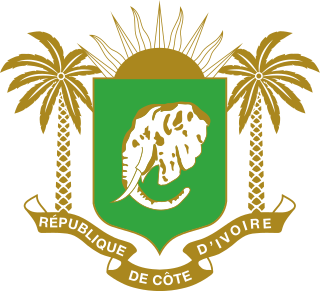
The Constitution of Ivory Coast was approved by referendum on October 30, 2016 and officially adopted on November 8, 2016.
Ivorian Americans are an ethnic group of Americans of Ivorian descent. According to estimates, in 2014 there were 6,000 people in the United States of Ivorian ancestry.
The Abbé, are an Akan people who live predominantly in the Ivory Coast, and number 580,000. Abbés speak the Akan dialect Abé.

Canada–Ivory Coast relations are the diplomatic relations between Canada and Ivory Coast. Both nations are members of the Organisation internationale de la Francophonie.
Ivorian nationality law is regulated by the Constitution of Ivory Coast, as amended; the Ivorian Nationality Code, and its revisions; and various international agreements to which the country is a signatory. These laws determine who is, or is eligible to be, a national of Ivory Coast. The legal means to acquire nationality, formal legal membership in a nation, differ from the domestic relationship of rights and obligations between a national and the nation, known as citizenship. Nationality describes the relationship of an individual to the state under international law, whereas citizenship is the domestic relationship of an individual within the nation. Ivorian nationality is typically obtained under the principle of jus soli, i.e. by birth in Ivory Coast, or jus sanguinis, i.e. by birth in Ivory Coast or abroad to parents with Ivorian nationality. It can be granted to persons with an affiliation to the country, or to a permanent resident who has lived in the country for a given period of time through naturalization.

France–Ivory Coast relations are the diplomatic relations between the French Republic and the Republic of Ivory Coast. Both nations are members of the Organisation internationale de la Francophonie and the United Nations.