
Manorialism, also known as seigneurialism, the manor system or manorial system, was the method of land ownership in parts of Europe, notably France and later England, during the Middle Ages. Its defining features included a large, sometimes fortified manor house in which the lord of the manor and his dependants lived and administered a rural estate, and a population of labourers or serfs who worked the surrounding land to support themselves and the lord. These labourers fulfilled their obligations with labour time or in-kind produce at first, and later by cash payment as commercial activity increased. Manorialism was part of the feudal system.

The House of Bourbon is a dynasty that originated in the Kingdom of France as a branch of the Capetian dynasty, the royal House of France. Bourbon kings first ruled France and Navarre in the 16th century. A branch descended from the French Bourbons came to rule Spain in the 18th century and is the current Spanish royal family. Further branches, descended from the Spanish Bourbons, held thrones in Naples, Sicily, and Parma. Today, Spain and Luxembourg have monarchs of the House of Bourbon. The royal Bourbons originated in 1272, when Robert, the youngest son of King Louis IX of France, married the heiress of the lordship of Bourbon. The house continued for three centuries as a cadet branch, serving as nobles under the direct Capetian and Valois kings.

Serfdom was the status of many peasants under feudalism, specifically relating to manorialism, and similar systems. It was a condition of debt bondage and indentured servitude with similarities to and differences from slavery. It developed during late antiquity and the Early Middle Ages in Europe and lasted in some countries until the mid-19th century.

The manorial system of New France, known as the seigneurial system, was the semi-feudal system of land tenure used in the North American French colonial empire. Economic historians have attributed the wealth gap between Quebec and other parts of Canada in the 19th and early 20th century to the persistent adverse impact of the seigneurial system.

Jacques Nompar de Caumont, 1st Duke of La Force was a Marshal of France and Peer of France. He was the son of a Huguenot, Francois de Caumont, lord of Castelnau, and Philippe de Beaupoil. He survived the St. Bartholomew's Day Massacre in 1572, but his father and older brother Armand were killed.

Château du Plessis-Bourré is a château in the Loire Valley in France, situated in the commune of Écuillé in the Maine-et-Loire department. Built in less than 5 years from 1468 to 1472 by Finance Minister Jean Bourré, the principal advisor to King Louis XI. The château has not been modified externally since its construction and still has a fully working drawbridge. It was classified as a Monument historique in 1931.

Forges-les-Eaux is a commune in the Seine-Maritime department in the Normandy region in northern France. On 1 January 2016, the former commune of Le Fossé was merged into Forges-les-Eaux.
Roger Bourdin was a French baritone, particularly associated with the French repertory. His career was largely based in France. His daughter is Françoise Bourdin.

Jean-Jacques de Mesmes, comte d'Avaux, vicomte de Neufchâtel (1630–1688) was a French magistrate, intendant of Soissons, and Président à mortier of the Parlement of Paris. He developed the town of Avaux-la-Ville, which is now called Asfeld. He was a member of the Académie française. He was brother of Jean-Antoine de Mesmes, the diplomat, and father of Jean-Antoine de Mesmes, the premier president of the Parlement of Paris.

Peter of Luxembourg was count of Saint-Pol. His inheritance included the counties of Brienne, Conversano and Saint-Pol.
Claude III de l’Aubespine, seigneur de Hauterive, baron of Châteauneuf-sur-Loire was a French diplomat, and Secretary of State. His father, Claude II de l'Aubespine was a key negotiator in the treaty of Cateau-Cambrésis (1559).
Guillaume Bochetel, seigneur de Sassy, Brouillamenon, Laforest-Thaumyer was a statesman and diplomat of the French Renaissance during the reigns of François I and Henry II of France.

The House of Potier was a noble house in Ancien Régime France. Members of the Potier family were Nobles of the Robe who gained their prominence through serving the King of France.
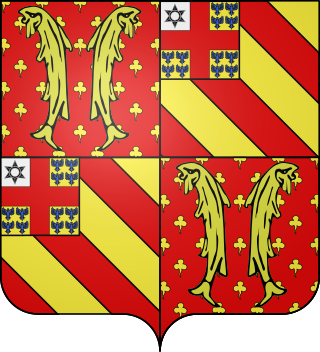
Guy I of Clermont-Nesle was a Marshal of France, Seigneur (Lord) of Offemont jure uxoris, and possibly of Ailly, Maulette and Breteuil. He might have been a Seigneur of Nesle also, or used the title "Sire of Nesle" due to his family. Difficulties about the seigneurie of Breteuil are present, and the status of Ailly and Maulette in relation to Breteuil.

Raoul II/III of Clermont-Nesle was Seigneur (Lord) of Nesle in Picardy (de), Viscount of Châteaudun (de), Grand Chamberlain of France and Constable of France.

Henri Jacques Nompar de Caumont, 5th Duke of La Force was a French nobleman and peer, the son of Jacques-Nompar II de Caumont, duc de La Force and Suzanne de Beringhen. He was a member of the Académie française.
John I (Jean) (d. 1278 or 1279), Count of Looz and Count of Chiny, eldest son of Arnold IV, Count of Looz and Chiny, and Jeanne, Countess of Chiny. He succeeded his father in 1272 or 1273, as the Count of Looz and Chiny. Virtually nothing is known about his reign.
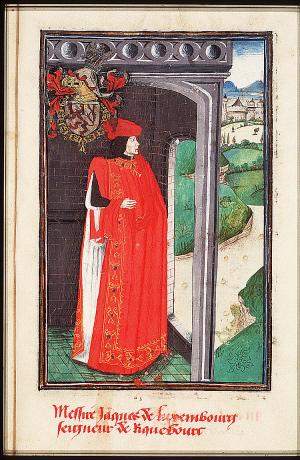
Jacques de Luxembourg, Seigneur de Richebourg was a French noble who served Charles the Bold, Duke of Burgundy and later King Louis XI of France.

Jean-Jacques Bourdin is a French journalist, radio and television presenter. Since 2001, he has hosted the morning radio programme Bourdin Direct on RMC. Since 2018, he has also presented the monthly talk show Rien n'est impossible on RMC Story.
