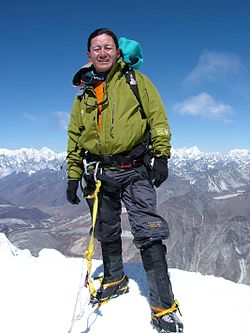
Jamling Tenzing Norgay (born 23 April 1965) is an Indian[2][3] mountaineer and author, best known for summiting Mount Everest as part of the 1996 Everest IMAX expedition. He was born in Darjeeling, India, and is the son of Tenzing Norgay.
He later followed in his father's footsteps and climbed Mount Everest in 1996 with a team led by David Breashears that also included mountaineer Ed Viesturs and Araceli Segarra, an experience documented in the 1998 IMAX film Everest. In 2002, he and Peter Hillary, the son of Edmund Hillary, were part of an expedition to climb Everest and commemorate the 50th anniversary of the first ascent.[6]
Norgay went on to write Touching My Father's Soul, a book documenting his experiences on the summit attempt. The book was notable for the frankness with which it discussed the relationship between the often wealthy climbers and the Sherpas who obtain their incomes from assisting expeditions. Norgay's book was the first to discuss from the Sherpas' point of view of the disastrous May 1996 climbing season, in which twelve climbers died. It noted that little notice is taken when Sherpas die, but much attention is given when those lost are clients.[6]
Jamling Tenzing Norgay and Sir Edmund Hillary receiving Everest 50 Years Award from Prime Minister of India Atal Bihari Vajpayee in 2003.
Bibliography
Norgay, Jamling Tenzing (2001), Touching my father's soul: a Sherpa's journey to the top of Everest (reprinted.), HarperSanFrancisco, ISBN978-0-06-251687-9
↑Chhetri, Aishwarya Thapa (16 June 2024). "A father's Everest legacy inspires mountaineer from India". NBC News. Retrieved 30 December 2025. A headline on an earlier version of this article misstated the nationality of mountaineer Jamling Tenzing Norgay. He is from India, not Nepal.
↑Norgay, Jamling Tenzing; Coburn, Broughton (2001). Touching My Father's Soul: A Sherpa's Journey to the Top of Everest (1sted.). San Francisco, Calif: HarperSanFrancisco. p.277. ISBN978-0-06-251687-9. I have my own citizenship and identity issues, although they may be less complicated than my father's, I was born in India as an Indian citizen, and I remain an Indian to this day. My quandary mainly concerns cultural identity. I've decided that I belong to both cultures, East and West, and both belong to me.
↑Norgay, Jamling Tenzing; Coburn, Broughton (2001). Touching my father's soul: a Sherpa's journey to the top of Everest (1sted.). San Francisco, Calif: HarperSanFrancisco. pp.xv. ISBN978-0-06-251687-9.
↑Norgay, Jamling Tenzing; Coburn, Broughton (2001). Touching my father's soul: a Sherpa's journey to the top of Everest (1sted.). San Francisco, Calif: HarperSanFrancisco. p.84. ISBN978-0-06-251687-9.
This page is based on this Wikipedia article Text is available under the CC BY-SA 4.0 license; additional terms may apply. Images, videos and audio are available under their respective licenses.