This article has multiple issues. Please help improve it or discuss these issues on the talk page . (Learn how and when to remove these messages)
|
Jean Pierre (29 September 1831 - 16 September 1873) was one of five Breton missionary priests to Louisiana who made a sacrifice of their lives in the 1873 Yellow Fever Epidemic in Shreveport, Louisiana. The group is collectively known as the Shreveport Martyrs. On December 8, 2020, Bishop Francis Malone of the Diocese of Shreveport declared him to be a Servant of God, opening the diocesan phase of inquiry into a Cause of Beatification and Canonization. In 2022, the Vatican's Dicastery for the Causes of Saints permitted Father Pierre and the other four Shreveport Martyrs to proceed for consideration as a single Cause. [1] Peter B. Mangum serves as the Episcopal Delegate for the Cause.
Born in Lanloup, France to Guillame and Claudine Pierre, he entered the Petit Seminaire de Tréguier on 3 August 1845, weeks before his fourteenth birthday. He joined a student association known as The Congregation of the Most Holy Virgin, a community dedicated to the cultivation of deeper personal piety. This association required a formal written pledge which Pierre signed, which reads, “after satisfying a time of approval, Jean Pierre of Lanloup is received into the Congregation of the Most Holy Virgin established in the ecclesiastical school.” [2]
On 1 October 1852, Pierre entered the Grand Seminaire de Saint-Brieuc. A signed document from the bishop of Saint-Brieuc, Jacques-Jean-Pierre Le Mée, acknowledged Pierre’s placement as second in his graduating class. Bishop Augustus Marie Martin recruited him to come to the newly erected Diocese of Natchitoches in Louisiana and Pierre departed the port of Le Havre on 8 October 1854. [3]
Ordained to the priesthood for the Diocese of Natchitoches on 22 September 1855, Pierre's first assignment was the construction of a church and rectory at Bayou Pierre, Louisiana. He completed this by mid-1856, when Bishop Martin assigned him to the task of building a permanent church for Shreveport. [4] Pierre became the first pastor of Holy Trinity Catholic Church (Shreveport, Louisiana) and was serving there when the Yellow Fever Epidemic of 1873 struck the city. [5]
Pierre was among the first to volunteer for the relief effort that the Howard Association organized in the city on 2 September. He worked with his assistant pastor, Isidore Quémerais, along with religious sisters from the Daughters of the Cross Convent in Shreveport, to care for fever victims in what was designated as Fever Ward Number 1 (most of downtown Shreveport). [6] Pierre and his assistant pastor fell ill with the fever within the first ten days of their field hospital mission work, and Pierre succumbed to the disease on 16 September 1873, just one day after Father Quémerais died. [7] At Father Pierre's bedside to administer the final sacraments of the Catholic Church was Father Jean Marie Biler, chaplain of the Daughters of the Cross, who was the third Shreveport priest to respond to the fever-stricken city and who then took the place of Pierre in leading a compassionate relief effort. [8]
Pierre was originally buried beneath the church he built in Shreveport, Holy Trinity Catholic Church (Shreveport, Louisiana), before his remains were moved in 1884 to St. Joseph's Catholic Cemetery in Shreveport. There he is buried with three of the other Shreveport Martyrs beneath a large Calvary monument. [9]
The Diocese of Alexandria in Louisiana is a Latin Church ecclesiastical territory, or diocese, of the Catholic Church in central Louisiana in the United States. It is a suffragan diocese in the ecclesiastical province of the metropolitan Archdiocese of New Orleans.
The Daughters of the Cross of Liège are religious sisters in the Catholic Church who are members of a religious congregation founded in 1833 by Marie Thérèse Haze (1782–1876). The organization's original mission is focused on caring for the needs of their society through education and nursing care.
The Diocese of Natchitoches was a Latin Church residential episcopal see of the Catholic Church from 1853 to 1910 and is now a titular see.
The Diocese of Shreveport is a Latin Church ecclesiastical territory, or diocese, of the Catholic Church covering the parishes of northern Louisiana in the United States.
The Metropolitan Archdiocese of Montpellier (–Lodève–Béziers–Agde–Saint-Pons-de-Thomières) is a Latin archdiocese of the Catholic Church in south-western France. The current metropolitan archbishop is Pierre-Marie Carré; the immediate past Archbishop Emeritus is Guy Marie Alexandre Thomazeau. On September 16, 2002, as part of the reshuffling of the map of the French ecclesiastical provinces, the diocese of Montpellier ceased to be a suffragan of Avignon and was elevated to archdiocese and metropolitan of a new ecclesiastical province, with the dioceses of Carcassonne, Mende, Nimes and Perpignan–Elne as suffragans.
The former Breton and French diocese of Tréguier existed in Lower Brittany from about the sixth century, or later, to the French Revolution. Its see was at Tréguier, in the modern department of Côtes-d'Armor.
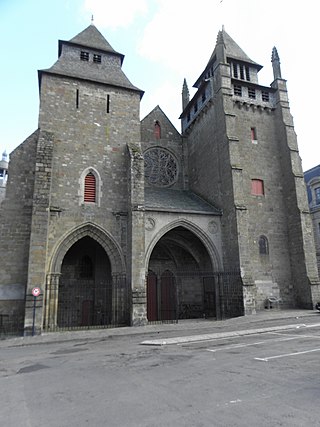
Tréguier Cathedral is a Roman Catholic church and former cathedral in Tréguier, Côtes-d'Armor, France. It is dedicated to Saint Tudwal. The church was formerly the seat of the Bishopric of Tréguier, abolished under the Concordat of 1801, when its territories were divided between the Diocese of Quimper and the Diocese of Saint-Brieuc, known since 1852 as Saint-Brieuc-Tréguier.
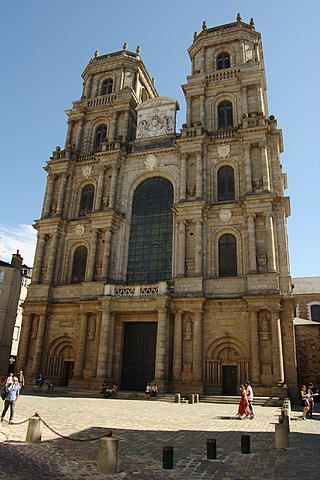
The Archdiocese of Rennes, Dol, and Saint-Malo is a Latin Church diocese of the Catholic Church in France. The diocese is coextensive with the department of Ille et Vilaine. The Archdiocese has 8 suffragans: the Diocese of Angers, the Diocese of Laval, the Diocese of Le Mans, the Diocese of Luçon, the Diocese of Nantes, the Diocese of Quimper and Léon, the Diocese of Saint-Brieuc and Tréguier, and the Diocese of Vannes.
The Diocese of Saint-Brieuc and Tréguier is a Latin Church diocese of the Catholic Church in France. The diocese comprises the department of Côtes d'Armor in the Region of Brittany. The diocese is currently suffragan to the Archdiocese of Rennes, Dol, and Saint-Malo. The current bishop is Denis Moutel, appointed in 2010.
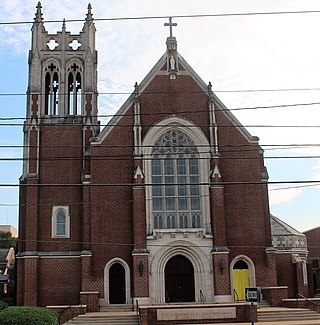
Holy Trinity Catholic Church in Shreveport, Louisiana was built in 1896. It was listed on the National Register of Historic Places in 1984. The current structure is the third church, with the first being constructed in 1856 by Fr. Jean Pierre, who became the first pastor. During the city's Yellow Fever epidemic of 1873, Fr. Jean Pierre and his assistant pastor, Fr. Isidore Quemerais, both gave their lives while caring for the sick and dying.
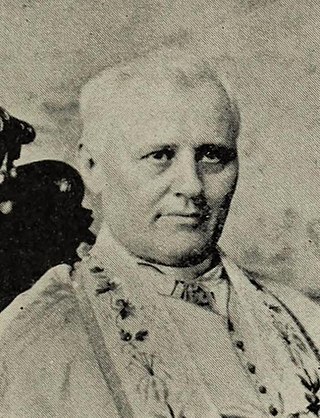
Augustus Marie Martin was a French-born prelate of the Roman Catholic Church. He served as the first bishop of the Diocese of Natchitoches in Louisiana from 1853 until 1875.
Francis Xavier Leray was a French-born prelate of the Roman Catholic Church who served as bishop of the Diocese of Natchitoches in Louisiana (1877–1879) and as archbishop of the Archdiocese of New Orleans (1883–1887).
Anthony Durier was a French-born American prelate of the Catholic Church. He served as the third bishop of the Diocese of Natchitoches in Louisianan from 1885 until his death in 1904.

Cornelius Van de Ven was a Dutch-born American prelate of the Catholic Church. He served as the fourth Bishop of Alexandria in Louisiana from 1910 until his death in 1932. He previously served as bishop of the Diocese of Natchitoches in Louisiana from 1904 until its dissolution in 1910.
The St. Anne Church in the vicinity of Robeline, Louisiana is a historic church founded in the 1800s as a mission from the St. Augustine Parish Church of Isle Brevelle. The current building was built in 1916. It is located at the southwest corner of the intersection of LA 485 and Blosmoore Road. It was added to the National Register in 1994.
Francis Ignatius Malone is an American prelate of the Roman Catholic Church who has been serving as bishop for the Diocese of Shreveport in Louisiana since 2019.
Isle Brevelle is an ethnically and culturally diverse community, which began as a Native American and Louisiana Creole settlement and is located in Natchitoches Parish, Louisiana. For many years this area was known as Côte Joyeuse. It is considered the birthplace of Creole culture and remains the epicenter of Creole art and literature blending European, African, and Native American cultures. It is home to the Cane River Creole National Historical Park and part of the Louisiana African American Heritage Trail.
The Shreveport Martyrs are five Roman Catholic priests who died while caring for strangers afflicted in the 1873 Yellow Fever Epidemic of Shreveport, Louisiana. All five were missionary priests from Brittany, France who came to serve the Diocese of Natchitoches under Augustus Marie Martin They are : Isidore Quémerais of Pleine-Fougères, Jean Pierre of Lanloup, Jean-Marie Biler of Plourivo, Louis Gergaud of Heric, and Francois Le Vézouët of Brélidy.