Jean VI Rolin

Last updated

Jean VI Rolin or Rollin (c.1450 April 4, 1501), often referred to as Jean II Rolin to differentiate him from his father Jean Rolin or Rollin in the succession of the offices of Bishop of Autun, abbot of the Abbey of St. Martin, Autun, and prior of the Abbey of Saint-Marcel-lès-Chalon, was a French bishop. [1] [2]

Abbey of Saint-Marcel-lès-Chalon abbey located in Saône-et-Loire, in France

The Abbey of Saint-Marcel-lès-Chalon, from the late 10th century the Priory of Saint-Marcel-lès-Chalon, was a monastery located in the present commune of Saint-Marcel near Chalon-sur-Saône, Saône-et-Loire, eastern France. It was founded in c. 590 as a Benedictine abbey. Somewhere between 979 and 988 it became part of the Congregation of Cluny, when it became a priory, like most Cluniac houses.

Biography

Jean VI Rolin was the illegitimate son of Jean V Rolin, Cardinal Rolin, and Raymonde de Roucy or Roussy, a nun of Avignon; he was legitimised by King Charles VIII in 1485. He spent his youth at the court of Burgundy, and won the tournament organized by John of Luxembourg for the feast day of the Order of the Golden Fleece in 1472, in Valenciennes.

Jean Rolin (cardinal) Catholic cardinal

Jean (Jehan) Rolin (1408–1483) was a Burgundian bishop and Cardinal.

Charles VIII of France King of France

Charles VIII, called the Affable, was King of France from 1483 to his death in 1498, the seventh from the House of Valois. He succeeded his father Louis XI at the age of 13. His elder sister Anne acted as regent jointly with her husband Peter II, Duke of Bourbon until 1491 when the young king turned 21 years of age. During Anne's regency, the great lords rebelled against royal centralisation efforts in a conflict known as the Mad War (1485–1488), which resulted in a victory for the royal government.

John of Luxembourg, Count of Soissons

John of Luxembourg was Count of Marle and Count of Soissons between 1462 and 1476, Lord of Dunkirk, Gravelines and Bourbourg.

In 1477, after the death of Charles the Bold, he remained in the service of Charles' widow Margaret of York and became master of the petitions of the Duke of Austria.

Charles the Bold 15th-century Duke of Burgundy

Charles the Bold, baptised Charles Martin, was Duke of Burgundy from 1467 to 1477. He was the last Duke of Burgundy from the House of Valois.

Margaret of York English countess

Margaret of York —also by marriage known as Margaret of Burgundy—was Duchess of Burgundy as the third wife of Charles the Bold and acted as a protector of the duchy after his death. She was a daughter of Richard, 3rd Duke of York, and Cecily Neville, and the sister of two kings of England, Edward IV and Richard III. She was born at Fotheringhay Castle, Northamptonshire, in the Kingdom of England, and she died at Mechelen in the Low Countries.

He obtained a prebend in 1482 at the Collegiate Church of Our Lady, Beaune, and the position of dean of the Collegiate Church of Our Lady, Semur-en-Auxois. Antoine de Chalon, bishop of Autun, gave him his support in obtaining the position of dean of Autun Cathedral in 1484. The States of Burgundy named him ambassador to Charles VIII of France, of whom he quickly became the counsellor. He entered the Parlement of Paris and rose through the various levels.

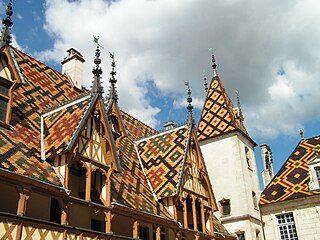
Beaune Subprefecture and commune in Bourgogne-Franche-Comté, France

Beaune is the wine capital of Burgundy in the Côte d'Or department in eastern France. It is located between Paris and Geneva.

A dean, in a church context, is a cleric holding certain positions of authority within a religious hierarchy. The title is used mainly in the Anglican Communion, the Roman Catholic Church, and many Lutheran denominations. A dean's assistant is called a subdean.

Semur-en-Auxois Commune in Bourgogne-Franche-Comté, France

Semur-en-Auxois is a commune of the Côte-d'Or department in eastern France. The engineer Edmé Régnier L'Aîné (1751–1825) and the Encyclopédiste Philippe Guéneau de Montbeillard (1720–1785) were born in Semur-en-Auxois, while the military engineer Vauban (1633-1707) was educated at the Carmelite college.

He was bishop of Autun from June 8, 1500, to the date of his death on April 4, 1501, some considerable time after receiving the pallium, a position obtained with difficulty, because the previous bishop, Antoine de Chalon, had resigned to make way for Olivier de Vienne, a canon of Lyon, and Pope Alexander VI, had already granted the appropriate bulls. The canons of Autun protested and with the support of King Louis XII of France pressed their claim freely to elect their bishop, in this instance in the person of their dean, Jean Rolin. The Pope revoked the provision already made and transferred the bishopric to Rolin, but not until after the death of Olivier de Vienne. [3]

Pallium an ecclesiastical vestment in the Catholic Church: a narrow band, seen from front or back the ornament resembles the letter Y and decorated with six black crosses

The pallium is an ecclesiastical vestment in the Roman Catholic Church, originally peculiar to the Pope, but for many centuries bestowed by him on metropolitans and primates as a symbol of the jurisdiction delegated to them by the Holy See. In that context, it has remained connected to the papacy.

Pope Alexander VI Pope of the Catholic Church 1492–1503

Pope Alexander VI, born Rodrigo de Borja, was Pope from 11 August 1492 until his death. He is one of the most controversial of the Renaissance popes, partly because he acknowledged fathering several children by his mistresses. Therefore his Italianized Valencian surname, Borgia, became a byword for libertinism and nepotism, which are traditionally considered as characterizing his pontificate.

Papal bull type of letters patent or charter issued by a Pope of the Catholic Church

A papal bull is a type of public decree, letters patent, or charter issued by a pope of the Roman Catholic Church. It is named after the leaden seal (bulla) that was traditionally appended to the end in order to authenticate it.

In his will Jean Rolin asked for a modest funeral and to be buried in Autun Cathedral, in the chapel of the Holy Cross, located in the eastern side, which he had put under the patronage of St. Martin. According to his wishes his body was accompanied during the funeral ceremony by thirty paupers, six foundlings and prayers of the Friars Minor, recently established in the city. He founded an anniversary mass in the Abbey of St. Martin, the Abbey of St. Symphorian and the Abbey of St. Andoche, all in Autun. [4]

The Abbey of St. Symphorian, Autun, is a former abbey, later a priory, of Benedictine monks located outside the walls of Autun in Burgundy, France.

Related Research Articles

Autun Subprefecture and commune in Bourgogne-Franche-Comté, France

Autun is a commune in the Saône-et-Loire department, France. Located in the Bourgogne-Franche-Comté region, it was founded during the Principate era of the early Roman Empire by Emperor Augustus as Augustodunum to give a Roman capital to the Gallic people Aedui, who had Bibracte as their political centre. In Roman times the city may have been home to 30,000 to 100,000 people, according to different estimates. Nowadays, Autun has a population of about 15,000.

Roman Catholic Archdiocese of Besançon archdiocese

The Roman Catholic Archdiocese of Besançon is a Latin Rite Roman Catholic ecclesiastical territory in France. It comprises the département of Doubs and the département of Haute-Saône, except for the canton of Héricourt.

Saisy Commune in Bourgogne-Franche-Comté, France

Saisy is a commune in the Saône-et-Loire department in the region of Bourgogne in eastern France.

Roman Catholic Diocese of Langres diocese of the Catholic Church

The Roman Catholic Diocese of Langres is a Roman Catholic diocese comprising the département of Haute-Marne in France.

Roman Catholic Diocese of Autun diocese of the Catholic Church

The Roman Catholic Diocese of Autun (–Chalon-sur-Saône–Mâcon–Cluny), more simply known as the Diocese of Autun, is a diocese of the Latin Rite of the Roman Catholic Church in France. The diocese comprises the entire Department of Saone et Loire, in the Region of Bourgogne.
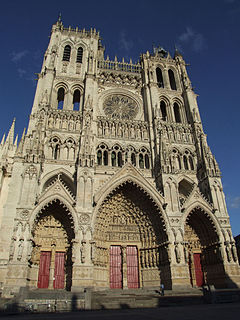
Roman Catholic Diocese of Amiens diocese of the Catholic Church

The Roman Catholic Diocese of Amiens is a diocese of the Latin Rite of the Roman Catholic Church in France. The diocese comprises the department of Somme, of which the city of Amiens is the capital.

Nicolas Rolin chancellor of Burgundy

Nicolas Rolin (1376–1462) was a leading figure in the history of Burgundy and France, becoming chancellor to Philip the Good.

Roman Catholic Diocese of Châlons diocese of the Catholic Church

The Roman Catholic Diocese of Châlons is a diocese of the Latin Rite of the Roman Catholic Church in Châlons-sur-Marne, France. The diocese comprises the department of Marne, excluding the arrondissement of Reims.

Roman Catholic Archdiocese of Dijon archdiocese

The Roman Catholic Archdiocese of Dijon is a diocese of the Latin Rite of the Roman Catholic Church in France. The archepiscopal see is Dijon Cathedral, which is located in the city of Dijon. The diocese comprises the entire department of Côte-d'Or, in the Region of Bourgogne. Originally established as the Diocese of Dijon in 1731, and suffragan to the Archdiocese of Lyon, the diocese was elevated to the rank of archdiocese in 2002. The most significant jurisdiction change occurred after the Concordat of 1801, when the diocese annexed the department of Haute-Marne. In 1821, a Papal Bull re-established the Diocese of Langres. The current archbishop is Roland Minnerath, appointed in 2004.

Ancient Diocese of Chalon-sur-Saône diocese

The former French Catholic diocese of Chalon-sur-Saône existed until the French Revolution. After the Concordat of 1801, it was suppressed, and its territory went to the diocese of Autun. Its see was Chalon Cathedral.

Abbey of Saint Genevieve

The Abbey of St Genevieve (Abbaye-Sainte-Geneviève) was a monastery in Paris, suppressed at the time of the French Revolution.

House of Vergy French noble family

The House of Vergy is one of the oldest French noble families, a cadet dynasty related to the 5th century Merovingian Kingdom of Burgundy, attested since the 9th century.

Rolin may refer to:

Reverianus

Saint Reverianus of Autun was a 3rd-century bishop of Autun.

Guigone de Salins (1403-1470) was a member of the nobility in the state of Burgundy in early modern France. A well-known philanthropist in her time, she founded the Hospices de Beaune in 1443 with her husband Nicolas Rolin, chancellor to the Duke of Burgundy.

Eustache also known as Eustace or Eustase of Bourges or Autun where he originated, was a 6th-century priest who became bishop of Bourges. He trained at the Abbey of Saint-Symphorien, Autun.

Jean de Vienne (archbishop, died 1382) French archbishop

Jean de Vienne was a Burgundian nobleman, prelate and prince of the Holy Roman Empire. He served as the archbishop of Besançon from 1355 until his transfer to the diocese of Metz in 1361. He was transferred to the prince-bishopric of Basel in 1365. In all three dioceses, he was unable to live peacefully with the townspeople, finally resulting in open warfare in Basel. In each of his bishoprics he was the third bishop of his name, Jean III.

Claude Courtépée was a French priest, teacher and historian. He is known for his comprehensive geographical and historical study of the Province of Burgundy based on his personal observations and deep research, which is still used as a work of reference.

Guillaume de Vienne, sometimes identified as Guillaume VI de Vienne, was a French prelate, archbishop of Rouen from 1389.

References

  1. Billioud, Les États du duché de Bourgogne jusqu'en 1498, Paris, 1911, pp.188, 276-278.
  2. Dejussieu, Histoire de l'église d'Autun et son chapitre, ed. École Sainte-Geneviève, 1774, book III; Jean-Pierre Brelaud, Les chanoines de la collégiale Notre-Dame de Beaune au XVe siècle, mémoire de Maîtrise d'histoire, Université de Bourgogne, 1997, vol.II, p.97, no 232
  3. Dejussieu, Histoire de l'église d'Autun et son chapitre, École Sainte-Geneviève, chez P.P. Dejussieu, 1774, Book III, p.389
  4. Fasti, Ecclesiae Gallicanae, volume on Autun