
Tohatchi is a census-designated place (CDP) in McKinley County, New Mexico, United States. It is known as a health-services and education hub along Highway 491. Its population was reported to be 785 at the 2020 census. As Tohatchi is located on the Navajo Nation, it is designated federal trust land.

The Navajo Nation, also known as Navajoland, is a Native American reservation of Navajo people in the United States. It occupies portions of northeastern Arizona, northwestern New Mexico, and southeastern Utah. The seat of government is located in Window Rock, Arizona.

Annie Dodge Wauneka was an influential member of the Navajo Nation as member of the Navajo Nation Council. As a member and three term head of the council's Health and Welfare Committee, she worked to improve the health and education of the Navajo. Wauneka is widely known for her countless efforts to improve health on the Navajo Nation, focusing mostly on the eradication of tuberculosis within her nation. She also authored a dictionary, in which translated English medical terms into the Navajo language. She was awarded the Presidential Medal of Freedom in 1963 by Lyndon B. Johnson as well as the Indian Council Fire Achievement Award and the Navajo Medal of Honor. She also received an honorary doctorate in Humanities from the University of New Mexico. In 2000, Wauneka was inducted into the National Women's Hall of Fame.
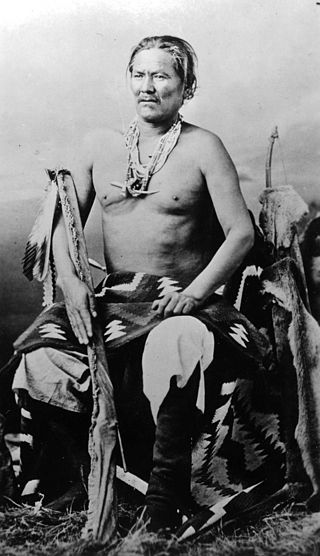
Chief Manuelito or Hastiin Chʼil Haajiní was one of the principal headmen of the Diné people before, during and after the Long Walk Period. Manuelito is the diminutive form of the name Manuel, the Iberian variant of the name Immanuel; Manuelito translates to Little Immanuel. He was born to the Bit'ahnii or ″Folded Arms People Clan″, near the Bears Ears in southeastern Utah about 1818. As many Navajo, he was known by different names depending upon context. He was Ashkii Diyinii, Dahaana Baadaané, Hastiin Ch'ilhaajinii and as Nabááh Jiłtʼaa to other Diné, and non-Navajo nicknamed him "Bullet Hole".
The Navajo are a Native American people of the Southwestern United States.

Luci Tapahonso is a Navajo poet and a lecturer in Native American Studies. She is the first poet laureate of the Navajo Nation, succeeded by Laura Tohe.
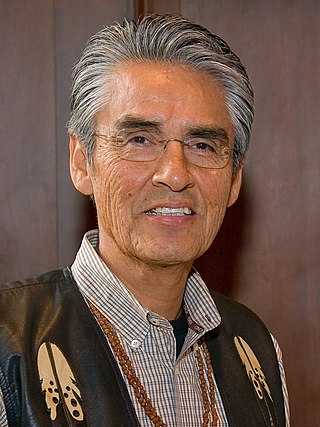
Joe Shirley Jr. is a Navajo politician who is the only two-term President of the Navajo Nation. He served as president from 2003 to 2011. He lives in Chinle, Arizona, and is Tódíchʼíiʼnii, born for Tábąąhá.
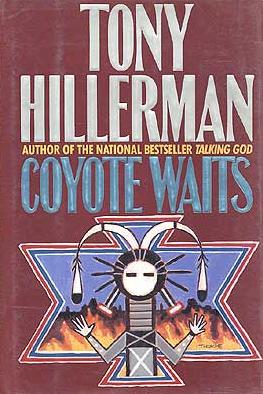
Coyote Waits is a crime novel by American writer Tony Hillerman, the tenth in the Joe Leaphorn/Jim Chee Navajo Tribal Police series, first published in 1990.
Melanie A. Yazzie is a Navajo sculptor, painter, printmaker, and professor. She teaches at the University of Colorado at Boulder.
Pablita Abeyta was a Native American activist and sculptor born in Gallup, New Mexico, United States. She is the eldest daughter of Sylvia Ann (Shipley) Abeyta and artist Narciso Abeyta. She was named for her grandmother and her name Navajo name translates to "One Who Completes a Circle." Her family was originally from the Cañoncito Band of the Navajo Reservation in New Mexico, located west of Albuquerque. In 2000 the reservation decided to change its name to To'Hajiilee.

Jonathan Nez is a Navajo politician who served as the 9th President of the Navajo Nation from 2019 to 2023. He previously served as Vice President and as a Navajo Nation Council delegate.
Cassandra Manuelito-Kerkvliet is an American academic administrator. She was the president of Antioch University Seattle from 2007 to 2013—the first Native American woman to serve as president of an accredited university outside of the Tribal College and University System. She was formerly the president of Diné College from 2000 to 2003.
Maggie L. George is an American academic administrator and educator. She served as president of Diné College from August 2011 to January 2016. In 2006, George became the inaugural director of academic affairs and Indian education for the New Mexico Higher Education Department.

Myron Lizer is an American politician and businessman and served as the 10th vice president of the Navajo Nation under President Jonathan Nez.
Jani Ingram is a professor of chemistry and biochemistry at Northern Arizona University. Ingram researches the chemistry and health impacts of environmental pollutants, especially uranium and arsenic. Ingram is a member of the Navajo tribe, and the Naneesht’ezhi clan. She leads the Bridging Arizona Native American Students to Bachelor's Degrees program and the Native American Cancer Prevention Program. She promotes educational and professional opportunities for Native American students in chemistry through a number of initiatives and for this work was awarded the 2018 American Chemical Society Award for Encouraging Disadvantaged Students into Careers in the Chemical Sciences.
Sandra K. Begay is an American/Navajo Nation mechanical engineer who designs research and development systems at Sandia National Laboratories in Albuquerque, New Mexico. In 2020, she was honored by the American Indian Science and Engineering Society's Indigenous Excellence Award. She is known for her work expanding energy access through alternative and renewable solutions for remote tribal members on the Navajo Reservation.
Nancy Cottrell Maryboy is a Cherokee and Navajo Indigenous science expert and educator. Maryboy is the president of the Indigenous Education Institute, an organization she founded in 1995 to apply traditional Indigenous knowledge to contemporary settings. Much of her work has focused on Indigenous astronomy and she has written several books on Navajo astronomy.
Richelle Montoya is an American politician who is the 11th vice president of the Navajo Nation. She is the first woman elected to the executive office of Navajo Nation.
Michelle Brown-Yazzie is a Native American attorney who serves as the Assistant Attorney General for the Navajo Nation Department of Justice Water Rights Unit. In this role, she works to protect the water rights of the Navajo Nation, advocating for the rights of the Nation's citizens and protecting the natural resources of the area.

Milton "Jack" Snow was an American photographer who extensively photographed the environmental degradation of Navajo land and the Diné people in the American Southwest. Snow's career spanned twenty years, focusing on U.S.–Navajo relations.
