Related Research Articles

The Isle of Man TT or Tourist Trophy races are an annual motorcycle racing event run on the Isle of Man in May/June of most years since its inaugural race in 1907. The event is often called one of the most dangerous racing events in the world as many competitors have died.

The Race Across America, or RAAM, is an ultra-distance road cycling race held across the United States that started in 1982 as the Great American Bike Race.

Cycle sport is competitive physical activity using bicycles. There are several categories of bicycle racing including road bicycle racing, cyclo-cross, mountain bike racing, track cycling, BMX, and cycle speedway. Non-racing cycling sports include artistic cycling, cycle polo, freestyle BMX and mountain bike trials. The Union Cycliste Internationale (UCI) is the world governing body for cycling and international competitive cycling events. The International Human Powered Vehicle Association is the governing body for human-powered vehicles that imposes far fewer restrictions on their design than does the UCI. The UltraMarathon Cycling Association is the governing body for many ultra-distance cycling races.

Road bicycle racing is the cycle sport discipline of road cycling, held primarily on paved roads. Road racing is the most popular professional form of bicycle racing, in terms of numbers of competitors, events and spectators. The two most common competition formats are mass start events, where riders start simultaneously and race to a set finish point; and time trials, where individual riders or teams race a course alone against the clock. Stage races or "tours" take multiple days, and consist of several mass-start or time-trial stages ridden consecutively.

This is a glossary of terms and jargon used in cycling, mountain biking, and cycle sport.

Cycle speedway is a form of bicycle racing on short oval dirt tracks, usually outdoors, occasionally indoors, typically 70–90 metres long. Like motorcycle speedway, riders use machines without brakes or multiple gears but, unlike motor speedway, the object is not to slide bikes round the turns.
The Tour Divide is an annual mountain biking ride traversing the length of the Rocky Mountains, from Canada to the Mexican border. Following the 2,745-mile (4,418 km) Great Divide Mountain Bike Route, it is an ultra-distance cycling ride that is an extreme test of endurance, self-reliance and mental toughness. The ride format is strictly self-supported, and it is not a stage race - the clock runs continuously from the start until riders cross the finish line, usually more than two weeks later.

Juliana Buhring is a British-German ultra-endurance cyclist and writer. In December 2012, she set the first Guinness World Record as the fastest woman to circumnavigate the globe by bike, riding over 29,000 kilometres (18,000 mi) in a total time of 152 days.

The Transcontinental Race (TCR) is an annual, self-supported, ultra-distance cycling race across Europe. It is one of the world's toughest ultra-endurance races. The route and distance varies for each edition between about 3,200 and 4,200 km, with the winners generally taking 7 to 10 days. Interest in the race grew rapidly from 30 people starting the first edition of the race in 2013 to over 1,000 people applying for a place in the fourth edition in 2016, 350 of whom were successful; since then, these numbers have been reasonably stable.

Michael Richard Hall was a British cyclist and race organiser who specialised in self-supported ultra-distance cycling races. In 2012, he won the inaugural World Cycle Race. In 2013 and 2016, he won the Tour Divide ultra-endurance mountain bike race across the Rocky Mountains in Canada and the United States. In 2014, he won the inaugural Trans Am Bike Race, a road-based event from the Pacific coast to the Atlantic coast in the United States. From 2013, he was the principal organiser of the Transcontinental Race, an event similar to the TransAm Bicycle Race, but that traverses Europe. Michael Hall was also featured in the cycling film Inspired to Ride a film directed by Mike Dion.

The Trans Am Bike Race (TABR) is an annual, self-supported, ultra-distance cycling race across the United States. The route is about 4,200 miles (6,800 km) long and uses the TransAmerica Bicycle Trail that was developed by the Adventure Cycling Association for the Bikecentennial event in 1976. The route runs from the Pacific coast in Astoria, Oregon to the Atlantic coast in Yorktown, Virginia, passing through ten states. The inaugural race was in 2014, which 25 people completed, the fastest of whom took less than 18 days.
The definition of ultra-distance cycling is far more vague than in ultra running or in ultra-triathlon. Any bike race or ride longer than a century ride, which is 100 miles (160 km), is sometimes considered to be ultra-distance cycling. However, such events are relatively common, so using a longer distance to define the category is more useful, such as any race or ride that is longer than 200 kilometres (120 mi), 300 kilometres (190 mi) or even a double century, 200 miles (320 km).
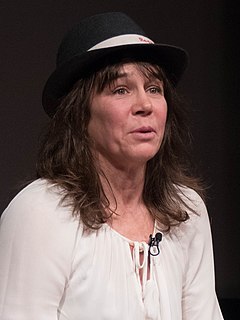
Rebecca Rusch is an American ultra endurance professional athlete, seven-time World Champion, author, entrepreneur, Emmy Award winner, and motivational speaker whose career has spanned numerous adventure sports including rock climbing, adventure racing, whitewater rafting, cross-country skiing and mountain biking. Rusch was nominated to the International Mountain Bike Hall of Fame in 2019 as well as the inaugural class of the Gravel Cycling Hall of Fame in 2022 and owns seven World Championship titles in multiple disciplines. Rusch was a member of the US National Whitewater Rafting Team as well as several international adventure racing teams, participating in the Eco Challenge (1997–2002), Primal Quest (2002–2006) and Raid Gauloises series.
Kristof Allegaert is a Belgian cyclist who specializes in ultra-distance cycling races and lives in Kortrijk, Belgium.
Steffen Streich is a German-born Greek ultra-endurance bicycle racer who won the 2015 Trans Afrika Bicycle Race.
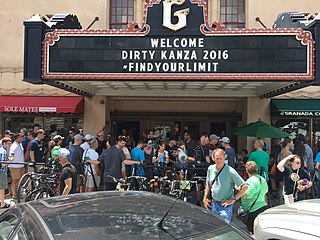
Unbound Gravel, formerly known as the Dirty Kanza, is an event comprising gravel racing covering various distances held annually during the late spring in the Flint Hills region of the Great Plains around Emporia, Kansas, United States. The race's organizers refer to the 200 miles (320 km) mile race as the "World's Premiere Gravel Grinder", and ranked as one of the top gravel bike races. Winners are awarded a belt buckle.
Sarah Hammond is an Australian ultra-endurance bicycle racer who in 2014 became the first woman to Everest by riding the equivalent of the height of Mount Everest in a 24-hour period and has won the Race to the Rock for three consecutive years.
The Race to the Rock is an annual unsupported ultra-distance bicycle race through the Australian Outback organized by Jesse Carlsson. Unlike stage races, such as the Tour De France, ultra-distance races start and run continuously until the competitors finish the race, forcing them to make such strategic choices as whether it would be better to take time to eat or sleep, or to sacrifice those things and press on. Race to the Rock is an unsupported race, which means that racers are not permitted to draft or to obtain help from anything other than publicly available sources that are available for all. The course varies every year, but finishes at Uluru, also known as Ayers Rock, and has been so gruelling that only a very small percentage of the competitors have ever finished the race. Roads are mostly unsealed, with limited water supplies, and stretches of 400-500 kilometres at times with no food resupply available.

The Simpson Desert Bike Challenge (SDBC) is an annual staged mountain bike race held in the Simpson Desert of Australia. First held in 1987, the SDBC is run by the non-profit organisation Desert Challenge Inc

Gravel cycling, gravel biking or gravel grinding is a sport, or a leisure activity, in which participants ride bicycles mostly on gravel roads. Sometimes, specially designed gravel bikes are used; in other cases, any bicycle capable of covering the terrain can be used.
References
- ↑ Crowley, Liam (26 June 2015). "Jesse Carlsson races to victory in the Trans Am" . Retrieved 22 September 2018.
- ↑ "Trans Am Bike Race" . Retrieved 22 September 2018.
- ↑ O'Mahoney, Jayson (15 July 2016). "Interview: Jesse Carlsson – Melbourne Gravel & Race to the Rock". Gravel Cyclist. Retrieved 22 September 2018.
- ↑ "Jesse Carlsson leads the charge in the inaugural Race to the Rock". 5 September 2016. Retrieved 22 September 2018.
- ↑ McGowan, Michael (7 February 2018). "Cycling race across Australia cancelled after British rider's death in event last year".
- ↑ Bromhead, Nat (20 March 2017). "Jesse Carlsson & Durian Rider Out Of Indian Pacific Wheel Race As Leaders Pass 1200km" . Retrieved 22 September 2018.
- ↑ Maddox, Garry (2 October 2017). "Indian Pacific Wheel Race to be held again despite rider Mike Hall's death" . Retrieved 22 September 2018.
- ↑ "Jesse's Trans Am" . Retrieved 22 September 2018.