
Acupressure is an alternative medicine technique often used in conjunction with acupuncture or reflexology. It is based on the concept of life energy (qi), which purportedly flows through "meridians" in the body. In treatment, physical pressure is applied to acupuncture points, or ashi trigger points, with the aim of clearing blockages in these meridians. Pressure may be applied by hand, by elbow, or with various devices. There is no scientific evidence for the existence of acupuncture points, meridians, or qi.

Massage is the rubbing or kneading of the body's soft tissues. Massage techniques are commonly applied with hands, fingers, elbows, knees, forearms, feet, or a device. The purpose of massage is generally for the treatment of body stress or pain. In European countries, a person professionally trained to give massages is traditionally known as a masseur (male) or masseuse (female). In the United States, these individuals are often referred to as "massage therapists". In some provinces of Canada, they are called "registered massage therapists."

Shiatsu is a form of Japanese bodywork based on concepts in traditional Chinese medicine such as qi meridians. Having been popularized in the twentieth century by Tokujiro Namikoshi (1905–2000), shiatsu derives from the older Japanese massage modality called anma.
Rolfing is a form of alternative medicine originally developed by Ida Rolf (1896–1979) as Structural Integration. Rolfing is marketed with unproven claims of various health benefits, is recognized as pseudoscience and has been characterized as quackery. It is based on Rolf's ideas about how the human body's "energy field" can benefit when aligned with the Earth's gravitational field.

Reflexology, also known as zone therapy, is an alternative medical practice involving the application of pressure to specific points on the feet, ears, and hands. This is done using thumb, finger, and hand massage techniques without the use of oil or lotion. It is based on a pseudoscientific system of zones and reflex areas that purportedly reflect an image of the body on the feet and hands, with the premise that such work on the feet and hands causes a physical change to the supposedly related areas of the body.
In alternative medicine, bodywork is any therapeutic or personal development technique that involves working with the human body in a form involving manipulative therapy, breath work, or energy medicine. Bodywork techniques also aim to assess or improve posture, promote awareness of the "bodymind connection" which is an approach that sees the human body and mind as a single integrated unit, or to manipulate the electromagnetic field alleged to surround the human body and affect health.

Tui na is a form of alternative medicine similar to shiatsu. As a branch of traditional Chinese medicine, it is often used in conjunction with acupuncture, moxibustion, fire cupping, Chinese herbalism, tai chi or other Chinese internal martial arts, and qigong.
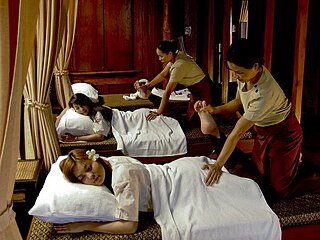
Traditional Thai massage or Thai yoga massage is a traditional therapy combining acupressure, Indian Ayurvedic principles, and assisted yoga postures. In the Thai language, it is usually called nuat phaen thai or nuat phaen boran, though its formal name is nuat thai according to the Traditional Thai Medical Professions Act, BE 2556 (2013).
Manual therapy, or manipulative therapy, is a part of Physiotherapy, it is a physical treatment primarily used by physical therapists, occupational therapists to treat musculoskeletal pain and disability; it mostly includes kneading and manipulation of muscles, joint mobilization and joint manipulation. It is also used by Rolfers, massage therapists, athletic trainers, osteopaths, and physicians.
Kappo are healing techniques that often involve stimulation of specific acupuncture points. Kappo is commonly used in martial arts such as Danzan Ryu and Judo. Kappo contains two kanji: katsu and ho.

Anma is a practice of traditional Japanese massage; the word also refers to practitioners of that art. Modern shiatsu is largely derived from anma.
Postural Integration is a type of bodywork purporting to draw on "energy" and allow access to the past. It was devised in the late 1960s by Jack Painter (1933–2010) in California, US, after exploration in the fields of humanistic psychology and the human potential movement.
In the Japanese medical tradition and in Japanese martial arts traditions, the word Hara is used as a technical term for a specific area (physical/anatomical) or energy field (physiological/energetic) of the body. An alternative Japanese reading of the character is Fuku, the Chinese reading is Fu.
Reidman International College for Complementary and Integrative Medicine, also known as Reidman College, is a private professional trade college founded in Tel Aviv, Israel in 1987 by Sally Reidman, a holistic practitioner from California that immigrated to Israel.

Sugiyama Waichi (1614–1694) was a Japanese acupuncturist, widely regarded as the "Father of Japanese Acupuncture".
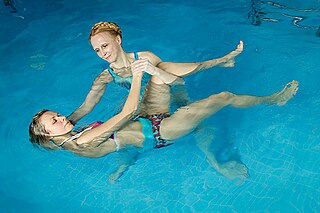
Watsu is a form of aquatic bodywork used for deep relaxation and passive aquatic therapy. Watsu is characterized by one-on-one sessions in which a practitioner or therapist gently cradles, moves, stretches, and massages a receiver in chest-deep warm water.
Harold Dull (1935—2019) was an American aquatic bodyworker and poet best known as the creator of Watsu, originally developed in the early 1980s at Harbin Hot Springs, California. He is also known for his poetry, as founder of the Worldwide Aquatic Bodywork Association (WABA), and as creator of Tantsu and Tantsuyoga. Watsu is a form of aquatic bodywork in which a practitioner or therapist gently cradles, moves, stretches, and massages a receiver in chest-deep warm water for deep relaxation and aquatic therapy.
The California Massage Therapy Council (CAMTC) is a nonprofit organisation charged with oversight of California's massage businesses. It comprises representatives from the massage industry.
Acupuncture and Massage College is a nationally-accredited, private for-profit university in Miami, Florida that specializes in Oriental medicine. The college was founded in 1983 and is the oldest acupuncture school in Florida.
