Nuozhadu Dam is an embankment dam on the Lancang (Mekong) River in Yunnan Province, southwest China. The dam is 261.5 m (858 ft) tall, and creates a reservoir with a normal capacity of 21,749,000,000 m3 (17,632,000 acre⋅ft) at a level of 812 m (2,664 ft) asl. The purpose of the dam is hydroelectric power production along with flood control and navigation. The dam supports a power station with nine generators, each with generating capacity of 650 MW. The total generating capacity of the power station is 5,850 MW. Construction on the project began in 2004; the dam's first generator went online 6 September 2012 and the last generator was commissioned in June 2014. The construction and management of the project was implemented by Huaneng Power International Ltd., which has a concession to build, own and operate hydroelectric dams on China's stretch of the Mekong River.
The Xiaowan Dam is an arch dam on the Lancang (Mekong) River in Nanjian County, Yunnan Province, southwest China. The primary purpose of the dam is hydroelectric power generation and it supports a 4,200 MW power station. Constructed between 2002 and 2010 by Huaneng Power International at a cost of ¥32 billion, it is the world's second highest arch dam at 292 m (958 ft). It is also third highest among dams of all types behind Jinping-I and Nurek and the third largest hydroelectric power station in China.

The Fengman Dam is a concrete gravity dam 20 km (12 mi) from Jilin City on the Second Songhua River in Jilin Province, China. The main purposes of the dam are hydroelectric power generation and flood control. Construction of the dam began in 1937 and was complete in 1953. Northeast China Grid Company Limited, the dam's owner, plans on rebuilding it in the future.
The Liyuan Dam is a concrete-face rock-fill dam on the Jinsha River on the border of Yulong County and Shangri-La County, Yunnan Province, China. The dam will have an associated hydroelectric power station with a 2,400 MW power station containing 4 x 600 MW generators. Construction on the river diversion for the dam began in 2008. It began to impound its reservoir in November 2014 and on December 28, 2014 the first generator was commissioned. The second generator was commissioned in July 2015.

The Yantan Dam is a gravity dam on the Hongshui River near Dahua County, Guangxi China. The main purpose of the dam is hydroelectric power production and it has an associated 1,210 MW power station consisting of 4 x 302.5 MW Francis turbine-generators.

The Danjiangkou Dam is a concrete gravity dam on the Han river near Danjiangkou in Hubei Province, China. The original dam was constructed between 1958 and 1973. The dam creates a large Danjiangkou Reservoir.

The Jinping-I Dam also known as the Jinping-I Hydropower Station or Jinping 1st Cascade, is a tall arch dam on the Jinping Bend of the Yalong River in Liangshan, Sichuan, China. Construction on the project began in 2005 and was completed in 2014. Its power station has a 3,600 MW capacity to produce between 16 and 18 TW·h annually. Supplying the power station is a reservoir created by the 305-meter-tall arch dam, the tallest in the world. The project's objective is to supply energy for expanding industrialization and urbanization, improve flood protection, and prevent erosion.
The Jinshuitan Dam is an arch dam on Longquan Creek, a tributary of the Oujiang River in Zhejiang Province, China. It is located about 47 km (29 mi) southwest of Lishui. The dam and power station were completed in 1988 and serve several purposes to include hydroelectric power generation, water supply, flood control and navigation. It is the first dam of the Oujiang River cascade to be constructed and creates the second largest lake in Zhejiang.

The Bikou Dam is an embankment dam on the Bailong River just upstream of Bikou in Wen County, Gansu Province, China. Construction on the dam began in 1969, the generators were commissioned in 1976 and the dam was complete in 1977. The 101 m (331 ft) tall earth-core rock-fill dam creates a reservoir with a 521,000,000 m3 (422,382 acre⋅ft) capacity. The dam supports a 300 MW power station.
The Dongfeng Dam is an arch dam on the Wu River 65 km (40 mi) northwest of Qingzhen in Guizhou Province, China. The primary purpose of the dam is hydroelectric power generation and it supports a 570 MW power station. Construction on the dam began in 1989 and the first generator was operational in 1994, the last in 1995. The generators were up-rated between 2004 and 2005; bringing their capacity from 170 MW each to 190 MW.
The Dongping Dam is an arch dam on the Zhongjian River (忠建河), a right tributary of the Qing River, in Xuan'en County, Hubei Province, China. The primary purpose of the dam is hydroelectric power generation and it supports a 110 MW power station consisting of two 55 MW Francis turbine-generators. The 135-metre-tall (443 ft) arch dam withholds a reservoir of 336,000,000 m3 (272,000 acre⋅ft). Construction began in 2000, the first generator was operational in 2005 and the project completed in 2006.
The Huanglongtan Dam is a concrete gravity dam located on the Du River, a tributary of the Han River. It is located 25 km (16 mi) west of Shiyan in Hubei Province, China. The main purpose of the dam is hydroelectric power generation but it also provides for flood control. It was constructed between 1969 and 1976 and support a 510 MW power station.
The Hunanzhen Dam is a trapezoidal buttress dam on the Qiantang River, located 27 km (17 mi) south of Quzhou in Zhejiang Province, China. The primary purpose of the dam is hydroelectric power generation but it also serves to provide for flood control and irrigation water supply. Construction on the dam began in 1958 but was halted in 1961. It recommenced in 1970, the first generator was operational in 1979 and the project complete in 1980. The original installed capacity of the dam's power plant was 170 MW but the plant was expanded with an additional 100 MW generator, commissioned in 2006.
The Jiangya Dam is a concrete gravity dam on the Loushui River, located 50 km (31 mi) northeast of Zhangjiajie in Hunan Province, China. The primary purpose of the multi-purpose dam is flood control but it also generates hydroelectricty, supplies water for irrigation and municipal use and improves navigation.
The Longshou II Dam, also referred to as Longshou No. 2, is a concrete-face rock-fill dam on the Heihe River, located 35 km (22 mi) southwest of Zhangye in Gansu Province, China. It is part of the Gansu Heihe Rural Hydropower Development and supports a 157 MW power station. The dam's first feasibility study was carried out in 2000 and river diversion construction began in December 2001. In June 2002, the river was diverted and in September that year, filling of the dam's body began. On 17 August 2004, the first generator was operational with the rest by the end of the year. The 146.5 m (481 ft) high dam withholds a reservoir with a capacity of 86,200,000 m3 (69,883 acre⋅ft). It's spillway is located on the right bank and is a controlled chute type with a discharge capacity of 2,696 m3/s (95,208 cu ft/s). Water is delivered to the dam's power station downstream via a 1.7 km (1 mi) long tunnel. The dam is located upstream of the Longshou I Dam, an 80 m (262 ft) tall double-curvature arch dam with an installed capacity of 52 MW. Upstream is the Xiaogushan Dam, a gravity dam which diverts water to a 102 MW power station.
The Panjiakou Dam is a concrete gravity dam on the Luan River in Qianxi County, Hebei Province, China. The primary purpose of the dam is to provide water for the cities of Tianjin and Tangshan, located to the south. The dam also provides flood control and its power plant has an installed capacity of 420 MW which includes a 270 MW pumped storage power station.
The Shimenkan Dam (石门坎) is an arch dam on the Lixian River (李仙江), straddling the border between Ning'er and Mojiang County in Yunnan Province, China. The primary purpose of the dam is hydroelectric power generation and its power station has an installed capacity of 130 MW. Construction began in 2007 and the dam was complete in 2010. The dam is 116 m (381 ft) tall and creates a reservoir with a capacity of 197,000,000 m3 (159,710 acre⋅ft). It is the second dam in the Lixian River cascade.
The Suofengying Dam is a concrete gravity dam on the Wu River, 44 km (27 mi) northwest of Guiyang in Guizhou Province, China. It is located 35.5 km (22 mi) downstream of the Dongfeng Dam and 74.9 km (47 mi) upstream of the Wujiangdu Dam. The primary purpose of the dam is hydroelectric power generation and it supports a 600 MW power station. Construction on the dam began on 26 July 2002 and on December 18 of that year, the river was diverted. Pouring of roller-compacted concrete into the dam's body began on 14 January 2004 and in June, the dam began to impound its reservoir. On 18 August, the first generator was operational and the last two in 2005. The 121.8 m (400 ft) tall dam creates a reservoir with a capacity of 201,200,000 m3 (163,115 acre⋅ft). The dam's power station is located on its right bank and contains three 200 MW Francis turbine-generators.
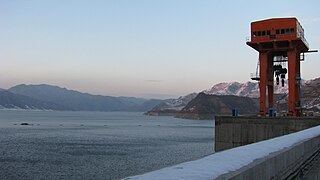
The Unbong Dam, or Yunfeng Dam, is a concrete gravity dam on the Yalu River which borders China and North Korea. It is located 33 km (21 mi) northeast of Ji'an in Jilin Province, China and Chasŏng in Chagang Province, North Korea. The primary purpose of the dam is hydroelectric power generation and it supports a 400 MW power station. Construction of the dam had initially began in August 1942 but was halted in 1945 after the surrender of Japan ending World War II. In October 1959, construction on the dam recommenced and in September 1965, the first of the four 100 MW Francis turbine-generators was operational. The last generator was operational on 4 April 1967. The 113.75 m (373 ft) tall dam creates a reservoir with a storage capacity of 3,895,000,000 m3 (3,157,728 acre⋅ft). The dam's spillway is an overflow type with 21 floodgates and has a maximum discharge of 21,900 m3/s (773,391 cu ft/s). The dam is located before a bend in the river and its power station is located on the other side of a ridge that meets the dam’s right abutment. Water is delivered to the power station via two tunnels, 775 m (2,543 ft) and 759 m (2,490 ft) long. Generators 1 and 3 deliver power to China while 2 and 4 deliver to North Korea.

The Daguangba Dam is a multi-purpose dam on the Changhua River in Hainan Province, China. It is located 35 km (22 mi) east of Dongfang. As the primary component of the Daguangba Multipurpose Project, the dam was constructed between 1990 and 1995. It serves to provide water for both hydroelectric power generation and agriculture. It supports a 240 MW power station and supplies water for the irrigation of 12,700 ha. It is also the largest dam and hydroelectric power station in Hainan.